Open Cell Spray Foam Insulation Oklahoma: Complete Guide
TL;DR
Open-cell spray foam is a soft, flexible insulation that expands up to 100 times its liquid volume, fills every crack and cavity in a single application, and delivers R-3.7 per inch with an air seal that fiberglass batts cannot match. It is vapor-permeable, which means it allows wall and roof assemblies to dry rather than trapping moisture. It absorbs sound significantly better than any other insulation type. And it costs roughly half as much per board foot as closed-cell. But it is not the right product for every location. Open-cell does not belong in crawl spaces, on metal building surfaces, below grade, or anywhere moisture control requires a vapor retarder. This guide covers the building science behind open-cell foam, every location where it excels in Oklahoma homes, every location where it should not be used, and how it works alongside closed-cell in hybrid assemblies.
What Open-Cell Spray Foam Actually Is
Open-cell spray foam (sometimes called half-pound foam because of its cured density of approximately 0.5 pounds per cubic foot) is a polyurethane insulation material created by the same two-component chemical reaction as closed-cell foam. The A-side (isocyanate) and B-side (polyol resin) are mixed at the spray gun, react on contact, and expand into foam.
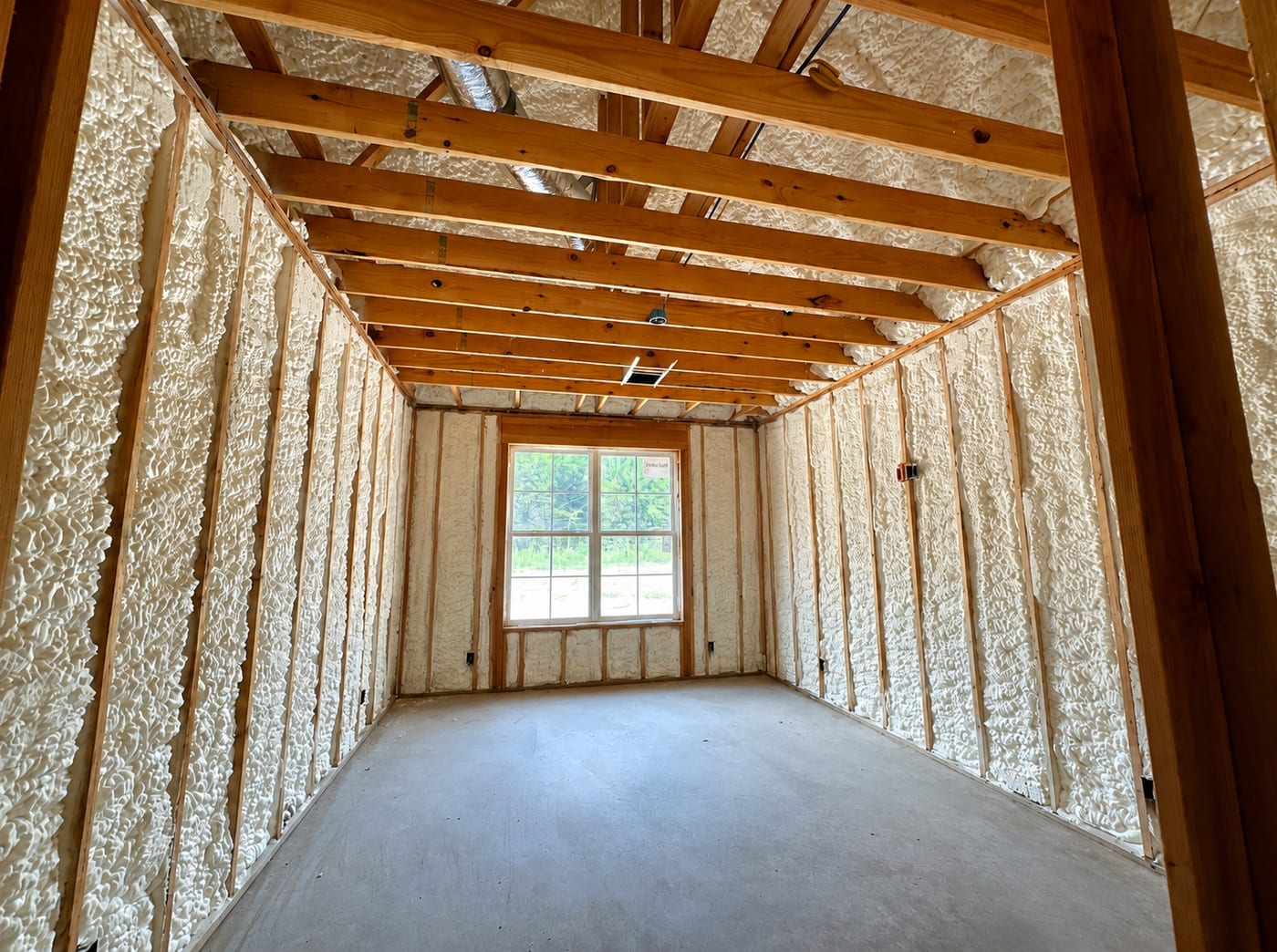
The difference is in the cell structure. During expansion, the cell walls in open-cell foam intentionally break open, creating an interconnected matrix of air pockets. The result is a soft, spongy material that is lightweight, flexible, and filled with air rather than the sealed gas cells found in closed-cell foam.
This broken cell structure gives open-cell foam a fundamentally different set of properties than its closed-cell counterpart. Neither is better overall. They serve different purposes in different locations. Understanding which product belongs where is the single most important decision in any spray foam project. For an overview of both foam types and how spray foam works in general, see our foundational guide: What Is Spray Foam Insulation?
The Numbers That Define Open-Cell Performance
R-value: R-3.7 per inch. This is lower per inch than closed-cell (R-6 to R-7), but the per-inch number is only part of the story. In a standard 2x4 wall cavity (3.5 inches deep), open-cell delivers approximately R-13, meeting the Oklahoma 2015 IECC wall requirement. In a 2x6 wall (5.5 inches), it delivers approximately R-20. In a full 2x12 rafter bay (11.25 inches), it delivers approximately R-42, exceeding Oklahoma's R-38 attic code minimum. When cavity depth is available, open-cell achieves code targets at a lower cost per square foot than closed-cell.
Density: approximately 0.5 lb per cubic foot. This is one-quarter the density of closed-cell foam (2.0 lb/cu ft). The lightweight structure makes open-cell easier to trim after curing and means it adds virtually no weight to the assembly.
Expansion: up to 100 times its liquid volume. Open-cell expands dramatically, filling every void, crack, and irregular cavity shape it encounters. This aggressive expansion is why installers intentionally overfill cavities and then trim the excess flush with the stud faces after curing. The expansion guarantees complete coverage with no voids.
Air permeability: air barrier at 3.5 inches or more. Despite being soft and porous to the touch, open-cell foam at adequate thickness functions as an air barrier that stops air from moving through the assembly. This air-sealing capability is what separates spray foam from fiberglass batts, which slow heat transfer but allow air to pass through freely. As Rocking Rad's own service page puts it: a fiberglass batt might have a similar R-value on paper, but the moment wind pushes through gaps around it, that number means nothing.
Vapor permeability: vapor-permeable, NOT a vapor barrier. This is the most critical distinction between open-cell and closed-cell. Open-cell foam has a relatively high perm rating, meaning water vapor can diffuse through it. This is an advantage in assemblies that need to dry in both directions, and a limitation in assemblies where vapor must be blocked from reaching a cold surface.
Where Open-Cell Belongs in Oklahoma Homes
Attic Roof Decks (Unvented Conditioned Attics)
This is open-cell foam's highest-value application in Oklahoma. When sprayed to the underside of the roof sheathing, open-cell converts the attic from a 150-degree unconditioned oven into a semi-conditioned space. Ductwork and HVAC equipment in the attic now operate inside the building envelope rather than fighting extreme temperatures. For a full explanation of vented vs. unvented attics, see our guide: Why Your Attic Ductwork Is Costing You Money.
A 2x10 rafter filled with open-cell delivers approximately R-34. A 2x12 delivers approximately R-42. Both approach or exceed Oklahoma's R-38 attic code minimum. In Oklahoma's Climate Zone 3A, open-cell can be used for unvented roof assemblies per IRC R806.5, though some jurisdictions may require a vapor retarder paint on the interior ceiling surface.
Interior Partition Walls (Sound Control)
Open-cell foam's soft, porous cell structure absorbs sound waves far more effectively than any other insulation product. It achieves a Noise Reduction Coefficient (NRC) of approximately 0.7, meaning it absorbs about 70% of the sound energy it encounters. Rocking Rad notes that open-cell cuts noise transfer by 50% or more compared to fiberglass. This makes it the preferred product for walls between bedrooms, home offices, bathrooms, and media rooms. For a full treatment of how spray foam handles sound, see our guide: Spray Foam Soundproofing in Oklahoma.
Vaulted and Cathedral Ceilings
Cathedral ceilings have no attic space above them, so the rafter cavity is the only available space for insulation. Open-cell fills deep rafter bays cost-effectively and provides the air seal that the assembly requires. In Oklahoma Climate Zone 3A, open-cell is permitted for unvented cathedral ceiling assemblies. For details on thickness requirements and hybrid approaches, see our guide: Vaulted Ceiling Insulation in Oklahoma.
Ceilings and Floor Assemblies
Open-cell is an excellent choice for ceiling assemblies between floors (reducing noise and thermal transfer between stories), garage ceilings with living space above (where the garage insulation blog covers this in detail), and above-garage bonus room floors where cold floors and noise are common complaints.
New Construction (Hybrid Approach)
Many well-designed Oklahoma new builds use open-cell for attics, ceilings, and interior partitions, paired with closed-cell where moisture control is critical (crawl spaces, rim joists, below-grade walls). This hybrid approach puts each product where it performs best and keeps the total project cost lower than using closed-cell everywhere. For more on new construction insulation strategy, see our guide: New Construction Insulation in Oklahoma.
Where Open-Cell Does NOT Belong
Exterior Walls
For exterior wall assemblies in Oklahoma, Rocking Rad typically recommends closed-cell spray foam because it provides the vapor retarder properties that Oklahoma's humidity demands. Closed-cell at 2 inches blocks both air and vapor from migrating through the wall, which protects the sheathing from condensation during our humid spring and summer months. While open-cell can technically work in above-grade exterior walls with adequate depth in Climate Zones 3 and 4, closed-cell is the safer, more reliable choice for exterior assemblies in Oklahoma's mixed-humid climate.
Crawl Spaces
Crawl space walls and rim joists are moisture-critical assemblies. Humid soil air, ground moisture, and Oklahoma's spring humidity all push moisture into the crawl space from every direction. Open-cell foam's vapor permeability allows that moisture to pass through the foam and reach the framing behind it, where condensation and mold can develop. Closed-cell is the correct product for crawl space walls and rim joists because it blocks both air and vapor. See our guide: Crawl Space Encapsulation in Oklahoma.
Metal Building Walls and Roof Panels
Steel surfaces in metal buildings produce extreme condensation when warm humid air contacts cold metal. Open-cell foam allows that moisture to migrate through the insulation and condense on the steel surface behind it, causing rust, corrosion, and insulation failure. Closed-cell is the only appropriate foam type for direct contact with metal surfaces. See our guide: Metal Building Insulation in Oklahoma.
Below-Grade Walls and Foundations
Below-grade concrete and block walls are in constant contact with soil moisture. Open-cell foam on these surfaces absorbs moisture from the wall and loses R-value over time. Closed-cell provides both the insulation and the vapor retarder performance that below-grade assemblies require.
Shipping Containers
The same all-metal, zero-drying-potential issues that apply to metal buildings apply to shipping containers. Open-cell on container walls allows moisture to reach the steel and condense. Closed-cell is required. See our guide: Shipping Container Insulation in Oklahoma.
The Cost Advantage
Open-cell spray foam typically costs $0.44 to $0.65 per board foot installed, compared to $1.00 to $1.50 per board foot for closed-cell. For a standard 2x4 wall at 3.5 inches of depth, that means open-cell costs roughly $1.54 to $2.28 per square foot of wall area, while closed-cell at the same depth would cost $3.50 to $5.25 per square foot.
For large-area applications like attic roof decks and full-home ceiling systems, this cost difference is significant. A 1,500 square foot attic roof deck insulated with open-cell at 5.5 inches might cost $3,600 to $5,400, while the same area with closed-cell at the same depth could run $8,250 to $12,375.
This is why the hybrid approach is so popular in Oklahoma: use closed-cell only where its vapor retarder and moisture resistance are structurally necessary (crawl space, rim joists, below-grade, exterior walls), and use open-cell for attics, ceilings, and interior walls where its air sealing, sound dampening, and thermal performance meet the need at a lower cost.
The Moisture Drying Advantage
Open-cell foam's vapor permeability is not always a limitation. In many assemblies, it is an advantage.
Assemblies need to dry. If moisture enters a roof or ceiling assembly from either direction (a small roof leak, a flashing failure, condensation during a temperature swing), the assembly must be able to dry before damage occurs. Closed-cell foam on both sides traps moisture with no drying path. Open-cell foam allows moisture to diffuse through the insulation and dry toward the interior, where it can be managed by the home's HVAC system.
Building science professionals note that open-cell's vapor permeability allows any moisture that gets into a cavity to dry out, which can help prevent mold and rot. This is particularly relevant in Oklahoma's mixed-humid climate where moisture can enter assemblies from both sides depending on the season.
The key is matching the foam type to the assembly's drying requirements. Assemblies that face persistent moisture from one direction (crawl spaces, metal surfaces, below-grade) need closed-cell's vapor barrier. Assemblies that face intermittent moisture from either direction (attic roof decks, ceilings) benefit from open-cell's drying potential.
Ready to Find Out Where Open-Cell Fits in Your Oklahoma Home?
At Rocking Rad Spray Foam LLC, we evaluate every surface in your home and recommend the right foam type for each location. Open-cell where it belongs. Closed-cell where it is needed. We do not default to one product for every application because the building science does not support it. Free on-site estimates and 0% financing available across Oklahoma. Contact us or fill out our online form to schedule yours.
Frequently Asked Questions
Is open-cell spray foam waterproof?
No. Open-cell foam is vapor-permeable and can absorb moisture. It should not be used in direct contact with water or in locations where moisture resistance is the primary requirement. For crawl spaces, metal buildings, below-grade walls, and flood-prone areas, closed-cell is the correct product.
Can open-cell foam be used on the underside of a roof deck in Oklahoma?
Yes. Open-cell is commonly used for unvented conditioned attic assemblies in Oklahoma's Climate Zones 3A and 4A. The IRC allows this application when the foam thickness meets the code minimum R-value. Some jurisdictions may require a vapor retarder paint on the interior ceiling. Check with your local building official.
How thick does open-cell foam need to be to work as an air barrier?
Approximately 3.5 inches. At that thickness, open-cell foam functions as an effective air barrier that stops air movement through the assembly. This is one reason it works so well in standard 2x4 wall cavities filled completely.
Does open-cell foam grow mold?
The foam itself does not support mold growth. However, if open-cell foam absorbs enough moisture (from a leak or persistent humidity), the moisture trapped in the foam can support mold on adjacent wood surfaces. This is why open-cell should not be used in moisture-prone locations where closed-cell's vapor retarder properties are needed.
Why does open-cell foam need to be trimmed after installation?
Open-cell expands up to 100 times its liquid volume, which means it intentionally overflows past the stud faces during application. This guarantees complete cavity fill with no voids. After curing, the excess is shaved flush with the studs so drywall can sit flat. This trimming step is planned, not a mistake. For more on what happens after foam is sprayed, see our guide: What Happens Between Spray Foam and Drywall.
Are there financial assistance programs for insulation in Oklahoma?
There is currently no federal tax credit for residential insulation. The Oklahoma Department of Commerce Weatherization Assistance Program provides no-cost energy efficiency improvements to qualifying households. Some Oklahoma utilities offer rebates for insulation work. Check with your provider for current options.