SPF Roofing Oklahoma: How It Works and Why It Beats Tear-Off
TL;DR
Spray polyurethane foam (SPF) roofing is a fluid-applied commercial roofing system that insulates, waterproofs, and seals your existing roof in a single seamless membrane with no tear-off required. It delivers R-6.5 per inch (the highest of any commercial roofing insulation), bonds directly to the existing substrate, and can last indefinitely with periodic recoating every 10 to 15 years. The oldest documented SPF roof was installed in 1972 at Playhouse Square in Cleveland, Ohio and was still performing after 53 years and multiple recoat cycles. For Oklahoma commercial buildings facing extreme heat, severe hail, and rising insurance costs, SPF roofing eliminates the seams, fasteners, and joints where conventional roofs fail.
What SPF Roofing Actually Is (and How It Differs from Interior Spray Foam)
SPF roofing and interior spray foam insulation use the same base chemistry, but they are completely different applications. Interior spray foam is applied inside walls, attics, and crawl spaces to insulate and air seal. SPF roofing is applied to the exterior surface of a flat or low-slope roof, where it functions as the roof membrane itself.
According to the Insurance Institute for Business and Home Safety (IBHS), SPF roofing systems consist of a thick layer of rigid, closed-cell, field-applied spray polyurethane foam that is seamless and fully adhered to its substrate. The SPF itself forms a waterproofing membrane and serves as insulation. Because SPF surfaces degrade when exposed to UV radiation, every SPF roof is covered with a protective elastomeric coating (typically silicone, acrylic, or polyurethane) that provides UV protection, additional waterproofing, and a reflective surface that reduces cooling loads.
The installation sequence follows SPFA guidelines: the existing roof is inspected and cleaned, the substrate is prepared, then the foam is spray-applied in multiple passes of approximately 1/2 to 1 inch per pass. Total thickness typically ranges from 1.5 to 2 inches for restoration over an existing roof and 2 to 3 inches for new construction. Once the foam has cured, the elastomeric topcoat is applied at a minimum of 20 mils per SPFA recommendations.
The result is a single, monolithic, fully adhered membrane with no seams, no joints, no mechanical fasteners, and no penetration points. Every one of those features that SPF eliminates is a failure point in conventional roofing systems.
The No Tear-Off Advantage
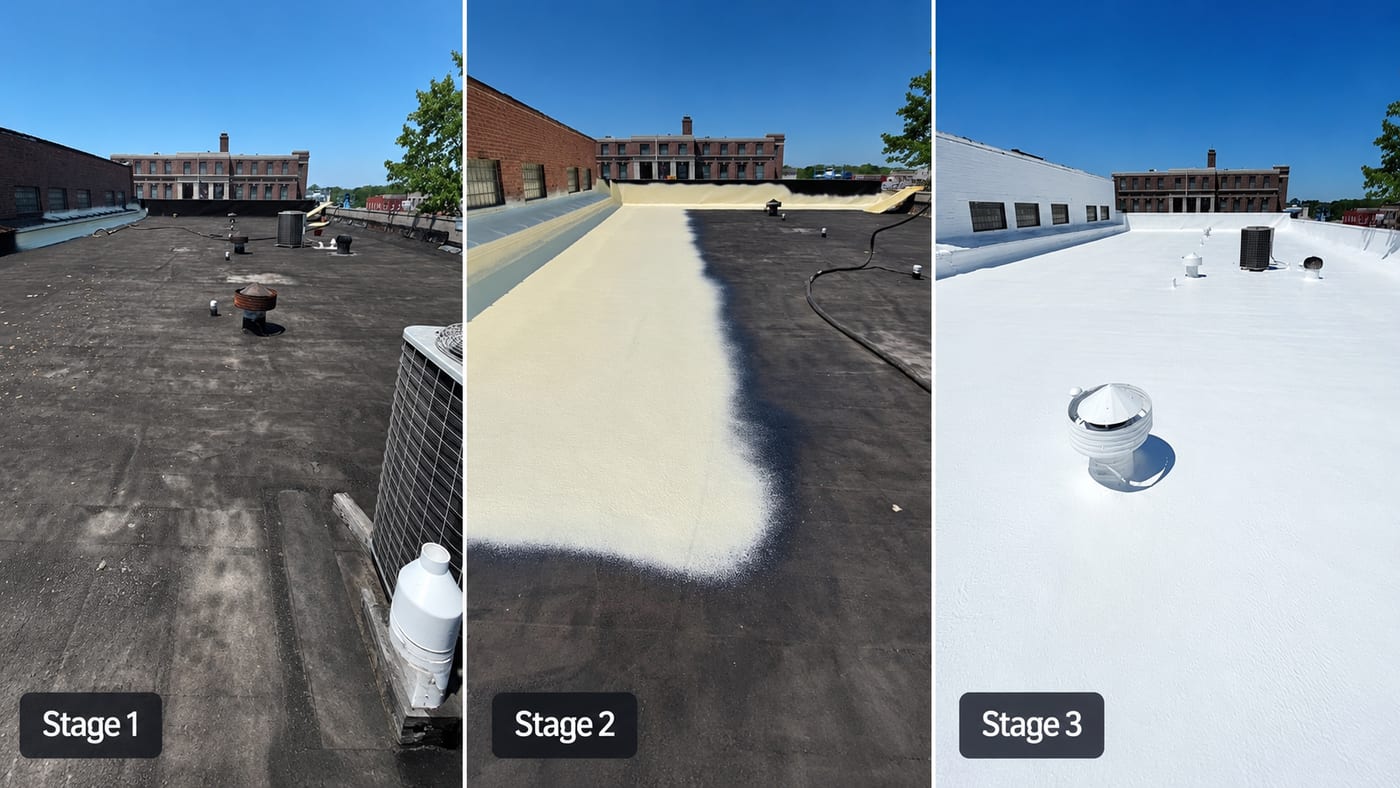
One of the most compelling benefits of SPF roofing for Oklahoma commercial property owners is that it can be applied directly over most existing roof substrates without removing the old roof. The hero image on this blog shows the full transformation in three stages: the dark, weathered existing membrane; the cream-colored foam being sprayed directly over it with no tear-off; and the finished white reflective surface after topcoat application.
This eliminates several major costs and headaches:
No tear-off labor. Removing an existing commercial roof is time-consuming, messy, and expensive. Industry data shows tear-off costs alone run $1.00 to $3.00 per square foot in demolition and disposal. On a 20,000 square foot building, that is $20,000 to $60,000 in savings before the new system even goes on.
No disposal costs. Conventional tear-offs generate tons of material that must be hauled to a landfill. SPF roofing produces virtually no waste during installation.
No disruption to building operations. Without a tear-off, the building interior stays protected throughout the installation process. For occupied commercial buildings, this means no need to relocate tenants, cover inventory, or shut down operations.
The only scenario where a tear-off is required is when the building already has two existing roof layers (the maximum allowed by building codes) or when an infrared moisture survey reveals that more than 25% of the existing roof area has moisture saturation. In those cases, the saturated sections must be removed and replaced before SPF can be applied.
Why Oklahoma's Climate Makes SPF Roofing Worth Considering
Oklahoma puts extraordinary stress on commercial roofs. Summer surface temperatures on a dark membrane roof can exceed 170°F. Winter ice storms load roofs with weight and thermal shock. And hail is a constant, expensive threat.
From 2021 to 2024, Oklahoma averaged 525 hail events per year, ranking 5th nationally for hailstorm frequency. State Farm paid over $5.6 billion in hail claims nationally in 2025, with Oklahoma consistently ranking among the top five states for payouts.
SPF roofing addresses each of these climate threats differently than conventional systems:
Heat. Closed-cell SPF delivers R-6.5 per inch, the highest R-value per inch of any commercially available roofing insulation. A typical 2-inch application provides R-13. Combined with a white silicone or acrylic topcoat, the system reflects solar energy rather than absorbing it. Building owners report 20 to 40% reductions in HVAC energy consumption after SPF roof installation, with payback periods of 3 to 7 years depending on building size and energy costs.
Hail. Because SPF is a rigid, fully adhered foam rather than a membrane stretched over fasteners, it absorbs hail impact differently. Small and moderate hail typically causes only cosmetic surface damage to the topcoat, not structural penetration. When significant damage does occur, SPF roofs are repaired locally rather than replaced entirely. The SPFA publishes specific guidance on evaluating and repairing hail damage to SPF roofs (SPFA-139), a major advantage over membrane systems that often require full replacement after a major hail event.
Wind. The IBHS documented that SPF roofing achieves tensile adhesion strength of approximately 900 psf, roughly 7 to 15 times greater than conventional mechanically fastened systems. Because the foam is chemically bonded to the substrate rather than held down by screws or adhesive strips, there are no edges or seams for wind to catch and peel.
What SPF Roofing Costs in Oklahoma
SPF roofing for a commercial building typically runs between $4.00 and $10.00 per square foot for a complete system including foam, topcoat, and labor. The exact price depends on roof size, existing substrate condition, foam thickness, coating type, and access.
For perspective, a conventional single-ply membrane (TPO or EPDM) tear-off and replacement on the same roof often costs $7.00 to $14.00 per square foot when you factor in tear-off labor, disposal, new insulation board, membrane, and fastening. SPF frequently comes in at or below the cost of a full replacement while delivering superior insulation and eliminating the tear-off process.
Recoating an existing SPF roof after 10 to 15 years typically costs approximately one-third of the original installation, which extends the system's life by another 10 to 15 years. Over a 30-year building ownership period, SPF roofing's lifecycle costs run 10 to 50% lower than membrane alternatives because you are recoating rather than replacing.
Maintenance and Longevity
SPF roofing requires less maintenance than most conventional systems, but it is not maintenance-free. The SPFA recommends semi-annual inspections (spring and fall) to check for coating wear, ponding water, mechanical damage from foot traffic or dropped tools, and any localized hail damage.
The topcoat is the system's first line of defense against UV degradation and weather. After 10 to 15 years of exposure, the original 20 to 30 mils of coating will have worn down and needs to be restored with a fresh coat. This recoating process is straightforward: clean the surface, repair any localized damage, and spray a new coat of silicone or elastomeric material. No tear-off, no structural work, no disruption.
The foam itself has an indefinite functional lifespan when properly maintained. The wear component is the protective topcoat, not the foam. The Playhouse Square SPF roof in Cleveland, installed in 1972, has been recoated multiple times and was still performing after more than 53 years of continuous service. That kind of longevity is difficult to match with conventional membrane systems that typically need full replacement every 15 to 20 years.
When SPF Roofing Is Not the Right Fit
SPF roofing is not the best choice for every building. Being honest about its limitations helps you make a better decision.
Steep-slope roofs are not good candidates. SPF roofing is designed for flat and low-slope roofs (2:12 pitch or less). On steep slopes, the liquid foam cannot be applied evenly and the coating may not adhere properly.
Roofs with saturated substrate may require partial or full tear-off before SPF can be applied. The foam must bond to a dry, structurally sound surface. A pre-installation infrared moisture survey determines whether the existing substrate is viable.
Application weather windows matter. SPF cannot be sprayed when the surface temperature is below 50°F, humidity is above 85%, or it is raining. In Oklahoma, this means early spring and late fall installations need to be scheduled around weather, and mid-winter applications are generally not feasible.
Contractor quality is critical. SPF roofing requires a high degree of technical knowledge and precision. The SPFA's Professional Certification Program (ISO 17024 compliant) certifies individual installers and accredits contractors. An improperly applied SPF roof can have adhesion failure, blistering, or uneven thickness that compromises both waterproofing and insulation performance. Always verify contractor certifications before signing a contract.
Ready to Find Out If SPF Roofing Is Right for Your Building?
At Rocking Rad Spray Foam LLC, we install SPF roofing systems on flat and low-slope commercial buildings across Oklahoma. We evaluate your existing roof condition, conduct moisture surveys, and provide a full cost comparison against tear-off and replacement. We offer free on-site estimates and 0% financing. Contact us or fill out our online form to schedule your estimate.
Frequently Asked Questions
Can SPF roofing be applied over my existing roof?
In most cases, yes. SPF bonds directly to most existing substrates including single-ply membranes (TPO, EPDM, PVC), built-up roofing, modified bitumen, and metal. The existing surface must be dry, structurally sound, and free of contaminants. An infrared moisture survey before installation identifies any saturated areas that need to be removed and replaced before foam is applied. If your building already has two roof layers, a tear-off of at least one layer is required before SPF can be added.
How does SPF roofing handle Oklahoma hail?
SPF absorbs hail impact differently than conventional membranes. Small and moderate hail typically damages only the topcoat surface without penetrating the foam. When larger hail causes localized damage, the affected area is cut out and patched rather than requiring a full roof replacement. The SPFA publishes specific repair guidelines for hail-damaged SPF roofs. After a major hail event, a qualified contractor inspects the roof and repairs only the damaged sections, which is typically far less expensive than replacing an entire membrane system.
How often does the coating need to be reapplied?
Plan for recoating every 10 to 15 years depending on coating type, UV exposure, and weather conditions. Silicone coatings tend to last longer than acrylics in high-UV environments like Oklahoma. The recoating process involves cleaning the surface, repairing any localized damage, and spraying a new coat. It costs approximately one-third of the original installation and extends the system's life by another full cycle.
What happens if my SPF roof develops a leak?
SPF roof leaks are rare because the system has no seams, joints, or fastener penetrations. When a leak does occur (usually from mechanical damage like a dropped tool or severe hail), it is localized and repairable. The damaged section is identified, cut out, filled with new foam, and recoated. Unlike membrane systems where a single puncture can allow water to travel laterally beneath the membrane, water intrusion in SPF stays localized to the damaged area.
Is SPF roofing safe for occupied buildings during installation?
The building interior remains protected throughout installation because there is no tear-off exposing the interior. The foam and coating are applied to the exterior roof surface. During application, occupants should avoid the immediate rooftop area. The foam cures within hours, and the topcoat dries the same day in most conditions. Normal rooftop access (HVAC service, etc.) can resume within 24 to 48 hours after coating application.
How does SPF roofing compare to a conventional roof replacement on total cost?
SPF roofing typically costs $4 to $10 per square foot installed. A conventional tear-off and replacement runs $7 to $14 per square foot. Over 30 years, SPF's lifecycle cost is 10 to 50% lower because you recoat rather than replace, and you never pay for tear-off. The foam itself lasts indefinitely when the topcoat is maintained.