Closed Cell Spray Foam Insulation Oklahoma: Complete Guide
TL;DR
Closed-cell spray foam is three products in one application: insulation at R-6.5 to R-7.0 per inch (the highest available), a Class II vapor retarder at 2 inches, and structural reinforcement that increases wall racking strength by up to 300%. It is the only cavity insulation classified by FEMA as a flood-damage-resistant material. For Oklahoma's metal buildings, crawl spaces, exterior walls, rim joists, and any location where moisture control is non-negotiable, closed-cell is the correct product. But it costs roughly twice as much per board foot as open-cell, and in locations where moisture control is not the primary concern (attic roof decks, interior walls, sound control), open-cell delivers the same air seal at a lower cost. This guide covers every location where closed-cell is required, every location where open-cell is the smarter choice, and the building science behind knowing the difference.
What Closed-Cell Spray Foam Actually Is
Closed-cell spray foam (sometimes called two-pound foam because of its cured density of approximately 2.0 pounds per cubic foot) is a rigid, dense polyurethane insulation created by the same two-component chemical reaction as open-cell foam. The A-side (isocyanate) and B-side (polyol resin) are mixed at the spray gun, react on contact, and expand into foam.
The difference is in the cell structure. Unlike open-cell foam, where the cell walls intentionally break during expansion, closed-cell foam's cells remain fully sealed. Each cell is an enclosed pocket filled with a blowing agent gas that provides higher thermal resistance than air. The result is a rigid, dense material that is fundamentally different from the soft, spongy texture of open-cell.
This sealed cell structure is what gives closed-cell foam its three defining properties: high R-value per inch, vapor retarder performance, and structural rigidity. No other single insulation product delivers all three. For an overview of both foam types and how spray foam works in general, see our foundational guide: What Is Spray Foam Insulation?
Why Density Matters: True 2-Pound vs. Cheaper Alternatives
Not all closed-cell spray foam is created equal, and this is a detail most homeowners never hear about until it is too late.
As Rocking Rad's service page states directly: not all spray foam companies use two-pound density foam. Some use a cheaper 1.7 or 1.8 density, which has a lower R-value per inch and must be sprayed thicker to achieve a Class II vapor retarder moisture barrier.
The difference matters because density drives every performance metric. A true 2.0 lb/cu ft closed-cell foam delivers R-6.5 to R-7.0 per inch. A 1.7 lb foam may deliver only R-5.5 to R-6.0 per inch. At 2 inches, that is the difference between R-13 and R-11 in the same cavity, and the lower-density foam may not achieve the sub-1-perm vapor permeance that qualifies it as a Class II vapor retarder.
When comparing contractor quotes, ask specifically what density product they use and request the manufacturer's technical data sheet. A lower bid may reflect a lower-density product that requires more thickness to achieve the same performance, which can eliminate the apparent cost savings.
The Numbers That Define Closed-Cell Performance
R-value: R-6.5 to R-7.0 per inch. Nearly double the per-inch performance of open-cell (R-3.7). Two inches delivers approximately R-13, meeting the Oklahoma 2015 IECC wall requirement in a standard 2x4 cavity. This ability to hit code targets in thinner applications is one of closed-cell's key advantages in shallow cavities where open-cell cannot reach the required R-value.
Density: approximately 2.0 lb per cubic foot. Four times the density of open-cell foam (0.5 lb/cu ft). This density gives closed-cell its rigidity, water resistance, and structural contribution.
Expansion: approximately 25 to 35 times its liquid volume. Far less than open-cell's 100x expansion. Skilled installers try to avoid overfilling cavities with closed-cell because the dense, rigid foam is extremely difficult to trim. When closed-cell does need trimming, it requires power tools rather than the hand tools that work on open-cell.
Vapor permeance: Class II vapor retarder at 2 inches. At 2 inches of thickness, closed-cell foam achieves a vapor permeance of 0.8 to 1.5 perms, qualifying as a Class II vapor retarder under the IRC. At 3 inches or more, permeance drops below 0.1 perms, functioning effectively as a vapor barrier. This eliminates the need for a separate poly vapor retarder membrane in most Oklahoma assemblies.
Compressive strength: 25 to 60 psi. This is what gives closed-cell its structural contribution. When bonded to framing and sheathing, it locks the assembly together and resists the lateral forces from wind and seismic loading.
Water absorption: less than 2% by volume. Closed-cell foam does not absorb water. This is why FEMA classifies it as a flood-resistant material and why it is the only appropriate foam for below-grade, crawl space, and flood-prone applications.
Three Products in One Application
This is the core value proposition of closed-cell spray foam, and it is what Rocking Rad means when they describe it as maximum protection for Oklahoma's toughest conditions.
Product 1: Insulation. R-6.5 to R-7.0 per inch delivers the highest thermal resistance per inch of any commercially available insulation. In cavities where depth is limited, closed-cell achieves R-values that no other product can match.
Product 2: Vapor retarder. At 2 inches, closed-cell blocks moisture vapor from diffusing through the wall, roof, or floor assembly. In Oklahoma's humid climate, this prevents the condensation that causes mold, rot, and corrosion on metal surfaces. No separate vapor retarder membrane is needed.
Product 3: Structural reinforcement. The NAHB Research Center confirmed that closed-cell spray foam increases the racking strength of wall assemblies by up to 300%. The rigid foam bonds to studs, sheathing, and plates, creating a composite assembly that is significantly stronger than the same wall with cavity-fill insulation. For Oklahoma's severe weather, this structural contribution provides measurable resilience against wind and pressure forces.
No other insulation product delivers all three in a single pass. Fiberglass provides insulation only. Rigid foam board provides insulation and some vapor control but does not bond to framing. Open-cell provides insulation and air sealing but no vapor control or structural contribution. Closed-cell is the only product that does all three simultaneously.
Where Closed-Cell Is Required in Oklahoma
Metal Buildings and Pole Barns
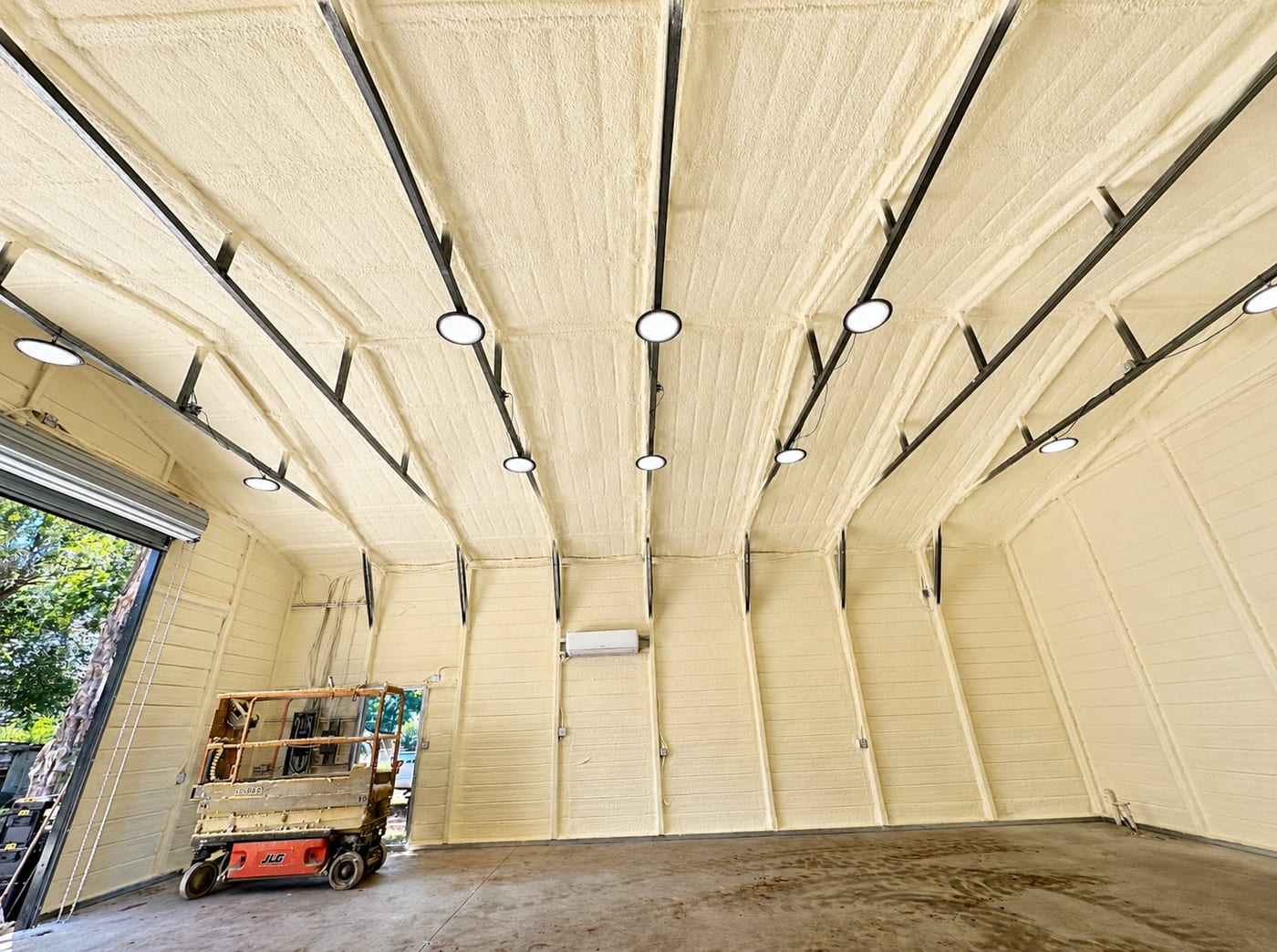
Steel conducts heat roughly 1,000 times faster than insulation. An uninsulated metal building sweats with condensation, overheats in summer, and freezes in winter. Closed-cell foam bonds directly to the metal panels, prevents the interior surface from reaching the dew point, and creates the thermal break that stops condensation at the source. Open-cell on metal surfaces allows moisture to migrate through and condense on the steel behind it, causing rust and corrosion. See our guide: Metal Building Insulation in Oklahoma.
Crawl Spaces and Rim Joists
Crawl space walls and rim joists face moisture from soil, ground contact, and Oklahoma's humid spring air from every direction. Closed-cell's vapor retarder performance blocks that moisture from reaching the framing. Open-cell allows it through. There is no debate on this application: closed-cell is the only appropriate foam for crawl space walls and rim joists. See our guide: Crawl Space Encapsulation in Oklahoma.
Exterior Walls
For exterior wall assemblies in Oklahoma's mixed-humid climate, Rocking Rad recommends closed-cell because it provides the vapor retarder that protects the sheathing from condensation during humid months. Two inches in a 2x4 cavity delivers R-13 (meeting code) plus vapor control plus air sealing plus structural strength. No other product achieves all of this in 2 inches.
Below-Grade Walls and Foundations
Concrete and block foundation walls are in constant contact with soil moisture. Closed-cell foam on these surfaces blocks both vapor diffusion and bulk water migration while insulating the wall. Open-cell absorbs moisture from the concrete over time and loses performance.
Shipping Containers
All-metal, zero-drying-potential structures where condensation is the primary threat. Closed-cell bonds to the steel, conforms to the corrugated profile, and prevents moisture from reaching the metal surface. See our guide: Shipping Container Insulation in Oklahoma.
Commercial and Industrial Buildings
Commercial metal buildings must meet ASHRAE 90.1 energy code requirements that account for thermal bridging through steel framing. Continuous insulation on the interior face of metal panels is effectively required, and closed-cell is the most practical way to achieve it. See our guide: Commercial Spray Foam Insulation in Oklahoma.
Flood-Prone Areas
FEMA Technical Bulletin 2 (2025) classifies closed-cell spray foam as an "acceptable" flood-damage-resistant material. Open-cell is rated "unacceptable" for below-base-flood-elevation applications. Closed-cell is the only cavity insulation to receive this FEMA classification. After flood exposure, closed-cell can be power-washed, dried, and returned to service without replacement. Every other insulation type (fiberglass, cellulose, open-cell foam) absorbs water and must be removed after flooding.
Where Open-Cell Is the Smarter Choice
Closed-cell is the superior product in moisture-critical and structurally demanding applications. But it is not the right choice everywhere, and using it where open-cell would suffice means spending twice as much for benefits you do not need.
Attic Roof Decks
When rafter depth allows (2x10 or deeper), open-cell fills the cavity to R-38 at roughly half the cost of closed-cell. Both products air seal the assembly. Open-cell's vapor permeability actually benefits attic assemblies by allowing the roof deck to dry toward the interior if moisture enters from above. In Oklahoma's Climate Zone 3A, open-cell is permitted for unvented roof assemblies per IRC R806.5.
Interior Partition Walls
Sound control between bedrooms, home offices, and media rooms is open-cell's strongest application. It absorbs 70% of sound energy compared to closed-cell's lower acoustic absorption. And since interior walls face no exterior moisture, closed-cell's vapor retarder adds no value here.
Vaulted and Cathedral Ceilings
Deep rafter bays in cathedral ceilings give open-cell enough depth to reach R-38 or higher at lower cost. Closed-cell in the same cavity would cost two to three times as much. The hybrid approach (closed-cell flash coat against the sheathing for condensation control, open-cell or fiberglass to fill the rest) balances performance and cost in shallower rafters. See our guide: Vaulted Ceiling Insulation in Oklahoma.
Ceilings and Floor Assemblies Between Conditioned Floors
When both sides of the assembly are conditioned space (second floor above first floor), there is no moisture drive and no structural demand that requires closed-cell. Open-cell fills the joist bay, dampens sound, and costs less.
The Cost Reality
Closed-cell spray foam typically costs $1.00 to $1.50 per board foot installed, compared to $0.44 to $0.65 for open-cell. For a 2-inch application on a wall, that translates to roughly $2.00 to $3.00 per square foot for closed-cell vs. $1.54 to $2.28 for the same cavity filled with open-cell at 3.5 inches.
The cost premium is justified in every "where closed-cell is required" location listed above because open-cell simply cannot do the job in those locations. The premium is not justified in locations where open-cell performs equally well because you are paying for vapor control and structural strength you do not need.
This is why Rocking Rad and most building science professionals recommend the hybrid approach for whole-home projects: closed-cell where moisture, structure, or limited cavity depth demand it (crawl space, rim joists, exterior walls, metal surfaces), and open-cell where air sealing and thermal performance are the only requirements (attic, interior walls, ceilings).
The Permanence Factor
Rocking Rad's service page makes a statement worth emphasizing: the insulation value never degrades. The structural improvement is permanent. The moisture barrier does not wear out. Twenty years from now, the closed-cell foam in your building will perform exactly as it does the day it is installed.
The DOE confirms that closed-cell polyurethane foam does not sag, settle, compress, or absorb moisture under normal conditions. Unlike fiberglass that loses up to 40% of its effectiveness over 15 to 20 years from settling, moisture cycling, and pest damage, closed-cell foam is applied once and continues performing for the life of the building.
Ready to Find Out Where Closed-Cell Fits in Your Oklahoma Project?
At Rocking Rad Spray Foam LLC, we use true 2-pound density closed-cell foam on every job. We evaluate every surface and recommend closed-cell where it is required and open-cell where it makes more sense. We do not default to one product for every application because the building science does not support it. Free on-site estimates and 0% financing available across Oklahoma. Contact us or fill out our online form to schedule yours.
Frequently Asked Questions
Is closed-cell spray foam worth the extra cost over open-cell?
In locations where moisture control, vapor retarder performance, or structural strength is needed (crawl spaces, metal buildings, exterior walls, rim joists, below-grade), closed-cell is not optional. Open-cell cannot do the job. In locations where only air sealing and thermal performance are needed (attic roof decks, interior walls, ceilings), open-cell delivers the same air seal at lower cost. The answer depends on where the foam is going.
How thick should closed-cell foam be?
For most wall applications in Oklahoma, 2 inches provides R-13 (meeting code), air barrier performance, and Class II vapor retarder status. For crawl space walls and rim joists, 2 to 3 inches is typical. For metal buildings, 2 to 3 inches on walls and 3 to 4 inches on the roof deck depending on the thermal performance target. Your contractor should specify thickness based on the assembly requirements and your climate zone.
Does closed-cell foam prevent condensation in metal buildings?
Yes. Closed-cell foam bonded directly to the metal panels keeps the interior surface above the dew point of the interior air. When warm humid air cannot contact cold steel, condensation cannot form. At 2 inches, the foam also functions as a vapor retarder, preventing moisture vapor from migrating through the insulation to reach the metal behind it. This dual mechanism (thermal break plus vapor control) is why closed-cell is the only appropriate foam for metal building surfaces.
Can closed-cell foam survive a flood?
Yes. FEMA classifies closed-cell spray foam as the only cavity insulation that qualifies as a flood-damage-resistant material. It does not absorb water, can be power-washed and dried after flood exposure, and returns to full performance without replacement. Every other insulation type (fiberglass, cellulose, open-cell foam) absorbs water and must be removed and replaced after flooding.
Does closed-cell foam need trimming like open-cell?
Rarely. Closed-cell expands only 25 to 35 times its liquid volume (vs. 100x for open-cell), and skilled installers deliberately underfill slightly to avoid the need for trimming. When trimming is needed, it requires power tools (reciprocating saws or grinders) because the dense, rigid foam cannot be cut easily with hand tools. For more detail on what happens after foam is sprayed, see our guide: What Happens Between Spray Foam and Drywall.
Are there financial assistance programs for insulation in Oklahoma?
There is currently no federal tax credit for residential insulation. The Oklahoma Department of Commerce Weatherization Assistance Program provides no-cost energy efficiency improvements to qualifying households. Some Oklahoma utilities offer rebates for insulation work. Check with your provider for current options.