Why Your Attic Ductwork Is Costing You Money in Oklahoma
TL;DR
If your HVAC ductwork runs through an unconditioned attic in Oklahoma, it is losing energy two ways at once: conditioned air leaks out through gaps in the duct connections, and the air still inside the ducts gains heat in summer (or loses heat in winter) as it passes through an attic that can exceed 150°F. DOE Building America research found that ducts in unconditioned, vented attics increase heating and cooling energy use by 10%, and duct air leakage commonly exceeds 20% of conditioned airflow. There are two ways to fix this: seal and insulate the ducts themselves while keeping the attic unconditioned, or bring the entire attic inside the conditioned envelope with spray foam on the roof deck. Both work. They cost different amounts, deliver different levels of improvement, and suit different situations.
The Problem Hiding Above Your Ceiling
Most Oklahoma homes built on a slab foundation put the HVAC air handler and ductwork in the attic. The DOE estimates that 50 to 70% of the 116 million residential homes in the U.S. are slab-on-grade with HVAC equipment and ductwork in the attic. In Oklahoma, where slab construction dominates, this percentage is likely even higher.
The problem is that your attic is not conditioned space. In an Oklahoma summer, attic temperatures routinely reach 130 to 150°F. In winter, attic temperatures drop to near-outdoor levels. Your ductwork sits in that extreme environment, and every foot of duct that runs through it is working against you.
This creates two separate energy penalties that compound each other.
Penalty 1: Heat Gain and Loss Through Duct Walls
Even perfectly sealed ducts lose energy through the duct wall itself. Your air conditioner cools air to approximately 55°F and pushes it through ducts that are surrounded by 150-degree attic air. The temperature difference across the duct wall is nearly 100 degrees. Even with R-6 or R-8 duct insulation, heat conducts through the duct wall and warms the supply air before it reaches your rooms.
ORNL research found that in many homes, ductwork in unconditioned attics increases air conditioner energy use by roughly 18% for moderately leaky ducts in a well-insulated attic. That 18% is energy your AC produces that never makes it to your rooms as useful cooling. You pay for it on your electric bill, but you never feel it.
The same principle works in reverse during winter. Your furnace heats air to approximately 120°F and pushes it through ducts surrounded by 30 or 40-degree attic air. The supply air loses heat through the duct wall, arriving at your registers cooler than intended. Your furnace runs longer to compensate.
If you have ever noticed that rooms farthest from the air handler feel warmer in summer and cooler in winter than rooms close to it, this is likely why. The supply air is losing or gaining temperature as it travels through the attic, and the longest duct runs lose the most.
Penalty 2: Air Leakage Through Duct Connections
The second penalty is worse than the first because it involves losing conditioned air entirely. Energy Star reports that in a typical home, about 20 to 30 percent of the air moving through the duct system is lost through leaks, holes, and poorly connected ducts.
Every connection between duct sections, every boot where a duct meets a register, every takeoff where a branch duct connects to the trunk line, and every joint at the air handler is a potential leak. In an unconditioned attic, these leaks mean:
Supply leaks push cooled or heated air directly into the attic, where it does nothing for your comfort. You paid to condition that air, and it went straight into an unconditioned space.
Return leaks are often worse. Gaps in the return duct system pull hot, humid attic air into the return stream. That 150-degree, moisture-laden attic air mixes with your room air and enters the air handler. Your AC now has to cool and dehumidify air that is significantly hotter and more humid than it should be. This is one of the most common reasons Oklahoma homes feel humid even with the AC running.
The combined effect of duct wall heat transfer and air leakage is substantial. ORNL analysis found that HVAC and ducts in unconditioned attics contribute 30 to 50 million BTUs per year of wasted energy per home. Nationally, that totals 2.9 quadrillion BTUs of wasted energy across the housing stock. At the individual home level, it shows up as higher utility bills, uneven room temperatures, and an HVAC system that runs longer than it should.
Solution A: Seal and Insulate the Ducts
The first approach keeps the attic unconditioned and focuses on making the ductwork itself perform better within that hostile environment.
Seal all duct connections with mastic. Mastic is a thick, paste-like sealant that is applied with a brush or gloved hand to every joint, connection, boot, and takeoff in the duct system. It dries to a permanent, flexible seal that does not crack or peel like duct tape does. Foil-faced tape (UL 181-rated) can supplement mastic at joints but should not be used alone as a primary sealant.
Insulate the ducts to code or better. Oklahoma's energy code requires a minimum of R-6 on ducts in unconditioned spaces, with R-8 on supply ducts in attics for Climate Zones 3 and above. If your existing duct insulation is compressed, torn, or missing its vapor retarder facing, replacing or supplementing it improves performance. Using duct insulation with an intact vapor retarder facing reduces condensation on the duct exterior during cooling season.
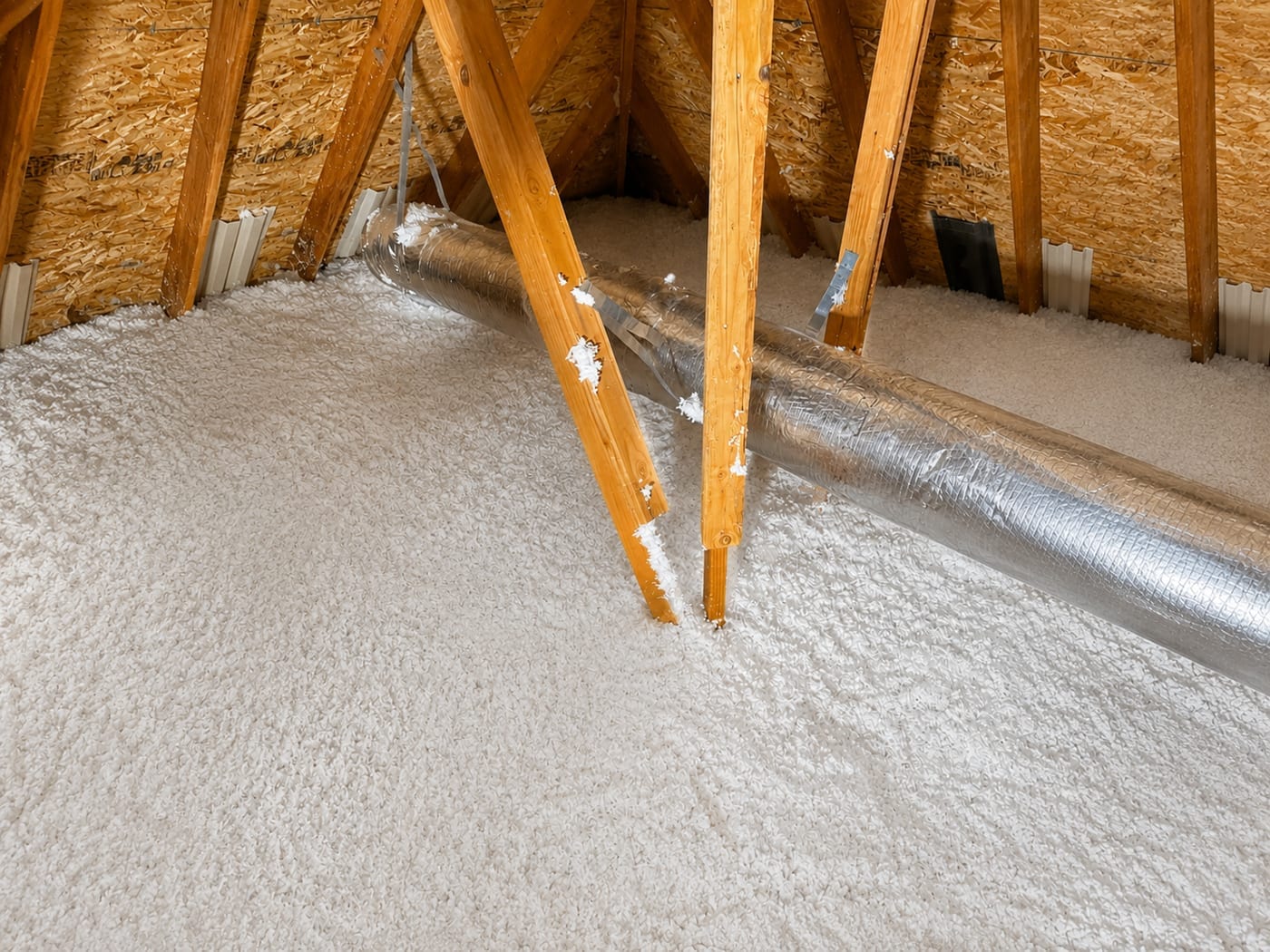
Bury the ducts in attic floor insulation. The DOE Building America Solution Center recommends laying ductwork directly on the ceiling joists and covering it with the same blown-in insulation used on the attic floor. In humid climates like Oklahoma, the ducts should first be encapsulated with closed-cell spray foam before being buried in blown-in insulation. This encapsulation prevents condensation from forming on the duct surface beneath the loose-fill.
When Solution A makes sense: Your budget is limited, the ducts are in reasonable condition and accessible for sealing, and you are not planning a major attic renovation. Solution A costs less than Solution B and delivers meaningful improvement, especially if your ducts are currently unsealed. It does not eliminate the heat gain/loss penalty entirely (the ducts are still in a hot attic), but it reduces the air leakage penalty significantly.
Solution B: Bring the Attic Inside the Conditioned Envelope
The second approach changes the game entirely. Instead of trying to protect the ducts from the attic environment, you change the attic environment.
Spray foam insulation applied to the underside of the roof deck (open-cell or closed-cell, depending on the assembly) converts the attic from an unconditioned, vented space into a semi-conditioned, unvented space. The insulation and air barrier move from the attic floor to the roofline. The attic is now inside the building's thermal envelope.
The result: your ductwork is no longer operating in a 150-degree environment. It is operating in an 85 to 95-degree semi-conditioned space. The temperature difference across the duct wall drops from 100 degrees to 30 degrees. Heat gain through the duct wall drops proportionally. And because the attic is now sealed from outdoor air, there is no hot, humid attic air to be pulled through return duct leaks.
ORNL's recommendation is direct: always install HVAC ducts in conditioned space, and making the attic into a semi-conditioned space is a viable option because the ducts are used to create their own conditioned space with air leakage that is otherwise lost to the environment. Moving ductwork from the attic to conditioned space or making the attic semi-conditioned halves the roof and attic energy compared to having leaky ducts in the attic.
When Solution B makes sense: Your ducts are in poor condition and would need extensive sealing anyway, you want maximum performance improvement, you are experiencing humidity problems or uneven temperatures between floors, you are planning to replace the HVAC system soon and want to right-size it for a tighter envelope, or you are building new and can specify the attic assembly from the start.
Solution B costs more than Solution A but delivers a larger improvement. It eliminates the duct environment problem entirely rather than mitigating it.
How to Decide Between the Two
The choice depends on three factors.
Budget. Sealing and insulating existing ducts typically costs $1,500 to $3,500 for a whole-house duct system. Spray foam on the roof deck for a typical Oklahoma home runs $3,500 to $7,000 depending on foam type and attic size. If budget is the primary constraint, Solution A delivers the best return per dollar.
Severity of the problem. If your home has rooms that are always too hot or too cold, persistent humidity issues, or energy bills that seem disproportionate to the size of your home, Solution B addresses the root cause more completely. If your comfort issues are mild and your main goal is reducing waste, Solution A may be sufficient.
Long-term plans. If you plan to stay in the home for 10 or more years, Solution B's higher upfront cost is offset by greater annual savings and reduced HVAC wear. If you are preparing to sell within a few years, Solution A's lower cost with immediate improvement may be the better investment.
A blower door test and duct pressurization test give you the data to quantify how much air your duct system is losing and how leaky your overall envelope is. Those numbers make the choice between Solution A and Solution B much clearer.
Ready to Find Out How Much Your Ductwork Is Costing You?
At Rocking Rad Spray Foam LLC, we help Oklahoma homeowners diagnose and fix duct energy loss with both approaches: duct sealing and insulation, or spray foam on the roof deck to bring the attic inside the envelope. We offer blower door testing to quantify your air leakage, free on-site estimates, and 0% financing. Contact us or fill out our online form to schedule yours.
Frequently Asked Questions
Can I seal my own ductwork or do I need a professional?
You can seal accessible duct connections with mastic yourself if you are comfortable working in an attic. The key is sealing every joint, not just the ones that are obviously leaking. Professionals use duct pressurization testing to identify leaks you cannot see or feel, which ensures nothing is missed. For Oklahoma attics that reach 150°F in summer, doing this work in spring or fall is strongly recommended for safety.
Will sealing my ducts make my house too tight?
No. Duct sealing addresses leaks in the duct system, not in the building envelope. It keeps conditioned air inside the ducts where it belongs. Your home's overall ventilation is not affected. If you pursue Solution B (spray foam on the roof deck), the home may become tight enough to need mechanical ventilation, which your contractor and blower door test results will determine.
My ducts are flex duct. Does that change anything?
Flex duct is common in Oklahoma attics and has the same issues as rigid duct: leaks at connections and heat gain through the duct wall. Flex duct connections are actually more prone to leakage because they rely on zip ties and tape rather than mechanical fasteners. Sealing with mastic at every boot and takeoff connection is critical. The duct insulation built into flex duct (typically R-6) helps but does not eliminate heat transfer in a 150-degree attic.
How do I know if my ducts are leaking?
Signs include rooms that will not cool or heat evenly, dust streaks around supply registers, higher energy bills than similar homes, and visible gaps at duct connections in the attic. A duct pressurization test provides a measured number for total duct leakage. Rocking Rad Spray Foam LLC can perform this test alongside a blower door test to give you the complete picture.
Does Oklahoma energy code require duct sealing?
The 2015 IECC (Oklahoma's adopted code) requires duct sealing and testing for new residential construction. Duct leakage must not exceed 4 CFM25 per 100 square feet of conditioned floor area when ducts are in unconditioned space. For existing homes, there is no retrofit requirement, but the energy savings from sealing leaky ducts are immediate and measurable.
Are there financial assistance programs for ductwork improvements?
There is currently no federal tax credit for duct sealing or insulation. However, some Oklahoma utilities offer rebates for HVAC and energy efficiency improvements that may include duct sealing. The Oklahoma Department of Commerce Weatherization Assistance Program provides no-cost energy efficiency improvements to qualifying low-income households. Check with your utility provider for current options.