New Construction Insulation: Spray Foam Before Drywall in OK
TL;DR
New construction is the easiest and most cost-effective time to install spray foam insulation. Walls are open, cavities are accessible, and there is no demolition or old insulation to remove. A properly spray-foamed new home in Oklahoma achieves tighter blower door results, qualifies for better HERS ratings, and allows your HVAC contractor to right-size the equipment to a smaller, less expensive system. Once the drywall goes up, accessing those same cavities costs significantly more. The window to get this right is narrow, and it closes the day framing inspection passes.
Why New Construction Is Your Best (and Cheapest) Chance to Insulate Right
Every home gets insulated once during construction. Retrofitting later is always more expensive, more disruptive, and less thorough because finished walls, ceilings, and floors block access to the cavities and penetrations that matter most.
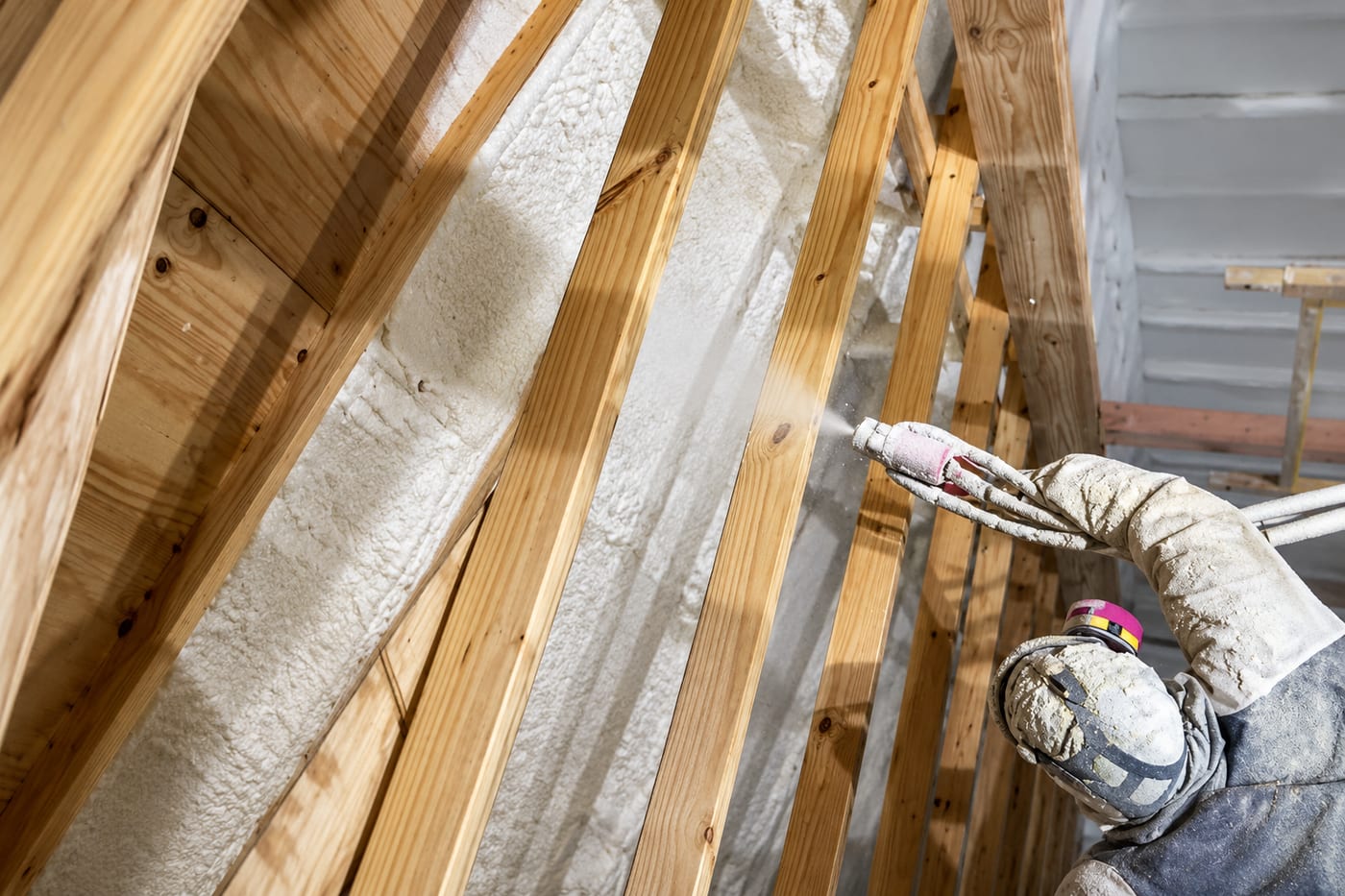
During new construction, every stud bay is open. Every rim joist is exposed. Every top plate, bottom plate, and penetration around wiring and plumbing is accessible. A spray foam applicator can seal and insulate every surface in a single pass, creating a continuous air barrier and thermal envelope before any of it gets buried behind drywall.
The EPA estimates that 9 out of 10 U.S. homes are under-insulated, and that homeowners save an average of 15% on heating and cooling costs by combining air sealing with insulation. Starting with spray foam on a new build locks in that performance from the first utility bill rather than chasing it years later through expensive retrofit work.
In Oklahoma, where summer cooling loads dominate energy budgets for six months of the year and winter heating demand is real, the building envelope is the single biggest factor in long-term operating cost. Getting it right during construction is not a luxury upgrade. It is the most cost-effective decision you can make for the life of the home.
When Spray Foam Happens in the Build Sequence
Timing matters on a construction schedule, and spray foam has a specific window. Here is where it fits relative to the other trades:
Framing is complete and the roof is on. The building is dried in and protected from weather. Rough framing inspection has passed.
Spray foam is applied after framing inspection but before HVAC rough-in, electrical trim, and drywall. The applicator needs full access to every cavity, top plate, rim joist, and penetration. If HVAC ductwork or electrical wiring is already installed in the cavities, the foam works around it, but clean open cavities produce the best coverage and the tightest air seal.
After foam cures (typically 24 hours), the other trades resume. HVAC rough-in, electrical, and plumbing can work around the cured foam. Drywall follows after all rough-in inspections are complete.
The critical coordination point is between the framing contractor, the spray foam installer, and the HVAC contractor. If the HVAC contractor sizes the system before the foam is installed, they may size based on the uninsulated envelope, producing an oversized system that short cycles once the foam is in place. The correct sequence is to specify the insulation first, then run the Manual J load calculation based on the insulated envelope, then select the HVAC equipment.
Open-Cell vs. Closed-Cell: Choosing by Location, Not by Price
Both open-cell and closed-cell spray foam are excellent products. The choice should be driven by where the foam is going and what it needs to do, not by which one costs less per board foot.
Open-cell spray foam expands aggressively, filling every cavity, crack, and corner with a soft, flexible material. It delivers R-3.6 to R-3.8 per inch per Johns Manville technical data, provides a strong air seal, and offers outstanding sound dampening. It is the smart choice for interior partition walls (sound control), attic roof decks in conditioned attic designs, and wall cavities where depth allows sufficient thickness to meet R-value targets.
Closed-cell spray foam is denser, delivers R-6 to R-7 per inch, and achieves a vapor permeance below 1 perm at 2 inches, functioning as its own vapor retarder. For Oklahoma's mixed-humid climate, closed-cell is the right call for crawl space walls and rim joists (moisture and soil gas control), below-grade foundation walls, roof decks where cavity depth is limited, and any surface where moisture resistance is critical.
Many well-designed Oklahoma new construction projects use a hybrid approach: closed-cell in moisture-critical zones (crawl space, rim joists, below-grade walls) and open-cell everywhere else (attic roof deck, interior walls, above-grade exterior walls with sufficient cavity depth). This balances performance and cost without compromising where it matters most.
For a deeper explanation of how the two foam types differ in chemistry, cell structure, and application, see our foundational guide: What Is Spray Foam Insulation?
What New Construction Spray Foam Costs in Oklahoma
On a typical 2,000 square foot Oklahoma home, spray foam for the full envelope (roof deck and exterior walls) runs between $8,000 and $15,000 depending on foam type, thickness, and project complexity. Traditional blown-in or batt insulation for the same home costs $5,000 to $8,000. The gap is real, and it is worth understanding what you get for the difference.
First, there is the equipment sizing offset. A tighter envelope reduces the Manual J heating and cooling load, which often allows a smaller HVAC system. The difference between a 5-ton and a 3-ton system can be $2,000 to $4,000 in equipment and installation cost. That offset is realized immediately, before the homeowner moves in.
Second, there are the operating cost savings. The EPA estimates 15% savings on heating and cooling costs from air sealing and insulation. For an Oklahoma home spending $2,400 annually on energy, that is roughly $360 per year in recurring savings. Homes that start from a tight, spray-foamed envelope rather than code-minimum fiberglass tend to see results at or above that average because the air sealing component is so much more thorough.
Third, there is the durability factor. The DOE notes that open-cell polyurethane foam has an R-value that does not change over time, and closed-cell foam does not sag, settle, or absorb moisture. You are not paying for the same insulation job twice in 15 years the way you might with fiberglass that compresses or gets wet.
For detailed pricing by project type, see 5 Myths About Spray Foam Insulation Cost in Oklahoma.
What Changes When You Spray Foam a New Build
Choosing spray foam for new construction is not just about insulation. It changes how the entire home functions as a system.
HVAC right-sizing becomes possible. An airtight envelope means the Manual J calculation produces a smaller load, which means a smaller system. That system runs longer, steadier cycles, dehumidifies more effectively in Oklahoma's humid summers, and lasts longer because it is not short cycling.
Indoor air quality improves. A tight envelope paired with mechanical ventilation (an ERV or HRV system) means you control what air enters the home rather than letting it infiltrate randomly through every gap in the framing. Oklahoma's pollen, red dirt dust, and humidity stay outside on your terms. Building codes require mechanical ventilation when homes achieve 3 ACH50 or below, which spray foam consistently delivers.
Energy code compliance is simpler. Oklahoma follows the 2015 IECC, which requires blower door testing and air leakage rates of 3 ACH50 or less for new residential construction. Spray foam is the most reliable single product for hitting that target. A blower door test and HERS rating document that the home performs as designed, which matters for permits, lenders, and future resale.
Fire barrier requirements apply. Any spray foam that remains exposed in attics, crawl spaces, or garages needs a thermal barrier or ignition barrier per building code. In most new construction, the drywall serves as the thermal barrier naturally. In spaces where foam will remain exposed, intumescent coatings provide a code-compliant alternative. For details, see our guide: Fire-Retardant Coatings for Spray Foam Insulation.
What to Ask Your Spray Foam Contractor on a New Build
Not every spray foam installer delivers the same quality, and on a new construction project the work gets buried behind drywall permanently. Here is what to verify before signing a contract:
What foam system will you use, and what are the R-value and vapor permeance specs? Ask for the manufacturer's technical data sheet, not just "open cell" or "closed cell."
How do you verify thickness during installation? The best contractors use depth gauges and walk the job with the builder after application to confirm every cavity meets the specified thickness.
Will you provide a blower door test after installation? Air tightness verification is the only objective way to prove the envelope performs. A HERS rating documents the full energy performance for permits, lenders, and appraisers.
How do you coordinate with the framing and HVAC trades? Scheduling matters. The foam needs to go in after framing inspection and before HVAC rough-in and drywall.
Are your applicators SPFA certified? The SPFA Professional Certification Program is the industry standard for spray foam installer training and competency verification.
Ready to Build with the Right Insulation from Day One?
At Rocking Rad Spray Foam LLC, we work with builders and homeowners across Oklahoma on new construction spray foam projects. We provide blower door testing, HERS ratings, and energy code compliance documentation alongside the insulation work. We offer free on-site estimates and 0% financing. Contact us or fill out our online form to get your new build started on the right envelope.
Frequently Asked Questions
Does spray foam replace the need for a vapor barrier in new construction?
Closed-cell spray foam at 2 inches or more achieves a vapor permeance below 1 perm, qualifying as a Class II vapor retarder. In many Oklahoma wall and crawl space assemblies, this eliminates the need for a separate poly vapor barrier. Open-cell foam does not have this property. Your installer and builder should review the specific assembly and local code requirements before making that determination.
Will spray foam help me pass the blower door test for energy code?
Yes. Spray foam is the single most effective product for achieving a tight blower door result on new construction. Oklahoma's adopted 2015 IECC requires 3 ACH50 or less. A well-installed spray foam envelope typically exceeds that target with room to spare, while code-minimum fiberglass installations frequently struggle to pass without extensive supplemental air sealing.
When exactly should spray foam be installed during construction?
After framing is complete and the rough framing inspection has passed, but before HVAC rough-in, electrical trim, or drywall. The installer needs full, unobstructed access to every stud bay, top plate, rim joist, and penetration. Coordinate the schedule so the foam crew has at least one full day (two for larger homes) with the building to themselves.
Can I use spray foam on just part of the house to save money?
Yes. Many builders use a hybrid approach: spray foam in the highest-impact areas (attic roof deck, crawl space walls, rim joists) and blown-in or batt insulation in lower-priority areas (interior partition walls, closets). This captures most of the air sealing benefit at a lower total cost than full-envelope spray foam.
Are there financial assistance programs for new construction insulation?
There is currently no federal tax credit for residential insulation. However, the Oklahoma Department of Commerce Weatherization Assistance Program serves qualifying households. Some Oklahoma utilities offer rebates for energy-efficient new construction. Builders may also qualify for the 45L New Energy Efficient Home Credit if the home meets specific energy performance thresholds. Consult a tax professional for your specific situation.