Metal Building Insulation Oklahoma: A Different Strategy
TL;DR
Steel conducts heat roughly 1,000 times faster than mineral fiber insulation. That means fiberglass batts inside a metal building lose up to 63% of their rated R-value to thermal bridging through the steel framing alone. Add Oklahoma's humidity and you get condensation dripping from every cold metal surface, rusting fasteners, degrading stored equipment, and stressing livestock. Closed-cell spray foam applied directly to the metal panels solves thermal bridging, condensation, and air leakage in a single application. For Oklahoma's 70,000 farm operations and the property owners running metal shops, equipment storage, and commercial buildings across the state, getting insulation right in a steel structure requires a fundamentally different approach than insulating a wood-framed home.
Steel Does Not Behave Like Wood
The biggest mistake property owners make with metal building insulation is treating it like a house. In a wood-framed home, the studs themselves provide roughly R-1 per inch of thermal resistance, so fiberglass batts between the framing perform reasonably close to their labeled R-value. Steel changes that equation entirely.
According to ASHRAE data published in Building Enclosure, a layer of R-19 batt insulation is reduced by 63 percent to an effective R-7.1 when installed between metal studs spaced at 16 inches on center. That is not a minor penalty. You are paying for R-19 and getting R-7. The reason is thermal bridging: the steel framing conducts heat directly through the wall, bypassing the insulation completely.
The Concrete Masonry and Housing Association quantifies the problem even more starkly. Almost 1,000 times more heat flows through steel than through mineral fiber insulation of the same thickness and area. Every steel stud, purlin, and girt in your building is a highway for heat to travel in or out, regardless of what you stuff between them.
This is why continuous insulation applied over the framing, rather than between it, is the only way to break the thermal bridge in a metal building. Spray foam bonded directly to the interior face of the metal panels creates that continuous barrier. Fiberglass batts compressed between girts and purlins cannot.
The Condensation Problem That Fiberglass Cannot Fix
Thermal bridging is not just an energy problem. It is a moisture problem, and in Oklahoma's humid climate, moisture is what causes the real damage.
When warm, humid interior air contacts a cold steel surface, water condenses. This is basic dew point physics, and it happens in metal buildings constantly during spring and fall when daytime temperatures swing 30 to 40 degrees from morning to afternoon. The result is water dripping from roof panels, rust forming around fasteners, mold growing on stored materials, and insulation getting wet and losing even more R-value.
As Joseph Lstiburek, ASHRAE Fellow and principal at Building Science Corporation, explains, most metal buildings have interior vapor control layers, but they are usually not airtight enough to prevent interior air from leaking outward and condensing on metal surfaces. Fiberglass batts with a vapor-retarder facing look like they should solve this, but they leave the steel framing exposed. Moisture finds those exposed steel members and condenses on them, and the water runs down behind the insulation where you cannot see it until the damage is already done.
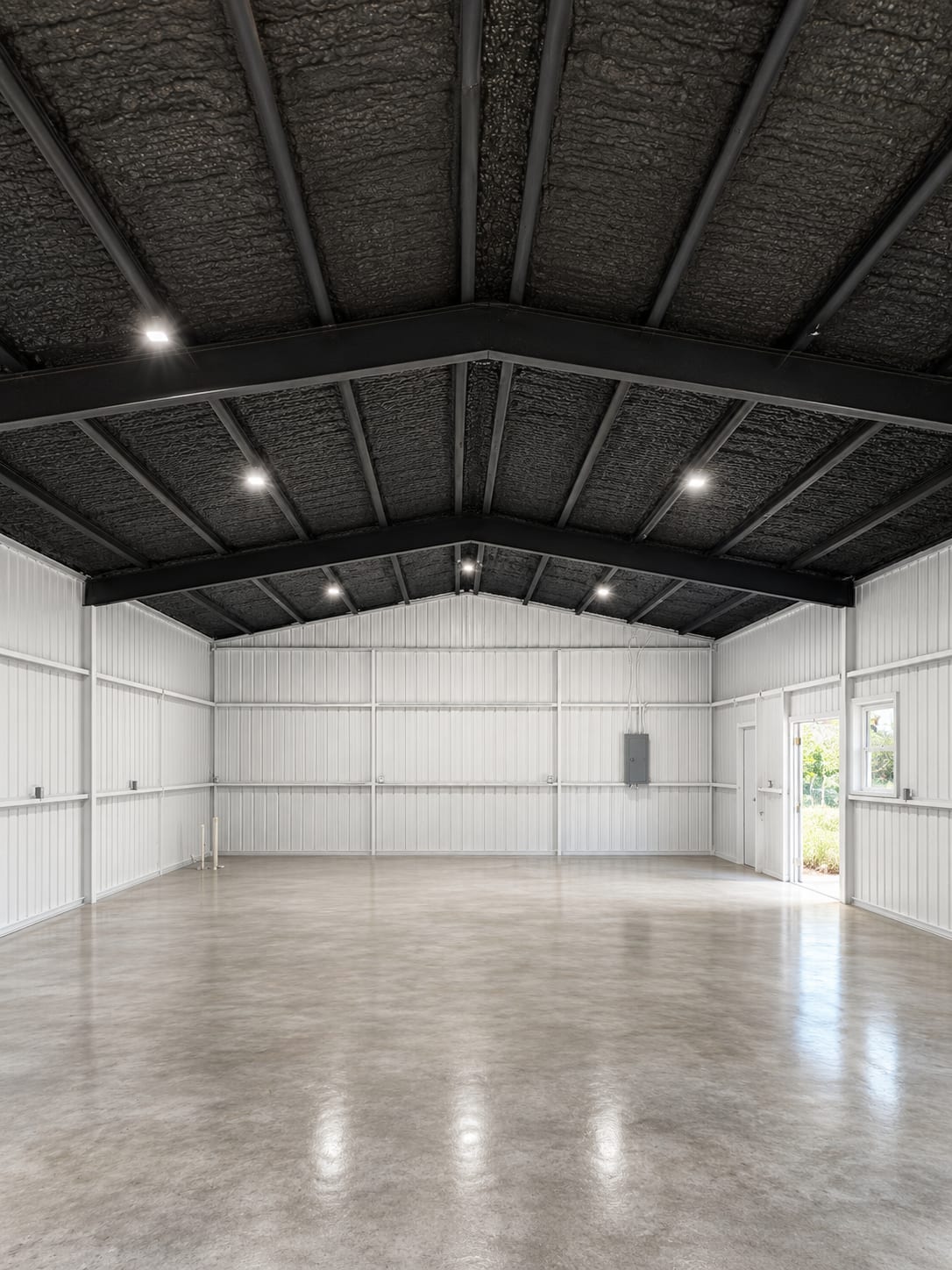
Closed-cell spray foam eliminates this cycle by bonding directly to the steel panel. The foam creates a thermal buffer that prevents the metal surface from reaching the dew point in the first place. No dew point crossover means no condensation. At two inches of thickness, closed-cell foam also achieves a vapor permeance below 1 perm, functioning as its own vapor retarder without requiring a separate membrane.
What This Means for Oklahoma Livestock Operations
Oklahoma is a cattle state. The USDA reports that Oklahoma had 4.6 million cattle (including calves) as of January 2025, with 1.95 million beef cows across 70,000 farm operations. The state generated $9.8 billion in agricultural cash receipts in 2022, with cattle and calves as the highest-valued commodity. Livestock is the economic backbone of rural Oklahoma, and heat stress is one of the biggest threats to that industry.
OSU Extension beef nutrition specialist Paul Beck puts it directly: in hot summer conditions, heat transfer failures cause accumulation of body heat resulting in heat stress, reduced performance, animal discomfort or death. He also notes that metal shades can actually gather heat and radiate it onto the animal, making the problem worse rather than better if the metal is not insulated.
OSU Extension livestock specialist Earl Ward adds that Oklahoma's humidity intensifies the problem because it makes body heat dissipation more difficult for cattle, whose primary cooling mechanism is panting and evapotranspiration.
The economic stakes are significant. A peer-reviewed study published in the Journal of Dairy Science using USDA and industry data estimated that heat stress costs U.S. livestock industries $2.4 billion annually without heat abatement measures, with $369 million attributed to beef cattle alone. Oklahoma was specifically identified among the states with the highest losses.
For operations that house cattle in metal barns or use metal structures for calving, insulating those buildings is not just about comfort or energy savings. It is about animal welfare, reproductive performance, and the economic viability of the operation.
How Insulation Strategy Differs by Building Use
Not every metal building needs the same approach. The right insulation depends on how the building is used, whether it is climate-controlled, and what it stores or shelters.
Fully conditioned shops, offices, and living spaces need the highest level of insulation and air sealing. These buildings run HVAC systems and need to hold temperature the way a house does. Closed-cell spray foam on the roof deck and walls, typically 2 to 3 inches for walls and 3 to 4 inches on the roof, provides both the thermal resistance and the vapor control needed to prevent condensation while keeping energy costs manageable. The DOE notes that closed-cell polyurethane foam is dense and forms its own vapor retarder, making it well suited for this application.
Livestock barns and calving facilities present a different challenge. Many of these buildings are not fully climate-controlled but still need temperature moderation, condensation prevention, and humidity management. Even 1.5 to 2 inches of closed-cell foam on the roof panels can prevent condensation drip, reduce radiant heat load on animals below, and moderate interior temperatures enough to reduce heat stress during Oklahoma's summer months. Ventilation remains critical in livestock buildings, so insulation needs to work alongside airflow, not replace it.
Equipment storage and general-use pole barns that are not climate-controlled still benefit from condensation control. Uninsulated metal roofs sweat on cool mornings, dripping water onto tractors, hay, feed, and tools. A thin application of closed-cell foam (1 to 1.5 inches) on the underside of the roof panels stops condensation without turning the building into a sealed box. This is often the most cost-effective application for producers who do not need full climate control but want to protect what is stored inside.
Commercial and industrial metal buildings (warehouses, manufacturing, retail) typically need to meet energy code requirements. ASHRAE 90.1 and the IECC set prescriptive R-values for metal building assemblies that account for thermal bridging, and meeting those requirements with cavity insulation alone is nearly impossible in steel framing. Continuous insulation, whether spray foam or rigid board, is effectively required to comply. For commercial projects, our guide to Commercial Spray Foam Insulation in Oklahoma covers the 179D tax deduction and energy code compliance in detail.
Why Spray Foam Works Where Other Products Struggle
Several insulation products are used in metal buildings. Each has trade-offs, and being honest about them helps you make a better decision.
Fiberglass blanket systems (the most common insulation in pre-engineered metal buildings) are affordable and widely available. Their weakness is thermal bridging: they sit between the steel framing, not over it, so every purlin and girt conducts heat around the insulation. They also do not seal air leaks, and they rely on a separate vapor retarder that must be installed perfectly to prevent moisture from reaching the steel.
Rigid board insulation provides continuous coverage and can be installed over the framing to reduce thermal bridging. It works well on walls but is more difficult to install on complex roof geometries, around penetrations, and at transitions. It also does not adhere to the metal, so air can move behind it if it is not sealed at every edge.
Closed-cell spray foam bonds directly to the steel. It conforms to irregular surfaces, seals around penetrations, and eliminates the air gap between insulation and metal that allows condensation to form. It provides the highest R-value per inch (approximately R-7 per inch per Johns Manville), acts as its own vapor retarder, and adds racking strength to the panel assembly. For Oklahoma's combination of heat, humidity, and temperature swings, the single-application approach of spray foam addresses the three biggest problems in metal buildings (thermal bridging, condensation, and air leakage) at once.
Fire Barrier Requirements
Building codes require spray foam to be separated from occupied spaces by a fire-protective barrier. In metal buildings that are regularly occupied, a thermal barrier (1/2-inch drywall or an approved intumescent coating) is required. In buildings accessed only for storage or utilities, an ignition barrier may be permitted. Intumescent coatings applied over the cured foam provide a code-compliant alternative where drywall is impractical. For a detailed breakdown, see our guide: Fire-Retardant Coatings for Spray Foam Insulation.
Ready to Insulate Your Metal Building or Pole Barn?
At Rocking Rad Spray Foam LLC, we insulate metal buildings, pole barns, agricultural facilities, and commercial steel structures across Oklahoma. We assess your building's use, your condensation issues, and your budget before recommending a specific foam type and thickness. We offer free on-site estimates and 0% financing. Contact us or fill out our online form to schedule yours.
Frequently Asked Questions
Will spray foam cause oil canning or warping on my metal panels?
When applied correctly using proper thickness-per-pass limits and the recommended application technique, spray foam does not cause panel distortion. Thinner-gauge panels (29 gauge and below) require more care during application. A qualified installer will know the maximum lift thickness for your panel type and adjust accordingly.
Can I spray foam over existing fiberglass in my metal building?
It depends on the condition of the existing insulation. If the fiberglass is dry, intact, and not trapping moisture against the steel, spray foam can sometimes be applied over it. If the fiberglass is wet, compressed, or has mold, it should be removed first. A visual inspection during the estimate determines the right approach.
How thick does closed-cell foam need to be for condensation control?
In most Oklahoma applications, 1.5 to 2 inches of closed-cell foam on the roof panels is enough to prevent the metal surface from reaching the dew point under normal conditions. For fully conditioned buildings, 2 to 3 inches on walls and 3 to 4 inches on the roof provides both condensation control and meaningful energy performance.
Does insulating a pole barn make sense if I do not heat or cool it?
Yes, if you are storing equipment, hay, feed, or livestock. Even without climate control, condensation drip from uninsulated metal roofs damages what is stored below. A thin layer of closed-cell foam on the roof panels stops condensation without requiring a full insulation system. It is one of the most cost-effective single upgrades for a working pole barn.
Are there financial assistance programs for agricultural building insulation in Oklahoma?
There is currently no federal tax credit for agricultural building insulation. However, some USDA programs (such as EQIP through NRCS) may provide cost-share assistance for agricultural building improvements that address energy efficiency or animal welfare. The Oklahoma Department of Commerce Weatherization Assistance Program serves qualifying households. Check with your local NRCS office for current eligibility.
How long does a spray foam installation take on a metal building?
Most pole barns and metal shops (up to about 3,000 square feet) can be sprayed in a single day. Larger commercial or agricultural buildings may take two to three days depending on square footage, thickness, and access. The foam cures within 24 hours and the building can return to normal use the following day.