Crawl Space Encapsulation in Oklahoma: More Than a Vapor Barrier
TL;DR
Oklahoma's humid spring climate drives warm, moist air into cool crawl spaces where it condenses on framing, pipes, and insulation. A standard 6-mil vapor barrier on the ground slows soil moisture but does nothing to stop humid air from entering through vents and foundation gaps. Crawl space encapsulation with closed-cell spray foam on the walls and rim joists seals the space from outdoor air, creates a vapor retarder, and insulates the foundation in a single application. The result is a dry, controlled environment that eliminates musty odors, stops mold growth on floor joists, and reduces the moisture load your HVAC system fights every spring and summer.
Why Oklahoma Springs Are So Hard on Crawl Spaces
Oklahoma sits in a humid subtropical climate zone where spring brings extreme moisture swings. A 35-degree morning followed by a 78-degree afternoon in the same day is routine in March and April. That temperature whiplash causes warm, humid outdoor air to flow into cooler crawl spaces, where it condenses on floor joists, subfloor sheathing, pipes, and ductwork.
According to the U.S. Environmental Protection Agency, mold begins growing on building materials when relative humidity stays above 60 percent for extended periods. In a vented crawl space in central Oklahoma during April and May, that threshold gets crossed regularly. This is not a rare event. It is the seasonal norm.
The damage accumulates quietly. Floor joists develop surface mold within a few years of construction. Fiberglass batt insulation stapled between joists absorbs moisture, sags, and falls. Metal ductwork running through the space corrodes. And the musty smell that rises through the floor system into your living space is not just unpleasant. It is air from a moisture-compromised environment entering the rooms where your family breathes.
What a Vapor Barrier Actually Does (and Does Not Do)
A traditional vapor barrier is a sheet of polyethylene plastic, usually 6-mil thickness, laid across the crawl space floor and sometimes run partway up the foundation walls. Its job is to slow moisture from rising up through the soil. That part works reasonably well when the barrier is intact and properly overlapped at the seams.
The problem is what it does not do. A ground-level vapor barrier does not seal the crawl space walls. It does not stop humid outdoor air from entering through foundation vents. It does not insulate the floor system or the foundation. And when it gets damaged by pest activity, shifting soil, plumber access, or HVAC service work, it loses effectiveness without anyone knowing until the symptoms reappear.
In a climate like Oklahoma's, where outdoor dew points in May routinely climb into the low 60s, a vapor barrier alone is partial protection in a high-moisture environment. It addresses soil moisture but leaves airborne moisture completely uncontrolled. That airborne moisture is what condenses on your floor joists and ductwork, and it is the primary driver of mold, rot, and humidity problems in Oklahoma crawl spaces.
How Crawl Space Encapsulation Works
Encapsulation converts a vented, uncontrolled crawl space into a sealed buffer zone that follows the home's thermal and moisture envelope. Instead of trying to ventilate moisture out (which actually brings more moisture in during humid months), encapsulation stops the moisture from entering in the first place.
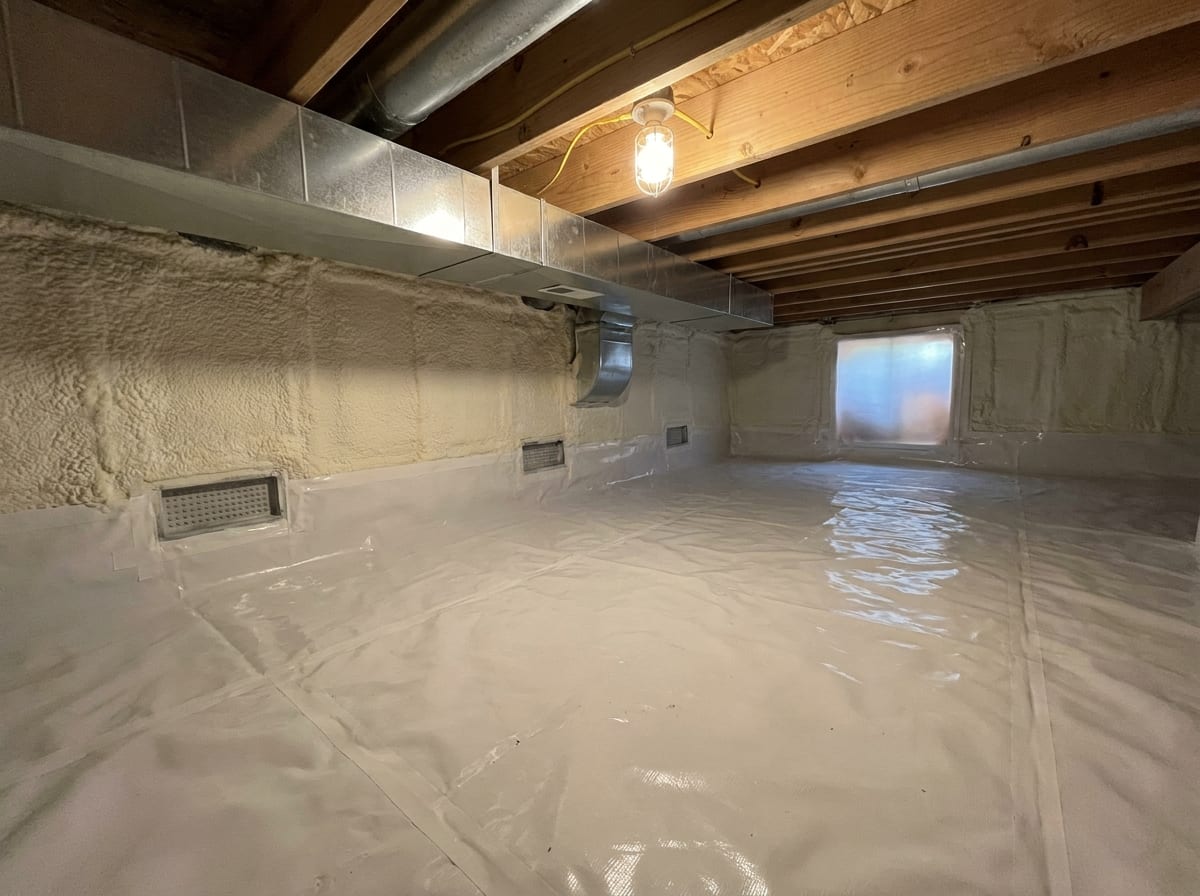
A properly encapsulated crawl space typically includes several components working together:
A heavy-duty vapor barrier (12 to 20-mil reinforced polyethylene) covers the entire floor and is sealed at seams, piers, and the base of the walls. This handles soil moisture.
Closed-cell spray foam applied to the foundation walls and rim joists handles everything the vapor barrier cannot. The foam adheres directly to block, poured concrete, or stone foundation walls, sealing every crack and gap. At the rim joist (where the floor framing meets the foundation), it fills the irregular cavities around sill plates, band boards, and mudsills that are some of the leakiest spots in any home.
Closed-cell foam at 2 to 3 inches achieves a vapor permeance below 1 perm, which qualifies it as a Class II vapor retarder under building code. That means it acts as insulation, air barrier, and vapor retarder simultaneously. Three inches on crawl space walls delivers R-18 to R-21 in a space most builders leave completely uninsulated.
Foundation vents are sealed or closed. In a properly encapsulated crawl space, the old vented approach is replaced with a sealed assembly. Conditioned air from the home (or a small dehumidifier or supply duct) manages the remaining moisture load inside the sealed space.
The DOE's guidance on insulation materials notes that closed-cell polyurethane foam is dense and forms its own vapor retarder, making it well suited for below-grade and moisture-prone applications where other insulation types would absorb water and lose effectiveness.
How to Know If Your Crawl Space Needs Attention
Not every crawl space is in crisis, but there are clear warning signs that the current setup is failing:
Musty odors inside the home. If you can smell the crawl space from your living room or hallway, air is moving up through the floor system carrying moisture, mold spores, and soil gases into your living space. That airflow path is the problem.
High indoor humidity in spring. If your home's relative humidity climbs above 55 percent during April and May without running a dehumidifier constantly, the crawl space is likely contributing uncontrolled moisture to the indoor environment.
Visible mold or dark staining on floor joists. This is a structural concern, not just a comfort issue. Mold on framing indicates sustained high moisture conditions. Spray foam will not fix existing rot, but it will stop new damage from occurring by eliminating the moisture source.
Cold floors in winter. An uninsulated crawl space connects your floor system directly to outside temperatures. Cold floors are the symptom. Missing insulation on the foundation walls and rim joists is the cause.
HVAC ductwork running through the crawl space. If your supply and return ducts run through an unconditioned crawl space, you are losing conditioned air to a damp, uncontrolled environment every day your system runs. Energy Star reports that 20 to 30 percent of conditioned air is typically lost through duct leaks. Encapsulating the crawl space brings those ducts inside the controlled envelope.
Sagging or fallen fiberglass insulation. Fiberglass batts stapled between floor joists are the standard builder approach for crawl space insulation. In Oklahoma's humidity, they absorb moisture, lose R-value, sag under their own weight, and eventually fall. If your crawl space insulation is hanging loose or lying on the ground, it is no longer doing its job.
A blower door test can confirm whether your crawl space is a significant source of air infiltration. The test quantifies how much outside air enters your home and, combined with a thermal camera walkthrough, reveals exactly where the leaks are.
What Encapsulation Costs and Whether It Is Worth It
Spray foam crawl space encapsulation costs more upfront than laying a 6-mil poly sheet on the ground. A standard ground vapor barrier might cost a few hundred dollars in materials. A full encapsulation with closed-cell spray foam on the walls and rim joists, a heavy-duty ground barrier, vent sealing, and any necessary drainage work on a 1,200 square foot crawl space typically runs several thousand dollars depending on wall height, access conditions, and foam thickness.
What you are buying is a permanent solution rather than a temporary one. The EPA estimates that homeowners save an average of 15% on heating and cooling costs by combining air sealing with insulation in attics, crawl spaces, and basements. In an Oklahoma home where summer cooling bills regularly exceed $200 to $400 per month, that percentage represents real, recurring savings.
A ground-only vapor barrier can degrade over time, especially in crawl spaces with regular service access, pest activity, or shifting soil. Once it is torn or displaced, moisture enters unchecked until someone discovers the damage and repairs it. Closed-cell spray foam on the walls and rim joists does not degrade, sag, absorb moisture, or lose R-value under normal conditions. It is applied once and continues performing.
For a detailed look at spray foam pricing by project type, see 5 Myths About Spray Foam Insulation Cost in Oklahoma.
Ready to Get Your Crawl Space Under Control Before Summer?
At Rocking Rad Spray Foam LLC, we encapsulate crawl spaces across Ada and central Oklahoma with closed-cell spray foam on the walls and rim joists, heavy-duty vapor barriers on the floor, and vent sealing. We pair crawl space work with blower door testing so you have documented proof of the improvement. We offer free on-site estimates and 0% financing. Contact us or fill out our online form to schedule yours.
Frequently Asked Questions
Can I just add a dehumidifier instead of encapsulating?
A dehumidifier manages symptoms but does not fix the underlying air infiltration problem. You would be running it indefinitely, paying for electricity every month, and still leaving the crawl space vulnerable to uncontrolled outdoor air. Encapsulation addresses the root cause by sealing the space from humid outdoor air. After encapsulation, a small dehumidifier may still be helpful as supplemental moisture management, but the heavy lifting is done by the sealed envelope.
Will crawl space encapsulation affect pest control treatments?
Closed-cell foam does not attract termites or rodents. However, it does cover foundation walls that pest control technicians sometimes treat directly. Coordinate with your pest control provider before encapsulation so any pre-treatments can be applied first. After encapsulation, pest control access remains available through the crawl space entry, and the sealed environment actually reduces overall pest pressure by eliminating the moisture and gap entry points that attract insects and rodents in the first place.
How thick does the spray foam need to be on crawl space walls?
For crawl space walls and rim joists in Oklahoma, 2 to 3 inches of closed-cell foam is the typical recommendation. That delivers R-12 to R-21 depending on thickness and provides the Class II vapor retarder performance needed for our climate. In new construction projects targeting specific HERS rating thresholds, additional thickness may be specified to meet energy code requirements.
Does encapsulation affect the building code status of my crawl space?
Crawl space encapsulation with closed-cell spray foam is an approved construction method under current International Residential Code standards. It is the preferred approach in newer energy-code-compliant builds. For resale, a sealed and insulated crawl space is a documented improvement that supports higher appraised value and cleaner home inspection reports.
How long does a crawl space encapsulation take?
Most residential crawl space jobs are completed in a single day. Larger homes or crawl spaces with complicated access, low clearance, or significant prep work (old insulation removal, moisture remediation) can extend into a second day. A clear timeline is provided during the on-site estimate so you can plan accordingly.
Are there financial assistance programs for crawl space insulation in Oklahoma?
There is currently no federal tax credit for residential insulation. However, the Oklahoma Department of Commerce Weatherization Assistance Program provides no-cost energy efficiency improvements to qualifying households at or below 200% of the federal poverty level. Some Oklahoma utilities also offer their own weatherization and rebate programs. Check with your provider for current options.