Spray Foam Soundproofing Oklahoma: Reducing Noise at Home
TL;DR
Open-cell spray foam insulation absorbs approximately 70% of the sound energy it encounters, with a Noise Reduction Coefficient (NRC) of around 0.7. It is most effective at mid-to-high frequency sounds like voices, TV audio, and daily household noise. A standard 2x4 wall with open-cell foam achieves a Sound Transmission Class (STC) rating of approximately 38, outperforming the same wall with fiberglass batts or no insulation. Open-cell foam also seals air gaps that allow sound to travel freely between rooms. For Oklahoma homeowners dealing with road noise, loud rooms over garages, thin walls between bedrooms, or home offices that need quiet, open-cell spray foam is one of the most effective single upgrades available. It will not make a room studio-silent, but it meaningfully reduces the everyday noise that makes a home feel loud.
How Sound Travels Through Walls (and Why Most Walls Do a Poor Job of Stopping It)
Sound moves through a wall assembly in two ways. Airborne sound (voices, music, TV, traffic) travels as pressure waves through the air. When those waves hit a wall, they vibrate the drywall, the vibration transfers through the framing, and the drywall on the other side radiates the sound into the next room. Structure-borne sound (footsteps, door slams, vibrating appliances) travels directly through solid materials.
Most residential walls are built to hold up the house, not to stop sound. A standard 2x4 wall with drywall on both sides and an empty cavity achieves an STC rating of roughly 33. That means normal speech is audible through the wall, and louder sounds (TV, music, arguments) are clearly heard. Every gap around electrical boxes, plumbing penetrations, and top and bottom plates creates a direct air path for sound to travel through without even hitting the drywall.
This is where insulation makes a difference, and where the type of insulation matters.
Why Open-Cell Spray Foam Outperforms Other Insulation for Sound
Two metrics define how a material handles sound. Sound Transmission Class (STC) measures how well a wall assembly blocks sound from passing through. It ranges from 0 to 100, with higher numbers meaning better sound blocking. Noise Reduction Coefficient (NRC) measures how well a material absorbs sound energy that hits its surface. It ranges from 0 to 1, with 0 being perfect reflection and 1 being perfect absorption.
Open-cell spray foam excels on the NRC scale because of its physical structure. It consists of millions of tiny, interconnected air pockets. When sound waves enter the material, they are forced through a complex path of open cells. The friction created by this path converts acoustic energy into a negligible amount of heat. The sound wave loses energy with every cell it passes through.
Open-cell spray foam achieves an NRC of approximately 0.7, meaning it absorbs about 70% of the sound energy it encounters. It is most effective at mid-to-high frequency sounds in the 250 to 2000 Hz range, which is exactly where human voices, television audio, barking dogs, and most everyday household noise falls.
A 2x4 stud wall insulated with open-cell spray foam achieves an STC of approximately 38, compared to 33 for the same wall with an empty cavity. That 5-point improvement represents a noticeable reduction in audible sound, roughly equivalent to the difference between clearly hearing a conversation through the wall and hearing only muffled sound.
Closed-cell spray foam is denser and performs slightly better at blocking low-frequency sounds (bass, machinery), but its rigid structure and higher cost make it less practical for interior soundproofing applications where moisture control is not a concern. For most residential sound reduction needs, open-cell is the better fit.
The Air Sealing Factor Most People Miss
Insulation materials get most of the attention in soundproofing discussions, but air sealing may matter even more. Sound travels through air gaps with almost no resistance. A 1% gap in a wall's surface area can transmit 50% of the sound that would otherwise be blocked.
Every electrical outlet box, light switch, plumbing penetration, and gap at the top and bottom plates of a wall is an air path for sound. Fiberglass batts fill the cavity but leave these air paths wide open. Sound passes through those gaps as if the insulation were not there.
Open-cell spray foam expands to fill every void in the cavity and seals around penetrations, eliminating the air paths that carry the most sound. Research from the National Institute of Standards and Technology confirms that even minor improvements in air tightness lead to measurable increases in the effective STC rating of a wall assembly. Spray foam's combined absorption and air sealing is what makes it more effective than fiberglass for sound reduction, even though fiberglass itself has reasonable NRC properties.
Where Soundproofing Matters Most in Oklahoma Homes
Not every wall in your home needs soundproofing. Targeting the highest-impact locations gives you the best return.
Walls between bedrooms are one of the most common requests, especially in homes with children, teenagers, or shift workers who sleep at different hours. Open-cell foam in the shared wall reduces voice, music, and TV transmission noticeably.
Home offices have become a priority since remote work became permanent for many Oklahoma families. A home office that shares a wall with a living room, kitchen, or kids' playroom benefits significantly from open-cell foam in that partition wall. Video calls become clearer on both ends when background noise from the rest of the house is dampened.
Rooms over garages deal with both temperature and noise problems. Garage door openers, car engines starting, and tools create noise that transmits directly through an uninsulated floor/ceiling assembly into the room above. Open-cell foam in the ceiling joists above the garage addresses both the thermal problem (which our garage insulation blog covers in detail) and the noise problem simultaneously.
Exterior walls facing busy roads are increasingly important as Oklahoma's suburban communities grow and traffic volumes increase. Open-cell foam in exterior wall cavities reduces road noise, especially the mid-frequency tire and engine sounds that are most intrusive. It will not eliminate heavy truck rumble (that is low-frequency and requires mass to block), but it meaningfully reduces the general traffic hum that makes homes near busy streets feel loud.
Bathroom walls shared with bedrooms or living spaces benefit from sound dampening for obvious privacy reasons. This is a small, inexpensive application that makes a disproportionate difference in perceived quality of life.
Media rooms and entertainment spaces benefit from open-cell foam in the surrounding walls and ceiling, though serious home theater soundproofing typically requires additional measures beyond spray foam alone (more on that below).
What Spray Foam Will Not Do (Being Honest About Limitations)
Open-cell spray foam is an excellent sound absorption and air sealing material. It is not a complete soundproofing solution on its own, and being honest about that helps you set realistic expectations.
Low-frequency sounds (bass, subwoofers, heavy machinery, truck rumble) are not effectively blocked by spray foam alone. Low-frequency sound waves are long and powerful, and stopping them requires mass (heavy, dense materials like multiple layers of drywall or mass-loaded vinyl). Spray foam lacks the density to block bass.
Structure-borne sound (footsteps on the floor above, door slams, vibrating washing machines) travels through solid framing members. Spray foam in the cavity does not interrupt that path. Addressing structure-borne sound requires decoupling (separating the drywall from the framing using resilient channel, staggered studs, or double-wall construction) so vibrations cannot transfer directly.
Professional-grade soundproofing for recording studios, music practice rooms, or dedicated home theaters requires a multi-layered approach: mass (double drywall with damping compound between layers), absorption (open-cell foam or mineral wool in the cavity), decoupling (resilient channel or staggered studs), and air sealing (spray foam excels here). Spray foam is one component of that system, not a substitute for the full assembly.
For everyday residential noise reduction (voices, TV, traffic, household sounds), open-cell spray foam delivers a significant, noticeable improvement. For extreme soundproofing needs, it is an important piece of a larger solution.
How Spray Foam Compares to Other Soundproofing Insulation
Fiberglass batts have reasonable NRC ratings (0.5 to 0.7 depending on density and thickness) but they do not seal air gaps. Sound passes through every penetration and gap the batts leave open, which significantly reduces the real-world performance of the wall assembly.
Mineral wool (Rockwool/Roxul) has excellent NRC ratings (0.7 to 1.0) and higher density than fiberglass, making it slightly better at blocking sound. However, like fiberglass, it does not air seal. It also costs more per square foot than fiberglass batts.
Open-cell spray foam combines a strong NRC rating (approximately 0.7) with complete air sealing of the cavity. It does not match mineral wool's density advantage, but the air sealing eliminates the gaps that undermine mineral wool's performance in real installations. For most residential applications where a separate air sealing step would not otherwise be done, spray foam delivers better real-world results than any cavity insulation that relies on a perfect fit around penetrations.
Ready to Quiet Down Your Oklahoma Home?
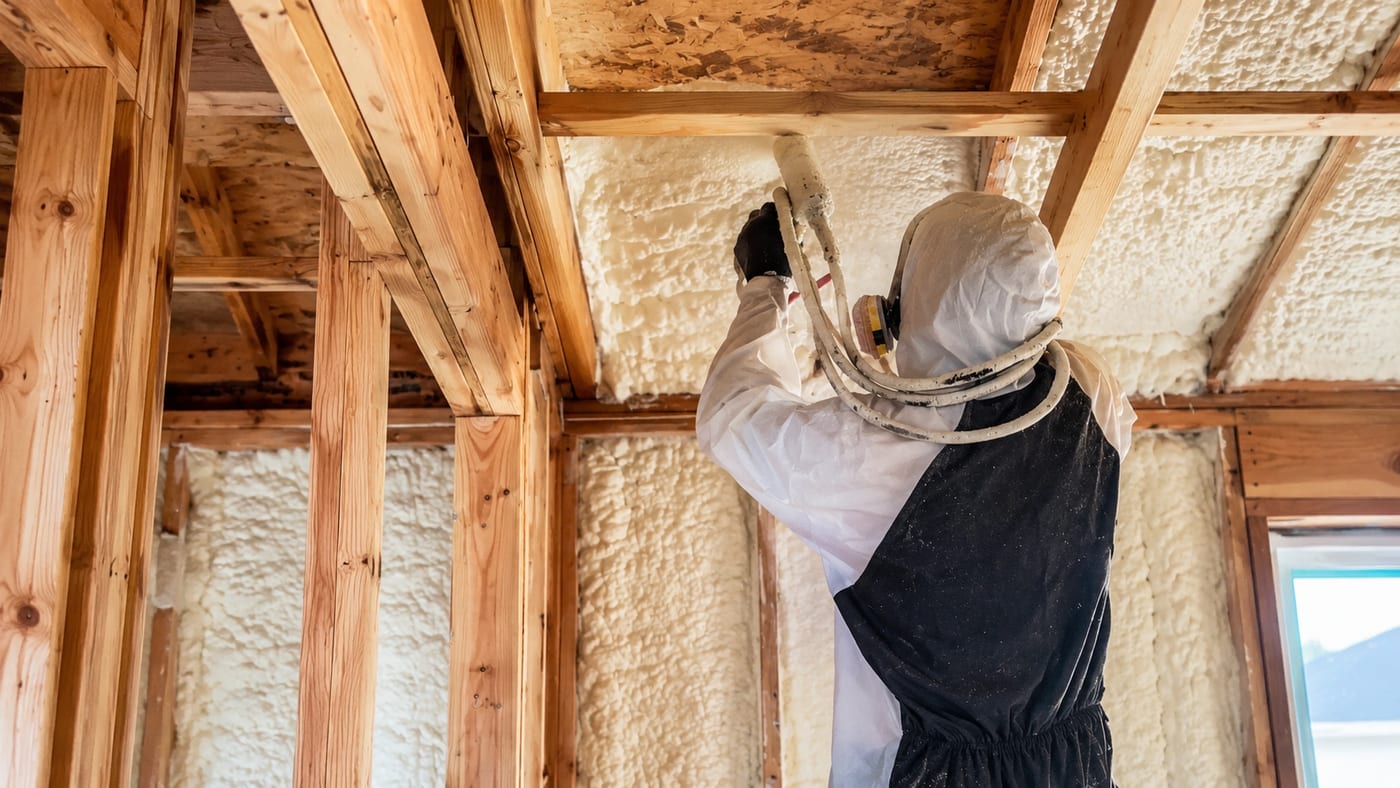
At Rocking Rad Spray Foam LLC, we install open-cell spray foam in interior walls, ceilings, and floor assemblies for sound reduction across Oklahoma. Whether it is a noisy wall between bedrooms, a home office that needs focus, or a room over a garage that hears every door opener cycle, we can help. We offer free on-site estimates and 0% financing. Contact us or fill out our online form to discuss your project.
Frequently Asked Questions
Will spray foam make my walls completely soundproof?
No insulation material alone makes a wall completely soundproof. Open-cell spray foam significantly reduces everyday noise (voices, TV, traffic) by absorbing approximately 70% of mid-to-high frequency sound energy and sealing the air gaps that carry sound between rooms. For most residential needs, the improvement is immediately noticeable. Complete soundproofing for studios or theaters requires additional measures including added drywall mass and decoupling.
Is open-cell or closed-cell better for soundproofing?
Open-cell is the better choice for most residential soundproofing applications. Its porous, flexible cell structure absorbs sound more effectively than the rigid, dense structure of closed-cell foam. Open-cell also costs less per board foot, which matters when you are insulating multiple interior walls. Closed-cell is the better choice when you need moisture control alongside sound reduction (crawl spaces, exterior walls), but for purely interior sound applications, open-cell is preferred.
Can spray foam be added to existing walls without tearing them down?
In some cases, yes. Spray foam can be injected into closed wall cavities through small holes drilled in the drywall, which are then patched. However, this approach is more common with injection foam products than with traditional spray foam, and the results are harder to verify. The most reliable approach is to apply open-cell foam in walls that are already open during renovation, new construction, or remodeling. If you are planning to open a wall for any other reason, adding foam at the same time is the most cost-effective opportunity.
How much does soundproofing with spray foam cost?
Cost depends on how many walls you are insulating and their total cavity square footage. Open-cell foam for a single shared wall between two rooms might run $300 to $800. A full-home interior soundproofing project covering multiple partition walls, a ceiling over a garage, and bathroom walls could run $2,000 to $5,000 depending on scope. A free on-site estimate gives you exact numbers for your specific layout.
Does spray foam help with rain noise on metal roofs?
Yes. Both open-cell and closed-cell foam applied to the underside of a metal roof dramatically reduce rain noise. The foam absorbs the impact vibration that makes rain on metal roofs so loud. Homeowners and metal building owners consistently report that rain noise drops from "deafening" to "background" after foam is applied. This is one of the most immediately noticeable benefits of insulating a metal building or home with a metal roof.
Will spray foam help with my neighbor's barking dog or loud music?
For airborne sounds like barking and music at moderate volumes, open-cell foam in the shared wall will reduce transmission noticeably. For loud bass or subwoofer sound, spray foam alone will not solve the problem because low-frequency sounds require mass to block. Adding a second layer of drywall with damping compound between the layers, combined with spray foam in the cavity, provides a much more effective barrier against the full range of neighbor noise.