Can You Mix Spray Foam and Fiberglass in Oklahoma?
TL;DR
Yes, you can mix spray foam with fiberglass or cellulose in the same assembly, but only if the layers are in the right locations with the right thicknesses. Building Science Corporation publishes specific guidance on hybrid assemblies, and the IRC code specifies minimum closed-cell spray foam thickness by climate zone to prevent condensation at the roof deck. Get the ratios wrong and you create a moisture trap that rots your sheathing from the inside. Get them right and you save money while hitting your R-value target. This blog covers which combinations work, which ones fail, and what the building science requires for Oklahoma's Climate Zones 3A and 4A.
The "Flash and Fill" Approach: When Hybrid Assemblies Work
The most common and well-documented hybrid insulation method is called "flash and fill." A layer of closed-cell spray foam is applied directly to the cold surface (roof sheathing, exterior wall sheathing, or rim joist), and the remaining cavity depth is filled with a less expensive insulation like fiberglass batts, blown-in fiberglass, or cellulose.
Building Science Corporation's Residential Spray Foam Guide specifically illustrates and endorses hybrid wall construction where spray polyurethane foam is used in conjunction with other cavity insulations such as fiberglass and cellulose. The DOE Building America Solution Center confirms this for roof assemblies, showing open- or closed-cell spray foam applied to the underside of the roof sheathing with additional fiberglass or cellulose blown in as a cost-saving method for meeting high insulation requirements.
The building science behind it is straightforward. The closed-cell spray foam layer does three critical jobs: it air seals the assembly (stopping uncontrolled air movement), it acts as a vapor retarder (preventing moisture from reaching the cold sheathing), and it keeps the sheathing warm enough to stay above the dew point of the interior air. The fiberglass or cellulose behind it provides additional R-value at a lower cost per inch.
This approach works because the expensive product (spray foam) handles the critical functions (air sealing, vapor control, condensation prevention) and the affordable product (fiberglass or cellulose) handles the simple function (adding thermal resistance). Each material does what it is good at.
The Thickness That Makes or Breaks the Assembly
Here is where most hybrid insulation failures originate. The closed-cell spray foam layer must be thick enough to keep the sheathing above the dew point of the interior air during the coldest part of winter. If it is too thin, moisture condenses on the sheathing behind the foam, and the fiberglass or cellulose behind it holds that moisture in the assembly where it cannot dry.
The IRC Table R806.5 specifies minimum air-impermeable insulation (closed-cell spray foam) thickness for unvented roof assemblies by climate zone:
For Oklahoma's Climate Zone 3 (most of the state): minimum R-5 of closed-cell foam against the roof deck. That is approximately 1 inch of closed-cell spray foam.
For Oklahoma's Climate Zone 4 (northern counties): minimum R-10 of closed-cell foam against the roof deck. That is approximately 1.5 inches of closed-cell spray foam.
Below these minimums, the sheathing gets cold enough for condensation to form on its interior surface. The foam is not thick enough to keep it warm. Moisture accumulates, and because the foam on one side and the roof membrane on the other prevent drying, the sheathing stays wet. Over months and years, that moisture causes mold growth, wood rot, and eventual structural failure.
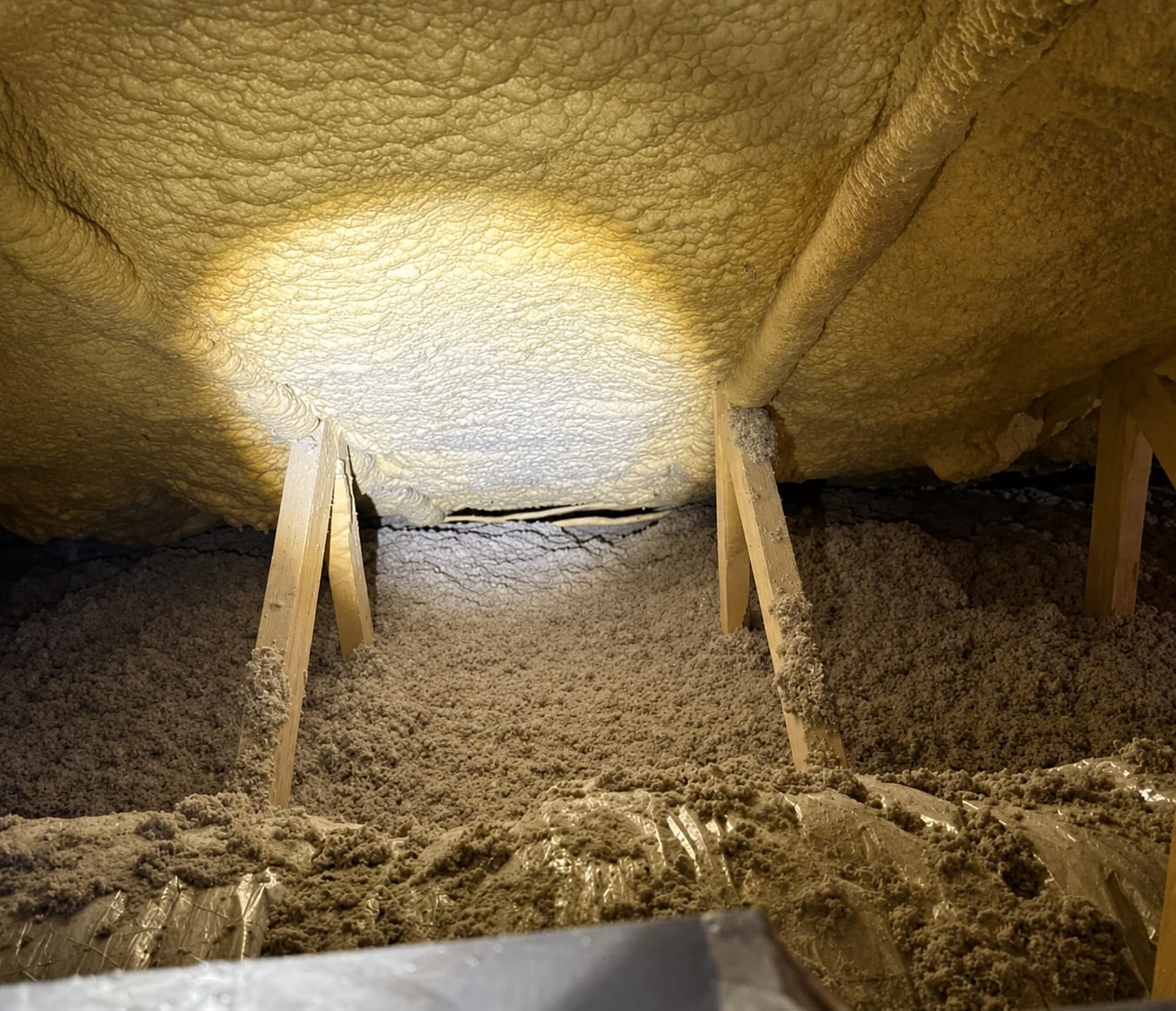
The hero image on this blog shows exactly this failure: thin spray foam on the roof deck with cellulose blown on the attic floor below, creating a moisture trap where neither layer can do its job properly.
Combinations That Work in Oklahoma
Flash and Fill Walls
Two inches of closed-cell spray foam against the exterior wall sheathing, with the remaining stud cavity filled with fiberglass batts or blown-in cellulose. Building Science Corporation's flash-and-fill wall guide confirms that this assembly provides air leakage control, vapor control, and adequate thermal resistance. The 2 inches of closed-cell foam provide R-13 plus air sealing and vapor retarder performance. The remaining 1.5 inches of a 2x4 cavity (or 3.5 inches of a 2x6 cavity) filled with fiberglass adds R-5 to R-11 more. Total assembly R-value of R-18 to R-24, well above Oklahoma's R-13 wall code minimum.
Hybrid Roof Deck (Unvented Attic)
Closed-cell spray foam at the IRC-specified minimum thickness against the roof sheathing, with open-cell foam, fiberglass, or cellulose filling the remaining rafter depth. For Oklahoma Climate Zone 3, that means at least 1 inch (R-5) of closed-cell against the sheathing, then fiberglass or open-cell to fill the rest of the rafter bay to R-38 or higher. This brings the attic inside the conditioned envelope, protects the ductwork, and costs less than filling the entire rafter depth with closed-cell foam.
Spray Foam Air Seal on Attic Floor Plus Blown-In on Top
The DOE Building America Solution Center recommends applying a layer of closed-cell spray foam to the attic floor to air seal all penetrations (top plates, recessed lights, plumbing chases, wiring holes), then installing blown-in fiberglass or cellulose on top to reach the target R-value depth. The spray foam handles air sealing (which fiberglass alone cannot do). The blown-in handles R-value depth (which is cheaper per inch than spray foam). This is one of the most cost-effective upgrade strategies for existing Oklahoma homes with vented attics.
Combinations That Fail
Thin Foam on Roof Deck Plus Insulation on Attic Floor
This is what the hero image shows, and it is the most common hybrid failure in Oklahoma. A thin layer of spray foam on the roof deck (less than the IRC minimum for the climate zone) combined with blown-in insulation on the attic floor creates a double-insulated assembly with a cold zone in between. The thin foam does not keep the sheathing warm enough. Moisture from the conditioned space below migrates upward through the attic floor insulation (which is air-permeable) and condenses on the cold sheathing. The foam on the sheathing prevents outward drying, and the attic floor insulation prevents inward drying. The moisture has nowhere to go.
Insulating Both the Roof Deck AND the Attic Floor
If you insulate the roof deck with spray foam to bring the attic inside the conditioned envelope, you should NOT also insulate the attic floor. The attic floor insulation is designed to separate conditioned space below from unconditioned space above. If the attic is now conditioned (because the roof deck is insulated), insulating the floor creates a double thermal boundary with a trapped air space between them. This trapped space can accumulate moisture and create condensation problems.
Pick one thermal boundary or the other. Either insulate the attic floor and leave the attic unconditioned (vented), or insulate the roof deck and bring the attic into the conditioned envelope (unvented). Not both.
Adding Blown-In Over Existing Fiberglass Without Air Sealing
This is not a spray foam combination, but it is the most common insulation mistake in Oklahoma attics. Adding 6 inches of blown-in cellulose on top of existing fiberglass batts increases the total depth but does nothing to address the air leaks beneath both layers. The penetrations in the ceiling (recessed lights, plumbing, wiring, top plates) still leak conditioned air into the attic. The new insulation sits on top of the old, and air bypasses both layers through the same unsealed gaps.
The fix: air-seal the attic floor penetrations with spray foam before adding any additional insulation on top. The spray foam handles the air leaks. The blown-in handles the R-value. In that order.
Why Oklahoma's Climate Zone Matters for Hybrid Assemblies
Oklahoma straddles Climate Zones 3A and 4A. Zone 3A covers most of the state (Ada, OKC, Tulsa, and south). Zone 4A covers the northern counties.
The IRC's minimum spray foam thickness requirements are lower for Zone 3 than Zone 4 because the winters are milder and the sheathing does not get as cold. This makes hybrid assemblies in Zone 3 more forgiving: even 1 inch of closed-cell (R-5) meets the condensation control threshold. In Zone 4, you need R-10 (about 1.5 inches), which is still modest compared to northern states that require R-20 or more.
Oklahoma's summer humidity adds a second consideration. During cooling season, vapor drive reverses: hot, humid outdoor air pushes moisture inward through the roof assembly. Closed-cell spray foam's low vapor permeance resists this inward drive as well, protecting the assembly in both directions. Open-cell foam on the roof deck in Oklahoma allows some inward vapor movement, which is generally acceptable in Zone 3 but should be paired with a vapor retarder paint on the interior ceiling for added protection.
How to Know If Your Existing Hybrid Assembly Is Working
If your attic has a combination of insulation types and you are not sure whether it was done correctly, here is what to check:
Look at the roof sheathing from inside the attic. If you can see the underside of the sheathing and it has dark staining, mold spots, or feels damp, the assembly is not controlling condensation. This means either the spray foam layer is too thin, the wrong type was used, or the assembly design is trapping moisture.
Check for moisture on the attic floor insulation. If the blown-in or batt insulation on the attic floor feels damp, clumped, or smells musty, moisture is accumulating in the assembly.
Check whether both the roof deck AND the attic floor are insulated. If both surfaces are insulated, moisture may be trapped in the attic space between them. This is a design error that needs correction.
A blower door test combined with a moisture meter reading on the roof sheathing gives you the data to determine whether the assembly is performing or failing.
Ready to Get Your Insulation Assembly Right?
At Rocking Rad Spray Foam LLC, we design and install hybrid insulation assemblies that meet IRC requirements and Building Science Corporation best practices. We know the minimum foam thicknesses for Oklahoma's climate zones, we match the right foam type to each surface, and we verify performance with blower door testing. If you have an existing assembly that may be trapping moisture, we can assess it and recommend the right fix. Free on-site estimates and 0% financing available. Contact us or fill out our online form to schedule yours.
Frequently Asked Questions
Can I spray closed-cell foam over existing fiberglass batts?
It is not recommended. Spray foam needs to bond directly to a solid substrate (sheathing, framing, masonry) to function as an air and vapor barrier. Spraying over fiberglass creates an inconsistent bond, traps the fiberglass beneath the foam where it cannot be inspected, and may hold moisture against the substrate. Remove the fiberglass first, then spray the foam directly onto the surface.
Is "flash and fill" cheaper than full spray foam?
Yes, typically 30 to 40% less for the same assembly R-value. The closed-cell foam handles the expensive, critical functions (air seal, vapor control, condensation prevention) in 2 inches, and the fiberglass or cellulose fills the rest of the cavity at a fraction of the cost per inch. This is why Building Science Corporation and the DOE endorse hybrid assemblies as a practical, code-compliant approach.
How do I know if my spray foam is thick enough on the roof deck?
Measure the foam depth with a probe or depth gauge at multiple points. For Oklahoma Climate Zone 3, you need at least 1 inch of closed-cell foam (R-5) against the roof sheathing. For Climate Zone 4, at least 1.5 inches (R-10). If the foam is thinner than these minimums in an unvented assembly, the sheathing may be reaching dew point and condensing moisture on its interior surface.
Can I use open-cell foam instead of closed-cell in a hybrid assembly?
For walls and roof decks in Oklahoma, the IRC allows open-cell foam for the full cavity fill in unvented assemblies, but open-cell alone does not provide vapor retarder performance. In a hybrid assembly where the spray foam layer is specifically providing condensation control, closed-cell is the safer choice because its low vapor permeance keeps moisture from reaching the cold sheathing. Open-cell can work as the fill layer behind a closed-cell flash coat.
What should I do if I think my hybrid insulation is trapping moisture?
Do not add more insulation on top. Have the assembly evaluated by a qualified contractor who can check sheathing moisture content, foam thickness, and assembly design. If moisture is present, the source must be identified and the assembly corrected before any additional work. In some cases, removing one layer (typically the attic floor insulation in a double-insulated attic) resolves the moisture path. In other cases, the foam on the roof deck needs to be thickened to meet the condensation control minimum.
Are there financial assistance programs for insulation upgrades in Oklahoma?
There is currently no federal tax credit for residential insulation. The Oklahoma Department of Commerce Weatherization Assistance Program provides no-cost energy efficiency improvements to qualifying households. Some Oklahoma utilities offer rebates for insulation work. Check with your provider for current options.