Shipping Container Insulation Oklahoma: Spray Foam Guide
TL;DR
A shipping container is a steel shell with zero insulation, extreme thermal conductivity, and no natural drying potential. Every square inch of the walls, ceiling, and floor is a thermal bridge that transfers outside temperatures directly into the interior. In Oklahoma's climate, that means interior temperatures above 130°F in summer, condensation dripping from every surface in spring and fall, and a space that is unusable without proper insulation. Closed-cell spray foam applied directly to the interior steel surfaces is the most effective insulation method for containers because it conforms to the corrugated wall profile, eliminates the air gap where condensation forms, acts as its own vapor retarder, and preserves more interior space than any framed insulation system. Whether you are converting a container into an office, workshop, hunting cabin, farm storage, or small living space, getting the insulation right is what determines whether the result feels permanent or temporary.
Why Shipping Containers Are Not Like Other Buildings
A wood-framed building has studs that provide roughly R-1 per inch of thermal resistance, air cavities that slow heat transfer, and a construction method designed around insulation from the start. A shipping container has none of that.
A standard 40-foot container is 40 feet long, 8 feet wide, and 8 feet 6 inches tall on the exterior, with interior dimensions of roughly 39 feet 5 inches by 7 feet 8 inches by 7 feet 10 inches. That gives you approximately 300 square feet of floor space inside a standard container, or 320 square feet in a high-cube (which adds one foot of ceiling height). A 20-foot container provides roughly 150 square feet of interior floor space.
The walls, ceiling, and floor are corrugated steel, typically 14-gauge (about 2mm thick) Corten weathering steel. Steel conducts heat roughly 1,000 times faster than mineral fiber insulation of the same thickness. That means every panel, rib, and corner post in the container transfers exterior temperature directly into the interior with almost no resistance. The entire structure is one continuous thermal bridge.
In Oklahoma, where summer surface temperatures on exposed steel can exceed 150°F and spring mornings can drop to 35°F before climbing to 75°F by afternoon, an uninsulated container is essentially a solar oven in summer and a condensation chamber in spring and fall.
The Condensation Problem That Destroys Container Projects
Condensation is the single biggest threat to container conversions, and it is the issue that most DIY insulation approaches fail to solve.
When warm, humid interior air contacts the cold steel wall of a container, water condenses on the metal surface. This is the same dew point physics that causes condensation in metal buildings, but containers make it worse because the steel is thinner, the interior volume is smaller, and there is almost no natural ventilation.
The result of uncontrolled condensation is water dripping from the ceiling and walls, rust forming on the interior steel surface, mold growing on any organic material (wood framing, stored goods, finished surfaces), and insulation getting wet and losing R-value if the insulation type absorbs moisture.
Rigid foam boards (EPS, XPS, polyiso) cut and fit between framing inside a container leave gaps at every seam, corner, and corrugation. Those gaps allow humid air to reach the bare steel behind the insulation, and condensation forms in the space you cannot see. Over time, the steel rusts, the framing absorbs moisture, and the insulation degrades from behind.
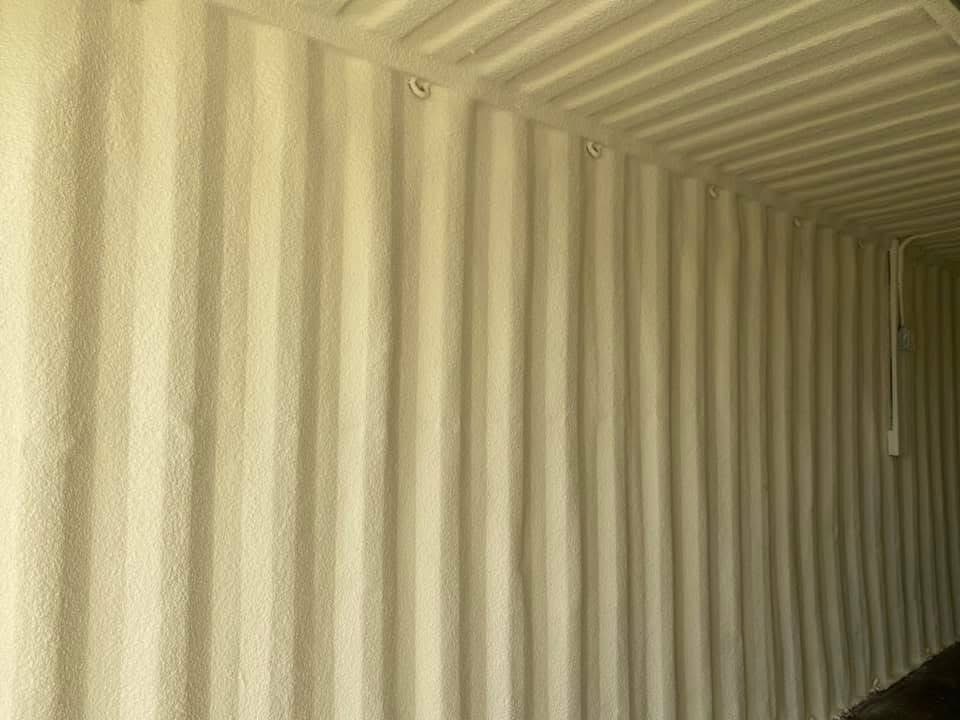
Closed-cell spray foam eliminates this problem because it bonds directly to the steel surface with no air gap. The foam conforms to every corrugation, rib, and corner, creating a continuous thermal and vapor barrier that prevents the interior air from ever contacting cold steel. No air gap means no condensation surface.
Why Closed-Cell Spray Foam Is the Right Product for Containers
Open-cell and closed-cell spray foam serve different purposes, and for container applications, closed-cell is the correct choice for every exterior-facing surface. The reasoning is the same as for metal buildings and grain bins: steel substrates require a product that insulates, air seals, and controls vapor in a single application.
Closed-cell spray foam delivers R-6 to R-7 per inch, which means 2 inches provides R-12 to R-14 and 3 inches provides R-18 to R-21. At 2 inches, it achieves a vapor permeance below 1 perm, functioning as its own vapor retarder without requiring a separate membrane. It bonds directly to steel, conforming to the corrugated profile without leaving air pockets. And it adds racking strength to the container panels, which is a practical benefit in a structure that may be transported or stacked.
Open-cell foam is not recommended for the walls, ceiling, or any surface that faces exterior steel in a container. Open-cell foam is vapor-permeable and absorbs moisture over time. In the high-humidity environment inside a sealed steel box, it would eventually allow moisture to reach the steel and begin the condensation and corrosion cycle it was supposed to prevent.
Space Matters: How Insulation Affects Your Usable Interior
In a standard container, the interior width is only 7 feet 8 inches. Every inch of insulation you add to the walls reduces that width. In a building with 20-foot-wide rooms, losing 2 inches per wall is negligible. In a container, losing 2 inches per wall drops your interior width from 92 inches to 88 inches, and if you frame a stud wall first, you may lose 3.5 to 5.5 inches per side, bringing the usable width down to 81 inches or less.
This is where closed-cell spray foam has a significant advantage over framed insulation systems. Because closed-cell foam delivers R-6 to R-7 per inch, you achieve meaningful thermal performance in just 2 to 3 inches of thickness applied directly to the steel with no framing required for the insulation itself. If you need interior finish surfaces (drywall, plywood, or paneling), furring strips attached over the cured foam provide a mounting surface while adding minimal depth.
A framed wall with fiberglass batts requires a minimum 2x4 stud (3.5 inches deep) plus the drywall, and it still leaves the steel ribs exposed to thermal bridging through the framing. Spray foam eliminates the framing requirement for the insulation layer and provides better thermal performance in less total thickness.
For ceiling height, the same principle applies. A standard container has 7 feet 10 inches of interior height. A high-cube gives you 8 feet 10 inches. After 2 to 3 inches of foam on the ceiling and any finish material, you want to preserve as much headroom as possible. Closed-cell foam's high R-value per inch keeps the ceiling buildup thin.
Common Container Conversion Uses in Oklahoma
Shipping container conversions are growing across rural and suburban Oklahoma for a range of practical applications.
Farm offices and field workshops are one of the most common uses. A 20-foot container placed near a barn or equipment yard provides a climate-controlled workspace for recordkeeping, tool storage, or break space without building a permanent structure. Closed-cell foam on the walls and ceiling makes it usable year-round with a small mini-split HVAC system.
Hunting cabins and rural retreats use containers as a durable, secure shell that can be dropped on a remote property and converted into a basic living space. Insulation, a mini-split, and basic interior finishing turn a steel box into a comfortable seasonal or weekend cabin.
Equipment and chemical storage benefits from temperature and moisture control. Containers storing electronics, lubricants, seed treatments, or other temperature-sensitive materials need insulation to prevent condensation and extreme heat cycling.
Small retail, food service, and pop-up commercial spaces are increasingly common in Oklahoma's smaller towns and event venues. A 20-foot container converted into a coffee shop, retail booth, or ticketing office needs to be comfortable for both workers and customers.
Residential conversions using single or multiple containers as the structural shell for a home. These projects require full insulation, mechanical ventilation, and code-compliant fire barriers to meet residential building standards.
Ventilation: The Step Most Container Projects Skip
A shipping container sealed with closed-cell spray foam is extremely airtight. That is the goal for thermal performance and condensation control, but it also means the space has no natural air exchange. In a steel box with no air leakage, CO2 levels, humidity from occupants, and off-gassing from interior materials accumulate quickly.
Any occupied container conversion needs mechanical ventilation. For small single-container offices and workshops, an exhaust fan paired with a filtered intake may be sufficient. For residential or commercial conversions where people occupy the space for extended periods, an ERV (energy recovery ventilator) or HRV (heat recovery ventilator) provides controlled fresh air exchange while recovering heating or cooling energy from the exhaust stream.
This is not optional in a spray-foamed container. The same airtightness that eliminates condensation also eliminates natural ventilation. Plan for mechanical air exchange from the start, not as an afterthought after the space feels stuffy.
Fire Barrier Requirements
Building codes require spray foam to be separated from occupied spaces by a fire-protective barrier. In a container conversion intended for occupancy (office, retail, residential), a thermal barrier is required, typically 1/2-inch drywall or an approved intumescent coating over the cured foam. For storage containers not intended for regular occupancy, an ignition barrier may be sufficient depending on local code interpretation.
Your contractor and local building official should agree on which barrier level applies before the foam is sprayed. For a detailed explanation, see our guide: Fire-Retardant Coatings for Spray Foam Insulation.
Ready to Convert Your Shipping Container Into a Usable Space?
At Rocking Rad Spray Foam LLC, we insulate shipping containers for offices, workshops, storage, and residential conversions across Oklahoma. We apply closed-cell spray foam directly to the interior steel surfaces, conforming to every corrugation and sealing the condensation problem at the source. We offer free on-site estimates and 0% financing. Contact us or fill out our online form to discuss your container project.
Frequently Asked Questions
How thick does the spray foam need to be inside a shipping container?
For condensation control alone, 1.5 to 2 inches of closed-cell foam prevents the steel surface from reaching the dew point under normal Oklahoma conditions. For meaningful thermal performance in an occupied or climate-controlled container, 2 to 3 inches (R-12 to R-21) is the typical recommendation. The right thickness depends on how the container will be used and whether it will be heated and cooled.
Can I insulate a container with rigid foam boards instead of spray foam?
You can, but rigid boards leave gaps at seams, corrugation valleys, and corners where humid air reaches bare steel and condenses. Spray foam conforms to the corrugated profile and eliminates the air gap entirely. If you use rigid boards, every seam and edge must be sealed with canned foam or tape, and even then, the corrugation profile makes a perfect seal extremely difficult to achieve.
Does the floor of a shipping container need insulation?
If the container sits directly on concrete or soil and will be climate-controlled, yes. The steel floor frame conducts ground temperature directly into the interior. Rigid foam board or spray foam applied to the underside or over the top of the existing plywood floor provides a thermal break. If the container is elevated on piers or blocks, insulating the underside is also recommended to prevent heat loss downward.
Do I need a building permit for a container conversion in Oklahoma?
It depends on the use and the jurisdiction. Storage containers placed on private property may not require a permit in some rural Oklahoma counties. Any container converted for occupancy (office, retail, residential) will typically require a building permit, inspections, and compliance with local building codes including fire barrier and ventilation requirements. Check with your local building department before starting the project.
How long does it take to spray foam a shipping container?
A single 20-foot container typically takes half a day. A 40-foot container takes most of a full day. Multi-container projects or projects requiring extensive surface preparation (rust treatment, cleaning) may take longer. The foam cures within 24 hours, after which interior finishing work can begin.
Are there financial assistance programs for container insulation?
There is currently no federal tax credit for container insulation. However, if the container is used as part of a farm operation, USDA programs such as EQIP through NRCS may provide cost-share assistance for energy efficiency improvements. The Oklahoma Department of Commerce Weatherization Assistance Program serves qualifying households. Check with your local NRCS office and utility provider for current options.