Best Insulation for Oklahoma Homes: Every Type Compared
TL;DR
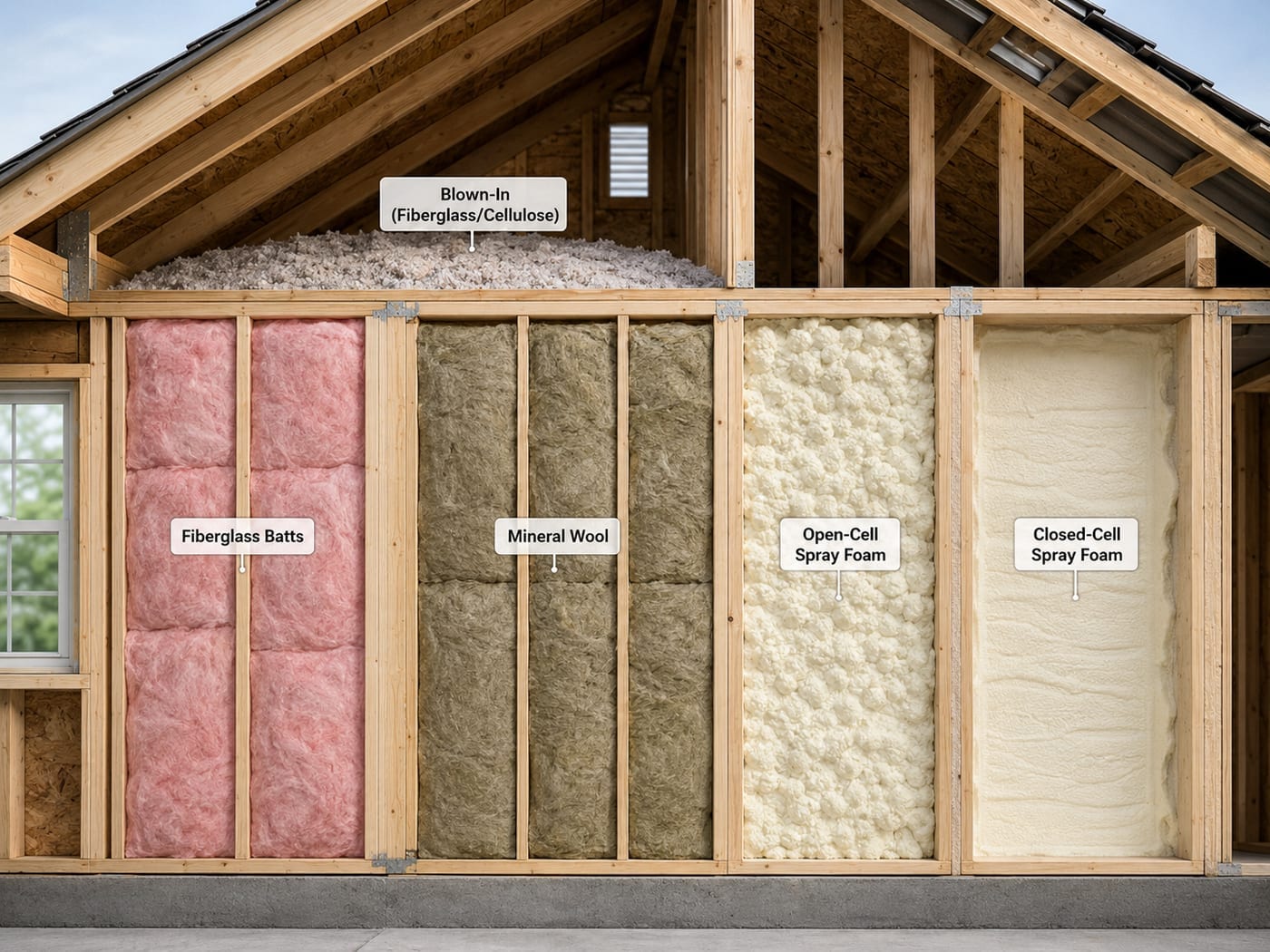
There is no single best insulation for every location in every home at every budget. Fiberglass batts are the cheapest option and work adequately in wall cavities when installed well. Blown-in fiberglass and cellulose cover attic floors cost-effectively. Mineral wool offers fire resistance and sound control at a premium. Open-cell spray foam adds air sealing that no batt or blown-in product can match. Closed-cell spray foam delivers the highest R-value per inch plus vapor control and structural strength in locations where moisture demands it. The right answer for your Oklahoma home is usually a combination: the highest-performing product where it matters most, and the most cost-effective product where it does not. This guide covers every type honestly, including what each one cannot do, so you can match the product to the job and the budget.
Side-by-Side Comparison
Feature | Fiberglass Batts | Blown-In (Fiberglass/Cellulose) | Mineral Wool | Open-Cell Spray Foam | Closed-Cell Spray Foam |
|---|---|---|---|---|---|
R-value per inch | R-3.0 to R-3.8 | R-2.2 to R-3.8 | R-3.0 to R-4.2 | R-3.7 | R-6.5 to R-7.0 |
Installed cost per sq ft | $0.30 to $1.50 | $0.40 to $1.00 | $0.80 to $2.10 | $1.00 to $3.50 | $1.75 to $4.50 |
Air sealing | No | No | No | Yes | Yes |
Vapor retarder | No (faced batts only) | No | No | No | Yes (at 2 inches) |
Moisture resistance | Low (absorbs water) | Low (absorbs water) | High (hydrophobic) | Low (vapor-permeable) | High (less than 2% absorption) |
Sound dampening | Moderate | Moderate | Excellent | Excellent (NRC 0.7) | Good |
Fire resistance | Non-combustible (melts at 1,300°F) | Non-combustible | Non-combustible (2,150°F) | Combustible (requires fire barrier) | Combustible (requires fire barrier) |
Structural contribution | None | None | None | None | Yes (300% racking strength) |
Settles over time | Sags in wall cavities | Cellulose settles 20% | No | No | No |
Installation | DIY possible | Professional recommended | DIY possible | Professional required | Professional required |
FEMA flood resistant | No | No | No | No | Yes |
Best for | Budget wall cavities | Attic floors | Fire-rated and sound walls | Attics, ceilings, interior walls | Crawl spaces, metal buildings, exterior walls |
How to Read This Comparison
Every insulation type has a marketing story that emphasizes its strengths and ignores its weaknesses. This guide does not do that. For each product below, you will see where it works best, where it should not be used, and the honest limitation that the manufacturer brochure will not tell you. The goal is not to rank them from best to worst. It is to show you which product belongs where so you stop paying for performance you do not need in locations where a cheaper option works fine, and stop using cheap products in locations where they cannot do the job.
Fiberglass Batts: The Budget Standard
Where it works: Interior partition walls between rooms. Standard wall cavities in new construction where budget is the primary constraint. Locations where air sealing is handled separately (caulk, canned foam, or spray foam at penetrations) and the batt provides thermal resistance only.
Where it should not be used: Crawl spaces (absorbs moisture, sags, and falls). Metal buildings (thermal bridging makes it nearly useless). Any location where air sealing is critical and no separate air barrier exists.
The honest limitation: Fiberglass batts do not air seal. Air passes through them freely. The DOE confirmed that homes with spray foam use 22.4% less energy than homes with fiberglass, and the majority of that gap comes from the air sealing difference, not the R-value difference. Additionally, RESNET data shows that most fiberglass batt installations fall at Grade II or III quality, losing 30% or more of their rated R-value from gaps, compression, and voids around wiring and plumbing. The R-value on the package is what you get in a lab. What you get in your wall depends entirely on how well the installer fits each batt.
Bottom line: Fiberglass batts are not bad insulation. They are insulation that depends on perfect installation to deliver their rated performance, installed in a construction environment that rarely produces perfect results. If budget forces you to choose fiberglass, insist on Grade I installation quality and add air sealing at every penetration.
Blown-In Fiberglass and Cellulose: The Attic Floor Standard
Where they work: Attic floors where depth is not limited and the insulation can be piled to the required thickness. R-38 in blown-in fiberglass requires approximately 12 inches of depth. R-38 in cellulose requires approximately 10 inches. Both fill around trusses, wiring, and ductwork better than batts. Rocking Rad uses blown-in fiberglass for their attic restoration service after air sealing the attic floor penetrations.
Where they should not be used: Wall cavities in existing finished homes (without specialized dense-pack equipment and training). Crawl spaces. Metal buildings. Any location where moisture is persistent.
The honest limitation: Neither product air seals. Blown-in fiberglass and cellulose sit on top of the attic floor and slow heat transfer through the insulation layer, but air moves freely through and around both products. If the attic floor penetrations (recessed lights, wiring holes, plumbing vents, top plates) are not sealed BEFORE the insulation is blown over them, 25 to 40% of your heating and cooling energy continues leaking through those gaps regardless of how much insulation is piled on top. Cellulose also settles approximately 20% over time, meaning R-38 at installation may perform at R-30 after a few years without topping off.
Bottom line: Blown-in fiberglass and cellulose are effective and affordable for attic floors, but only when the attic floor is air sealed first. Without air sealing, you are piling insulation on top of leaks. This is why Rocking Rad's attic restoration process always includes air sealing BEFORE the blown-in fiberglass goes in.
Mineral Wool (Rockwool): The Premium Batt
Where it works: Fire-rated wall assemblies where code requires non-combustible insulation. Sound isolation walls (home theaters, music rooms, shared walls between units). Exterior continuous insulation boards applied over sheathing to reduce thermal bridging. Locations where moisture resistance matters but spray foam is not desired (mineral wool is hydrophobic and repels water rather than absorbing it).
Where it should not be used: As a replacement for spray foam in locations requiring air sealing. Like fiberglass, mineral wool batts do not stop air movement. They are denser and hold their shape better than fiberglass, but air still passes through them.
The honest limitation: Mineral wool costs 40 to 70% more than fiberglass batts and delivers only marginally higher R-value per inch (R-4.2 vs R-3.8 at the high end). Its real advantages are fire resistance (non-combustible up to 2,150°F) and sound dampening, not thermal performance. If you are not in a fire-rated assembly or a serious sound isolation application, the cost premium over fiberglass is hard to justify on thermal grounds alone. Mineral wool is also less widely available in Oklahoma than fiberglass, which can affect lead times and contractor familiarity.
Bottom line: Mineral wool is a niche product with real strengths in fire and sound applications. For most Oklahoma residential insulation projects, it is not the most cost-effective choice unless fire rating or acoustic performance is the primary requirement.
Open-Cell Spray Foam: The Air Sealing Mid-Range
Where it works: Attic roof decks (bringing the attic inside the conditioned envelope and protecting ductwork). Vaulted ceilings where rafter depth allows. Interior partition walls where sound control is the priority. Ceilings between floors. Any location where air sealing matters and moisture control does not require a vapor retarder.
Where it should not be used: Crawl spaces, metal buildings, below-grade walls, shipping containers, or any location where moisture control requires a vapor retarder. Exterior walls in Oklahoma's humid climate (where Rocking Rad recommends closed-cell for the added vapor protection).
The honest limitation: Open-cell foam does not control vapor. It is vapor-permeable, which is an advantage in assemblies that need to dry but a liability in assemblies that face persistent moisture. It costs roughly twice as much as fiberglass batts, though significantly less than closed-cell. It also requires professional installation with full PPE and 24-hour vacating, which adds logistical complexity that batts and blown-in do not have.
Bottom line: Open-cell spray foam is the sweet spot between cost and performance for attics, ceilings, and interior walls. It costs more than fiberglass but delivers the air seal that fiberglass cannot provide. For locations where moisture control is not critical, it is the most cost-effective spray foam option.
Closed-Cell Spray Foam: The Highest Performance
Where it works: Crawl spaces and rim joists. Metal buildings and pole barns. Exterior walls. Below-grade foundation walls. Shipping containers. Any location where moisture control, vapor retarder performance, or maximum R-value in limited depth is required. Flood-prone areas (FEMA-classified flood-resistant material).
Where it is overkill: Interior partition walls where sound is the only concern (open-cell is better and cheaper). Attic roof decks with deep rafter bays where open-cell can reach R-38 at lower cost. Any location where moisture control and vapor retarder performance are not needed.
The honest limitation: Closed-cell is the most expensive insulation option by a significant margin. Using it in every location throughout a home when open-cell or fiberglass would suffice in many of those locations is overspending. The hybrid approach (closed-cell where required, open-cell or fiberglass where adequate) is the most cost-effective strategy for whole-home projects.
Bottom line: Closed-cell is the right product for locations that demand it. Using it everywhere is paying a premium for performance you do not need in every location. Using the right product in each location is smarter than defaulting to the most expensive option everywhere.
Which Product for Which Location in Oklahoma
Location | Best Product | Why |
|---|---|---|
Attic roof deck (ductwork inside) | Open-cell spray foam | Air seals, fills deep rafter bays, brings ducts inside envelope at lower cost than closed-cell |
Attic floor (vented attic) | Blown-in fiberglass or cellulose | Cost-effective depth, but MUST air seal penetrations first |
Exterior walls | Closed-cell spray foam | Vapor control needed in Oklahoma humidity |
Interior partition walls (sound) | Open-cell spray foam or mineral wool | Open-cell for best sound dampening, mineral wool for fire-rated assemblies |
Crawl space walls and rim joists | Closed-cell spray foam only | Moisture and vapor control non-negotiable |
Metal buildings | Closed-cell spray foam only | Fiberglass loses 63% of R-value to thermal bridging in steel |
Vaulted ceilings (deep rafters) | Open-cell spray foam | Fills cavity to R-38+ at lower cost |
Vaulted ceilings (shallow rafters) | Closed-cell flash coat plus fiberglass fill | Condensation control at sheathing plus affordable R-value depth |
Garage shared wall and ceiling | Open-cell spray foam | Thermal and sound control, with fire-rated drywall over foam |
Shipping containers | Closed-cell spray foam only | All-metal, zero drying potential, condensation control required |
Budget-constrained walls | Fiberglass batts with separate air sealing | Cheapest thermal option when paired with caulk and canned foam at penetrations |
The Budget Strategy: Where to Start If You Cannot Do Everything
If your budget does not allow spray foam everywhere, prioritize by impact:
First: The attic. It is the biggest energy loss zone and the highest-value single upgrade. Spray foam on the roof deck delivers the largest improvement per dollar.
Second: Crawl space and rim joists. Closed-cell foam here stops moisture, air leakage, and ground-level humidity from entering the floor system.
Third: Air sealing at attic floor penetrations (if you chose blown-in for the attic instead of roof deck foam). This is the step that makes fiberglass and cellulose actually perform at their rated R-value.
Fourth: Exterior walls. This is the most expensive area to address in an existing home (requires opening the walls) and is usually saved for renovations or new construction.
The worst option is no insulation at all. Fiberglass everywhere is better than spray foam in half the house and nothing in the other half. Start where the impact is greatest and improve as budget allows.
Ready to Figure Out the Right Combination for Your Home?
At Rocking Rad Spray Foam LLC, we install both spray foam and blown-in fiberglass because different locations call for different products. We evaluate your home, identify where each product delivers the most value, and recommend a plan that fits your budget and your priorities. Free on-site estimates and 0% financing available across Oklahoma. Contact us or fill out our online form to schedule yours.
Frequently Asked Questions
Is fiberglass insulation bad?
No. Fiberglass is adequate insulation when installed well and paired with a separate air barrier. Its weakness is that it does not air seal, and most real-world installations have gaps and compression that reduce its performance. The product is not bad. The gap between lab-tested R-value and field performance is the issue.
Which insulation is the quietest?
Open-cell spray foam (NRC 0.7) provides the best sound absorption in residential wall applications. Mineral wool is a close second and excels in fire-rated sound assemblies. Fiberglass batts provide moderate sound reduction. Closed-cell spray foam is rigid and reflects more sound than it absorbs, making it the least effective for purely acoustic applications.
Can I mix different insulation types in the same home?
Yes, and it is usually the smartest approach. Closed-cell in moisture-critical locations, open-cell in attics and ceilings, fiberglass or blown-in where budget requires. The key is matching the right product to each location based on what that assembly needs, not defaulting to one product everywhere.
What is the cheapest insulation that actually works?
Blown-in fiberglass on an attic floor ($0.40 to $0.70 per square foot) is the most affordable option that delivers meaningful energy savings, but only when the attic floor penetrations are air sealed first. Without air sealing, you are insulating on top of leaks.
Does Rocking Rad install fiberglass too?
Yes. Rocking Rad installs blown-in fiberglass as part of their attic restoration service (air seal first, then blow fiberglass to R-38) and recommends it for attic floor applications where it is the right fit.
Are there financial assistance programs for insulation in Oklahoma?
There is currently no federal tax credit for residential insulation. The Oklahoma Department of Commerce Weatherization Assistance Program provides no-cost energy efficiency improvements to qualifying households. Some Oklahoma utilities offer rebates. For details, see: Oklahoma Spray Foam Rebates and Incentives.