Commercial Roof Restoration vs. Replacement in Oklahoma
TL;DR
The decision between restoring and replacing a commercial roof hinges on three primary factors: membrane or surface condition, insulation integrity, and the percentage of the roof area requiring repair. Restoration is right when the roof system is fundamentally sound. Replacement is right when damage is widespread, the deck is compromised, or the system is at end of life. Restoration coating systems install at $2.50 to $5.00 per square foot compared to tear-off and replacement at $8.00 to $16.00 per square foot. For Oklahoma commercial buildings facing 525 hail events per year and roof surface temperatures exceeding 170°F, knowing which path your roof actually needs prevents you from spending replacement money on a roof that only needs restoration, or restoration money on a roof that needs to come off.
Three Paths, Not Two
Most commercial property owners think the choice is binary: repair or replace. There is actually a third option between them that is often the highest-value decision available.
Factor | Repair | Restoration | Replacement |
|---|---|---|---|
What it addresses | Isolated damage (one leak, one section) | Surface deterioration across the whole roof | Structural failure, widespread damage, end of life |
Typical cost per sq ft | $1 to $5 (localized) | $2.50 to $5.00 (full roof) | $8.00 to $16.00 (full roof) |
Lifespan extension | Months to a few years | 10 to 20 years with warranty | 20 to 30 years (new system) |
Tear-off required | No | No | Yes (in most cases) |
Building disruption | Minimal | Minimal to moderate | Significant |
Insulation upgrade | No | Optional (SPF adds insulation) | Yes (new insulation included) |
Best timing | When damage is recent and isolated | Before the roof reaches failure | When restoration is no longer viable |
The restoration decision is strongest when it is made before the roof reaches failure. Once water has entered insulation or decking, coating may no longer be a responsible recommendation. Timing matters. A roof assessed and restored at year 12 of its life costs a fraction of what the same roof costs to replace at year 20 after years of deferred maintenance have compromised the substrate.
How to Know Which Path Your Roof Needs
The decision should be based on data from a professional roof assessment, not a visual guess from the ground. Here is what the assessment evaluates and what each finding means.
Moisture Survey (Infrared Scan)
An infrared moisture survey identifies where water has saturated the insulation beneath the roof surface. Wet insulation does not dry out on its own. It must be removed and replaced because it has lost its R-value, adds weight to the structure, and supports mold growth.
If more than 25% of the roof area has moisture-saturated insulation, the project cost for repairing those areas before coating approaches replacement cost, and the long-term value of coating diminishes. At that point, full tear-off with new insulation and membrane typically provides better total cost of ownership over the next 25 years.
If moisture is isolated to less than 25% of the roof area, those sections can be cut out and replaced while the remaining sound areas are coated. This is where restoration delivers its strongest value: you pay to fix the damaged areas and protect the areas that are still performing.
Surface Condition
The existing roof surface must be sound enough to accept and hold a coating. For metal roofs (common in Oklahoma commercial and agricultural buildings), some rust and corrosion is acceptable if the panels themselves remain structurally intact. If the existing roof system is too compromised, coating over it will not solve the underlying issue. Restoring a roof that should be replaced can waste money and create bigger problems later.
Signs the surface is a candidate for restoration: surface oxidation and weathering without panel failure, open seams that can be sealed with compatible materials, isolated fastener corrosion that can be addressed during prep, and surface coating that has worn but the substrate beneath is sound.
Signs the surface needs replacement: panels with holes, cracks, or structural rust-through, widespread fastener failure, deck deflection or sagging between supports, and previous coating that is delaminating or flaking across large areas.
Structural Deck Condition
If the roof deck shows signs of structural compromise (rust-through on metal decks, rotted wood, cracked concrete), restoration is not appropriate. A coating system relies on the existing deck to carry loads and provide a stable substrate. If the deck itself is failing, no amount of surface coating will fix the structural problem beneath it.
Number of Existing Roof Layers
Building codes limit commercial roofs to a maximum of two layers. If two layers are already present, a tear-off of at least one layer is required before any new system (including restoration coating or SPF) can be applied. If one layer exists and the deck is sound, an overlay or restoration is typically viable.
When Restoration Is the Right Call
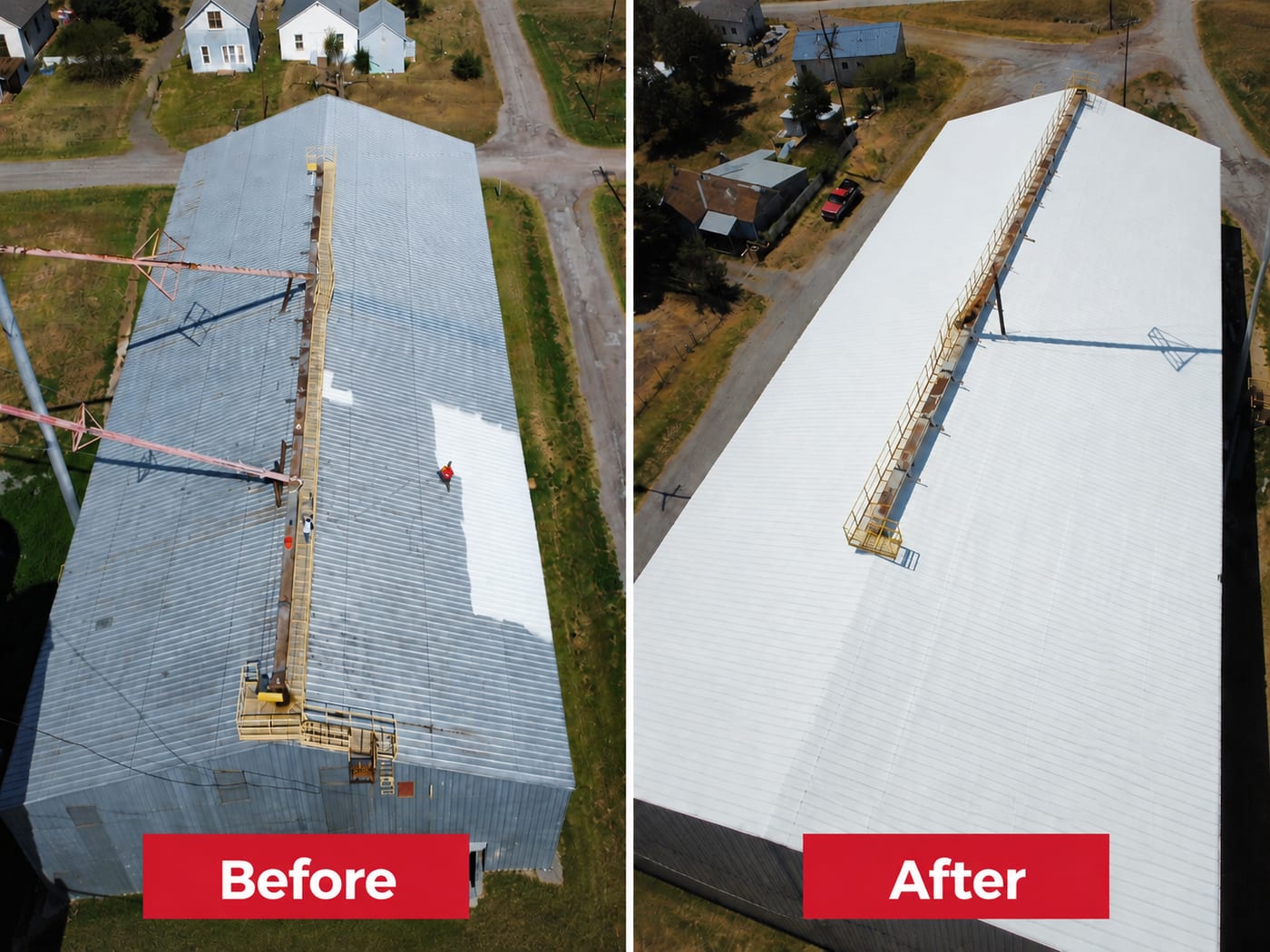
Restoration makes financial and practical sense when the roof is aging but structurally sound, the moisture survey shows less than 25% wet insulation, the surface can be cleaned and prepped to accept a coating, the building owner plans to hold the property for 10 or more years (to capture the full warranty period), the building is occupied and disruption from a tear-off would affect operations, and the budget does not support full replacement at this time but deferring maintenance further would cause greater damage.
Restoration adds 10 to 20 years to an aging but intact roof at roughly one-third of replacement cost. For a 20,000 square foot commercial building, that is the difference between a $50,000 to $100,000 restoration and a $160,000 to $320,000 replacement.
For Oklahoma commercial buildings, SPF (spray polyurethane foam) restoration adds a unique advantage that silicone and acrylic coatings alone do not: the foam layer adds insulation (R-6.5 per inch) on top of restoring the waterproof surface. A building that gets an SPF restoration gets both a new roof surface and improved energy performance in one project.
When Replacement Is Unavoidable
Replacement is usually the better choice when the roof has widespread wet insulation, structural deck damage, severe deterioration, too many existing roof layers, or repeated failures that cannot be corrected through repair and restoration.
Specifically, replacement is the right call when the moisture survey shows more than 25% of the roof area has saturated insulation, the deck is structurally compromised (sagging, rust-through, rotted), two roof layers already exist and code requires tear-off before adding a new system, previous restoration coatings have failed to adhere (indicating substrate problems that coating cannot solve), and the current system is at true end of life with no viable substrate remaining for a coating to bond to.
Replacement costs more upfront but provides a completely new roof system with new insulation, new membrane or SPF, and a full manufacturer warranty. For buildings with severely deteriorated roofs, replacement is the only responsible recommendation because coating over a failing substrate creates a false sense of security while the underlying problems continue to worsen.
Oklahoma-Specific Factors That Affect the Decision
Oklahoma's climate adds three considerations that commercial property owners in milder states do not face:
Hail frequency. Oklahoma averages 525 hail events per year. Hail damage to commercial roofs is not a question of if but when. SPF restoration systems handle hail better than most conventional roofing because damage is localized and repairable without full replacement. A puncture in an SPF roof stays localized. A puncture in a membrane system can allow water to travel laterally beneath the membrane, causing damage far from the point of impact.
Extreme heat cycling. Oklahoma roof surface temperatures exceed 170°F in summer. Reflective coating systems (white silicone, acrylic, or SPF with topcoat) reduce this dramatically. A dark roof absorbing that heat costs significantly more to cool than a reflective restored roof. The DOE reports that HVAC accounts for 43% of the average commercial utility bill. Reducing the roof's heat absorption through a reflective restoration directly reduces cooling costs.
Metal roof prevalence. Oklahoma's commercial and agricultural building stock is heavily metal-framed with metal panel roofs. For restoration to be effective on metal roofs, some rust or corrosion is acceptable, but the panels themselves must be strong and structurally intact. Metal roofs in Oklahoma that are 15 to 25 years old with surface oxidation but sound panels are prime candidates for SPF restoration. The foam bonds directly to the metal, conforms to the panel profile, and creates a seamless insulated surface without removing the existing panels.
The Assessment Process: What to Expect
A proper roof assessment before the restoration-vs-replacement decision takes two to four hours on site and includes a visual inspection of the entire roof surface (seams, flashings, penetrations, drains, parapet walls), an infrared moisture survey to map wet insulation areas, core samples to verify insulation type, thickness, and condition, adhesion testing to confirm the existing surface will accept a coating, measurement of the roof area for accurate project pricing, and a written report with findings, photos, and a recommendation.
This assessment is not a formality. It is the data that determines whether you spend $50,000 or $300,000. Any contractor who recommends restoration or replacement without performing a moisture survey is guessing with your money.
Ready to Find Out What Your Roof Actually Needs?
At Rocking Rad Spray Foam LLC, we perform full commercial roof assessments including infrared moisture surveys for Oklahoma commercial, industrial, and agricultural buildings. We recommend restoration when the roof supports it and replacement when it does not. If restoration is the right path, our SPF roofing system adds insulation on top of waterproofing, giving your building better energy performance along with a new roof surface. Free on-site assessments and 0% financing available. Contact us or fill out our online form to schedule yours.
Frequently Asked Questions
How do I know if my roof qualifies for restoration?
The only reliable way is a professional assessment with an infrared moisture survey. If the deck is structurally sound, less than 25% of the insulation is moisture-saturated, and the surface can accept a coating, restoration is likely viable. Age alone is not the deciding factor. A 20-year-old roof in sound condition can be a better restoration candidate than a 10-year-old roof with widespread leaks.
How long does a roof restoration last?
A properly applied restoration system with warranty-grade materials typically extends the roof's service life by 10 to 20 years depending on the coating type and Oklahoma's weather exposure. SPF restorations can be recoated at the end of that cycle for another 10 to 15 years, potentially extending the roof indefinitely without ever requiring a tear-off.
Can I restore a roof that has already been coated before?
Yes, if the existing coating is well-adhered and the substrate beneath it is sound. If the previous coating is peeling, bubbling, or delaminating across large areas, that indicates a substrate problem that must be addressed. Adhesion testing during the assessment confirms whether a new coating will bond to the existing surface.
Does restoration qualify for insurance claims after hail damage?
It depends on your policy and the extent of the damage. Some insurance carriers cover SPF restoration as an approved repair method for hail-damaged commercial roofs. Others require replacement. Document the damage with photos and a professional assessment report, then discuss restoration as an option with your adjuster before assuming replacement is the only covered path.
Is SPF restoration better than silicone coating alone?
SPF adds insulation (R-6.5 per inch) that silicone coating alone does not provide. If your building needs both a new roof surface and improved thermal performance, SPF delivers both in one project. If the existing insulation is adequate and only the surface needs restoration, a silicone coating over the existing substrate may be sufficient at lower cost. The assessment determines which approach fits.
Are there financial assistance programs for commercial roof work?
The Section 179D tax deduction for commercial energy improvements expired for projects beginning after June 30, 2026. Some utility rebate programs may apply to reflective roof systems that reduce cooling energy. Check with your utility provider. Standard commercial financing and Rocking Rad's 0% financing are available for qualifying projects.