Attic Restoration Oklahoma: Remove, Air Seal, Re-Insulate
TL;DR
Old, damaged, or contaminated attic insulation does not just underperform. It can be a health hazard. Rodent droppings and urine in insulation create airborne exposure risks, including hantavirus, salmonella, and leptospirosis that persist even after the rodents are gone. Moisture-damaged insulation loses R-value, supports mold growth, and traps humidity against your roof decking and framing. Adding new insulation on top of contaminated or degraded material does not solve either problem. A proper attic restoration removes the old insulation completely, sanitizes the space, air seals every penetration and gap in the attic floor, and then installs fresh insulation to the correct depth. The air sealing step is what most insulation companies skip, and it is what makes the difference between a cosmetic upgrade and a real performance improvement.
When Your Attic Insulation Becomes a Problem Instead of a Solution
Insulation is supposed to work quietly in the background for decades. In many Oklahoma homes, it does. But in homes where rodents have moved in, moisture has cycled through, or the original insulation has simply been in place for 30 or 40 years, the material in your attic may be doing more harm than good.
Rodent contamination is the most common trigger for full attic restoration in Oklahoma. Mice, rats, and squirrels nest in fiberglass and cellulose insulation, leaving behind droppings, urine, and nesting debris. The CDC warns that dried rodent droppings can become airborne when disturbed and that hantavirus, which is carried by deer mice found throughout Oklahoma, is transmitted primarily through inhaling contaminated dust. Hantavirus Pulmonary Syndrome has a mortality rate of approximately 38%. This is not a minor concern. Contaminated insulation is classified as a biohazard.
Insulation absorbs rodent urine deep into its fibers. Surface cleaning or disinfecting does not reach that contamination. Spot treatments do not work because the urine and droppings are distributed throughout the material, not just on the surface. The only reliable remediation is full removal.
Moisture damage is the second most common reason attic insulation fails. Oklahoma's humid springs and hot summers create condensation cycling in attics with poor ventilation. Fiberglass that has gotten wet loses R-value, compresses under its own weight, and can support mold growth on the paper facing and on adjacent wood framing. Cellulose insulation that absorbs moisture clumps, settles, and loses loft.
Age and settling affect even insulation that was never contaminated or wet. Blown-in fiberglass and cellulose settle over time, reducing the depth and the effective R-value. Insulation that was R-30 when installed may be performing at R-19 or lower after 25 years of settling.
Why You Cannot Just Add New Insulation on Top
This is the most important point in the entire blog, and it is where many insulation companies cut corners.
Adding new blown-in insulation on top of contaminated material traps the contamination underneath. Rodent droppings, urine, and allergens remain in your attic, continuing to affect indoor air quality as air moves through the attic floor into your living space. You have hidden the problem, not removed it.
Adding new insulation on top of moisture-damaged material traps moisture against your attic floor framing. The old material holds humidity against the wood, which continues to support mold growth and can lead to structural rot over time.
Adding new insulation on top of settled or degraded material gives you the appearance of adequate depth, but the bottom layer is still underperforming. The new material on top does its job, but the compressed layer beneath it contributes less R-value per inch than it should.
And critically, adding new insulation on top without air sealing the attic floor means the new insulation has the same air leakage problem the old insulation had. Warm, conditioned air still escapes through every unsealed recessed light, plumbing penetration, electrical box, and top plate gap into the attic. The EPA estimates that homeowners save an average of 15% on heating and cooling costs by combining air sealing with insulation. Without the air sealing step, you get the insulation but miss the largest portion of the savings.
The Three-Step Restoration Process
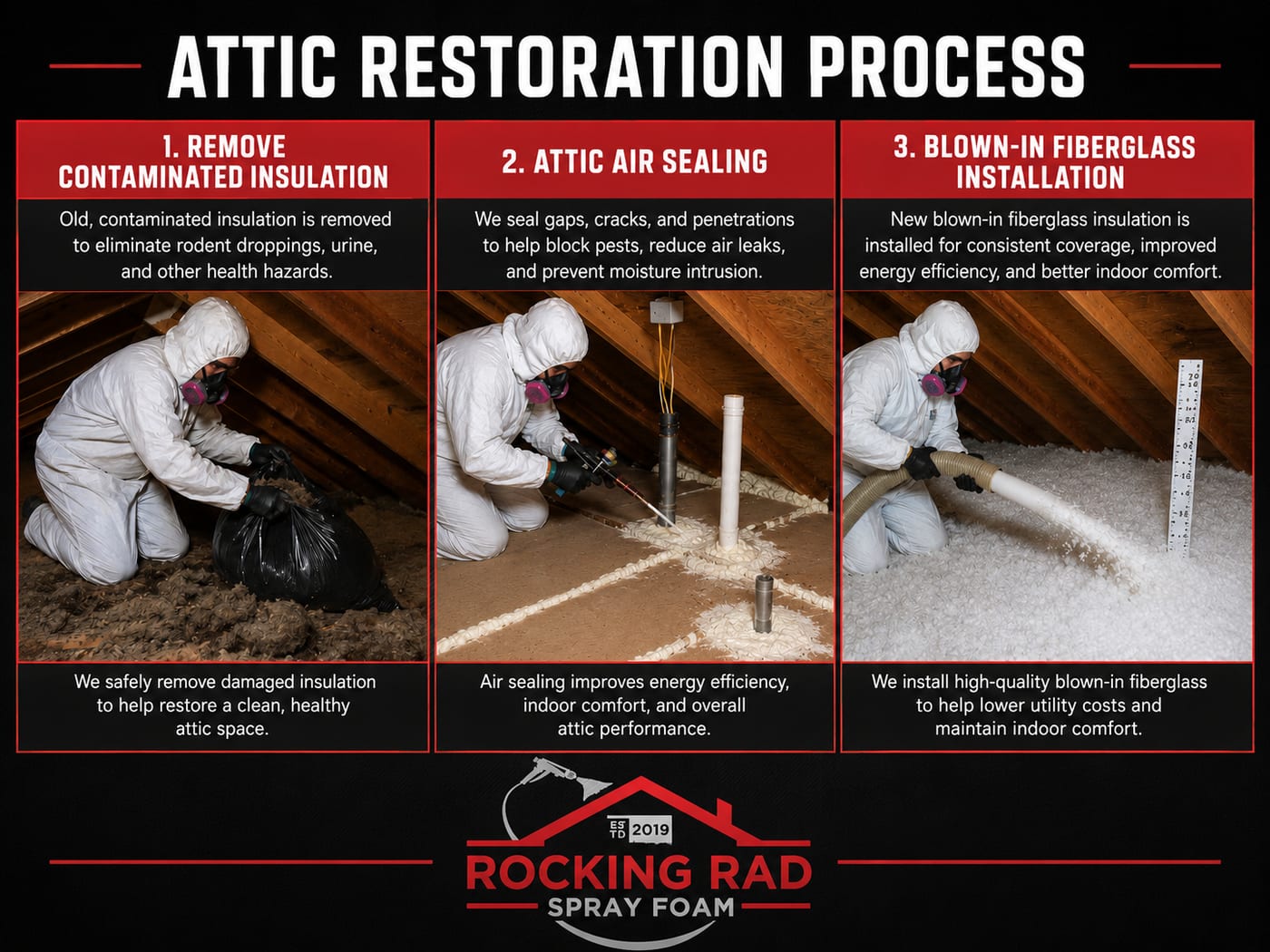
A proper attic restoration is not a one-step insulation replacement. It is a three-step process where each step serves a distinct purpose.
Step 1: Remove All Existing Insulation
Every piece of contaminated, damaged, or degraded insulation is removed from the attic using industrial vacuum equipment. This is not a job for a shop vac. Professional removal uses high-powered insulation vacuum systems that contain the material in sealed bags and prevent contaminated particles from spreading into the living space below.
For rodent-contaminated attics, removal crews wear full personal protective equipment, including respirators rated for particulate filtration. The CDC's cleanup guidelines emphasize that contaminated insulation must be wetted with disinfectant before disturbance to prevent airborne virus particles, and that the material must be bagged and disposed of properly.
After removal, the attic space is sanitized and treated. All surfaces (joists, decking, rafters, and any remaining material) are treated with professional-grade disinfectants effective against the pathogens associated with rodent contamination. This step ensures that the attic is clean and safe before any new materials go in.
Step 2: Air Seal the Attic Floor
This is the step most insulation companies skip, and it is the most important step in the entire process.
With the old insulation removed, every penetration in the attic floor is now exposed and accessible. Recessed light cans, plumbing vent pipes, electrical wiring holes, HVAC boots and registers, top plates where interior walls meet the ceiling, and the attic hatch itself are all visible and ready to be sealed.
Air sealing these penetrations with spray foam or fire-rated caulk closes the pathways that allow conditioned air to escape from your living space into the attic. This is where the energy performance improvement actually happens. Insulation slows heat transfer. Air sealing stops air movement. Without both, your HVAC system is still pushing conditioned air through gaps in the ceiling that bleed directly into unconditioned attic space.
The DOE identifies air sealing as one of the most cost-effective ways to improve comfort, reduce energy costs, and create a healthier indoor environment. When the attic floor is completely exposed after insulation removal, it is the one opportunity to seal every penetration thoroughly. Once new insulation covers those penetrations, accessing them again becomes difficult and expensive.
Step 3: Install New Insulation to the Correct Depth
With the attic clean, sanitized, and air sealed, new insulation is installed to the target R-value. For most Oklahoma homes, the target is R-38, which the Oklahoma 2015 Energy Code requires for attic assemblies in Climate Zone 3. Northern Oklahoma counties in Climate Zone 4 may require R-49.
Blown-in fiberglass is the most common product for attic floor applications in a restoration context. It fills around trusses, wiring, and ductwork evenly, conforms to irregular joist spacing, and achieves the required depth efficiently. When installed on top of a properly air-sealed attic floor, blown-in fiberglass performs at its full rated R-value because the air barrier beneath it prevents the convective air movement that degrades fiberglass performance in unsealed attics.
For homeowners who want maximum performance, spray foam applied to the underside of the roof deck is an alternative approach that brings the entire attic inside the conditioned envelope. This is a different strategy with different benefits (ductwork inside conditioned space, no ventilation required) and a higher cost. Both approaches work. The right choice depends on your attic configuration, your HVAC layout, and your budget. For a comparison of how these two approaches differ, see our guide: What Is Spray Foam Insulation?
Signs Your Attic Needs Restoration, Not Just More Insulation
Not every attic needs a full restoration. Here is how to tell whether yours does:
Rodent droppings or nesting material visible anywhere in the insulation. Even a small amount of contamination means the insulation has been exposed to urine and pathogens throughout, not just where you can see droppings.
Musty or animal odors in the attic or in the rooms below. If you smell it from inside the house, contaminated air is moving from the attic into your living space through unsealed penetrations.
Insulation that is visibly compressed, matted, or uneven. If you can see the tops of the ceiling joists through the insulation, it has settled below its effective R-value and is no longer performing as intended.
Dark staining or discoloration on the insulation surface, especially near attic bypasses. This indicates air movement through the insulation carrying dust and moisture, which means the attic floor is not sealed.
Mold visible on framing or sheathing above the insulation. Mold in the attic means moisture is present, and the insulation below may be absorbing it.
Energy bills that keep climbing despite no changes in usage. Degraded or contaminated insulation combined with an unsealed attic floor is one of the most common causes of gradually increasing energy costs in older Oklahoma homes.
A blower door test confirms whether your attic floor is a significant source of air leakage. Combined with a visual inspection of the insulation condition, it gives you the data to decide whether restoration is necessary or whether targeted improvements can address the issue.
Ready to Restore Your Attic the Right Way?
At Rocking Rad Spray Foam LLC, we provide complete attic restoration across Oklahoma: removal of old or contaminated insulation, sanitization and treatment of the attic space, air sealing of all penetrations and gaps, and installation of new R-38 blown-in fiberglass insulation. We also offer spray foam alternatives for homeowners who want to bring the attic inside the conditioned envelope. Free on-site attic inspections and estimates. 0% financing available. Contact us or fill out our online form to schedule yours.
Frequently Asked Questions
Is it safe to go into my attic if I suspect rodent contamination?
Exercise caution. Do not disturb droppings or insulation without respiratory protection. The CDC recommends ventilating the space for at least 30 minutes before entry, wearing an N95 or P100 respirator, and never sweeping or vacuuming dry droppings (which launches contaminated particles into the air). If contamination is heavy, a professional assessment is the safer first step.
Can I just remove the contaminated sections and leave the rest?
This is not recommended. Rodent urine spreads through insulation fibers beyond the visible contamination zone. Droppings may be concentrated in one area, but urine and allergens are typically distributed more widely. Partial removal leaves contamination in place and makes it harder to air seal the attic floor properly. Full removal followed by complete air sealing and re-insulation is the reliable approach.
How long does an attic restoration take?
Most residential attic restorations (removal, sanitization, air sealing, and re-insulation) are completed in one to two days depending on attic size, contamination level, and access conditions. Larger homes or heavily contaminated attics may require an additional day.
Why is air sealing done before the new insulation goes in?
Because it is the only time every penetration in the attic floor is fully exposed and accessible. Recessed lights, plumbing vents, wiring holes, and top plates are all visible when the old insulation is removed. Sealing them before new insulation goes on top means every gap is addressed. Once insulation covers those penetrations, finding and sealing them becomes much harder and more expensive.
How do I prevent rodents from coming back after restoration?
Rodent exclusion (sealing entry points) should be completed before or during the restoration. Common entry points include gaps around roof vents, soffit openings, gable vents, and plumbing penetrations through the roof. Steel mesh, metal flashing, and pest-rated sealants are used to close these openings. Generic foam alone is not sufficient for rodent exclusion because mice and rats can chew through it. Work with your pest control provider to ensure exclusion is complete before new insulation goes in.
What does attic restoration cost in Oklahoma?
Pricing depends on attic size, contamination level, insulation depth, and access conditions. Rocking Rad Spray Foam LLC's attic restoration packages start at $3.85 per square foot, which includes removal, sanitization, air sealing, and installation of new R-38 blown-in fiberglass insulation. A free on-site inspection gives you exact numbers for your specific attic.