Spray Foam and Indoor Air Quality in Oklahoma Homes
TL;DR
Oklahoma ranks among the worst states in the country for pollen allergies. Oklahoma City ranked #3 and Tulsa ranked #4 in the Asthma and Allergy Foundation of America's 2025 Allergy Capitals report. A 2026 MediFind study ranked Oklahoma as the worst state in America for peak-season pollen exposure. Pollen season here runs from February through November, roughly ten months of the year. Every unsealed gap in your building envelope is a direct pathway for that pollen, along with dust, humidity, and mold spores, to enter your home unfiltered. Air sealing with spray foam closes those pathways. Mechanical ventilation with filtration replaces random infiltration with controlled, filtered fresh air. The result is a home where you choose what air comes in and how it is cleaned, rather than letting Oklahoma's allergen-loaded wind decide for you.
Oklahoma Is One of the Worst Places in the Country for Airborne Allergens
This is not an exaggeration. The data is clear.
The AAFA's 2025 Allergy Capitals report ranked Oklahoma City as the 3rd worst city in the nation for pollen allergies and Tulsa as the 4th worst, based on pollen counts, over-the-counter allergy medication use, and access to allergy specialists. Both cities scored worse than average on tree and grass pollen and medication use.
Oklahoma's allergen profile is relentless. Cedar, ragweed, Bermuda grass, oak, mulberry, and hackberry are the major triggers. Trees pollinate from February through May. Grasses take over from May through August. Ragweed dominates from August through November. That leaves roughly December and January as the only months without significant pollen pressure, and even then, indoor allergens like dust mites and mold continue year-round.
Oklahoma's wind makes it worse. The state's open terrain and persistent wind patterns spread pollen across wide areas, increasing exposure even for people who stay indoors. ER visits for asthma jump by 30% during peak pollen periods in Oklahoma and neighboring states.
If you live in Oklahoma and have allergies, asthma, or respiratory sensitivity, your home's building envelope is either helping you or hurting you. There is no neutral.
How Allergens Get Into Your Home
Most people assume allergens enter through open windows and doors. Some do. But the majority of outdoor allergen infiltration in a typical home happens through gaps in the building envelope that are invisible and always open.
The EPA's guide to indoor air quality identifies air infiltration through the building shell as a primary pathway for outdoor pollutants entering the indoor environment. The agency notes that weatherization measures like insulation and air sealing can significantly reduce outdoor air infiltration, but adds the important caveat that reducing infiltration also means indoor pollutant concentrations can rise if ventilation is not managed properly.
Common infiltration pathways in Oklahoma homes include gaps around recessed light cans in the ceiling (each one is an open hole into the attic), unsealed top plates where interior walls meet the ceiling framing, plumbing and electrical penetrations through exterior walls, rim joists and band boards at the foundation-to-wall connection, attic hatches that are not weatherstripped, duct leaks in unconditioned attics or crawl spaces that pull in outside air, and gaps around window and door rough openings behind the trim.
Every one of these gaps allows unfiltered outdoor air to enter your home. That air carries whatever is in it: pollen, dust, mold spores, humidity, and in Oklahoma, red clay particulate that gets into everything.
The key insight from Building Enclosure's 2026 analysis of air barriers and indoor air quality puts it simply: air entering through a designed ventilation path passes through filtration. Air entering through gaps in the wall does not.
How Air Sealing Changes the Equation
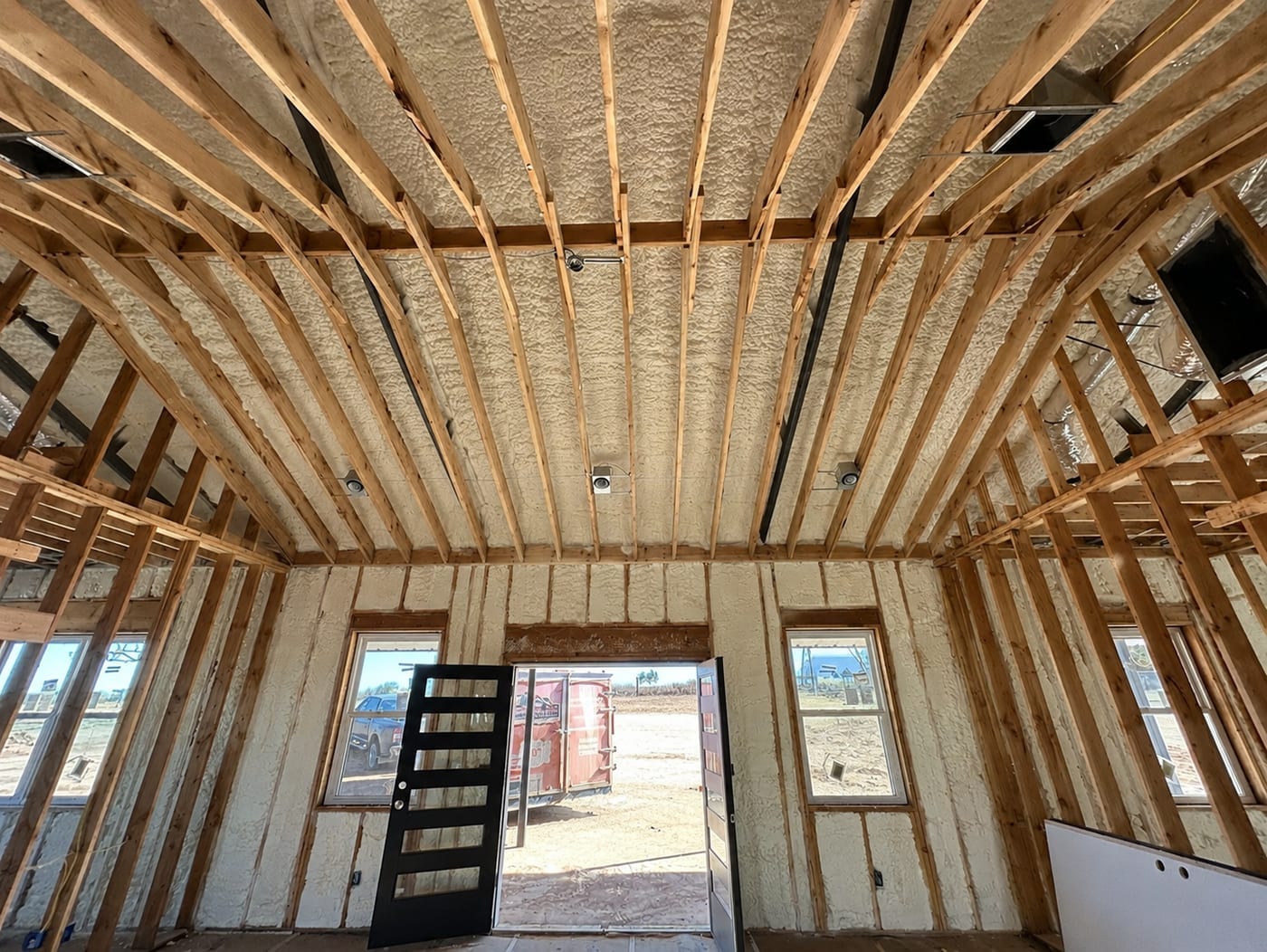
Spray foam insulation applied to the building envelope seals the gaps that allow uncontrolled infiltration. The foam bonds to framing, sheathing, and masonry, filling every crack, void, and penetration in one application. Once cured, it creates a continuous air barrier that stops outdoor air from bypassing your home's filtration system.
This does not mean the home is sealed off from fresh air. It means the home's fresh air comes through a designed pathway (the mechanical ventilation system) where it can be filtered, rather than through random cracks in the walls and ceiling where it cannot.
For allergy sufferers, this distinction is everything. In a leaky home, your HVAC filter only cleans the air that passes through the return duct. Outdoor air that infiltrates through wall gaps, attic bypasses, and crawl space vents enters your living space without ever touching a filter. You are breathing unfiltered Oklahoma air every minute of every day.
In an air-sealed home with mechanical ventilation, every cubic foot of fresh air enters through the ventilation system and passes through a filter rated to capture the particles that trigger your symptoms. MERV 13 or higher filtration captures the vast majority of pollen, dust mite allergens, mold spores, and fine particulate that cause respiratory problems.
Humidity Control: The Indoor Allergen You Cannot See
Oklahoma's outdoor humidity swings directly affect indoor allergen levels, and not just through comfort. Humidity controls whether dust mites and mold can thrive inside your home.
The EPA recommends maintaining indoor relative humidity between 30 and 50 percent. House dust mites, which the EPA identifies as one of the most powerful biological allergens, grow in damp, warm environments. Above 50% relative humidity, dust mite populations increase. Above 60%, mold growth on building materials becomes likely.
In a leaky Oklahoma home during spring and summer, humid outdoor air flows through every unsealed gap and pushes indoor humidity above 55 to 65% even with the AC running. Your air conditioner cools the air temperature but may not run long enough to dehumidify if it is oversized or if the infiltration rate exceeds the system's moisture removal capacity.
Air sealing reduces the volume of humid outdoor air entering the home, which reduces the moisture load your AC must handle. The system runs in longer, steadier cycles, dehumidifies more effectively, and indoor humidity drops into the 40 to 50% range where dust mites and mold struggle to reproduce.
This is not speculation. Homeowners who complete air sealing projects in Oklahoma consistently report that the clammy, sticky feeling disappears, visible condensation on windows stops, and musty smells from crawl spaces and closets diminish, all indicators that indoor humidity has dropped below the allergen-friendly threshold.
Mechanical Ventilation: The Other Half of the Solution
Air sealing without ventilation is not the answer. A home sealed to 3 ACH50 or below needs mechanical ventilation to bring in controlled fresh air and exhaust stale indoor air. Building codes require this, and it is good practice even when codes do not.
The two most common systems for residential mechanical ventilation are ERVs (Energy Recovery Ventilators) and HRVs (Heat Recovery Ventilators). Both bring in filtered outdoor air and exhaust stale indoor air through a heat exchanger that recovers heating or cooling energy from the outgoing stream. ERVs also transfer moisture between the incoming and outgoing air streams, which is beneficial in Oklahoma's humid climate because it prevents the incoming fresh air from adding to the indoor moisture load.
The filtration in the ventilation system is where allergy sufferers get the most benefit. A MERV 13 or higher filter in the ERV/HRV supply path captures pollen, mold spores, dust, and fine particulate before they enter the living space. Combined with a MERV 13 filter in the HVAC return, every path for air entering your home is now filtered.
The Building Enclosure article summarizes the principle clearly: the aim is to control where fresh air comes from and to ensure it arrives at the right rate, not to eliminate it. A tight home with filtered mechanical ventilation has better indoor air quality than a leaky home, not worse.
Where Air Sealing Makes the Biggest Difference for Allergies
If you are an allergy sufferer in Oklahoma and cannot seal the entire home at once, prioritize these locations for the largest impact on indoor air quality:
Attic air sealing closes the single largest set of infiltration pathways in most homes. Recessed lights, plumbing chases, wiring penetrations, attic hatches, and top plates all connect the living space to the attic, which connects to the outdoors through soffit and ridge vents. Sealing these penetrations with spray foam stops the stack effect from pulling pollen-laden attic air down into your living space.
Crawl space encapsulation stops humid, allergen-loaded ground-level air from entering through the floor system. Oklahoma's clay soils and humid springs make crawl spaces a major source of mold spores, moisture, and soil gases that migrate upward into the living space.
Rim joist sealing closes the gap where the floor framing meets the foundation, which is one of the leakiest spots in any Oklahoma home and a direct pathway for outdoor air.
Duct sealing prevents the HVAC system from pulling unfiltered air from attics and crawl spaces into the supply stream. If your ducts run through unconditioned space, every return leak is pulling in allergen-loaded air that bypasses your filter entirely.
Ready to Take Control of What Your Family Breathes?
At Rocking Rad Spray Foam LLC, we help Oklahoma homeowners seal their building envelopes so outdoor allergens, dust, and humidity stop entering uncontrolled. We offer blower door testing to quantify your infiltration, spray foam insulation to seal the envelope, and the experience to recommend where air sealing will make the biggest measurable difference for your specific home. Free on-site estimates and 0% financing available. Contact us or fill out our online form to schedule yours.
Frequently Asked Questions
Will air sealing make my home stuffy?
No. Air sealing stops uncontrolled air infiltration. Mechanical ventilation (ERV or HRV) replaces it with controlled, filtered fresh air at the rate your home needs. The result is better air quality, not less air. You get the same amount of fresh air but it passes through a filter before you breathe it.
What MERV rating filter should I use for allergies?
MERV 13 or higher is recommended for allergy-sensitive households. MERV 13 captures most pollen, mold spores, dust mite allergens, and fine particulate. MERV 16 and HEPA filtration capture even smaller particles but may require HVAC modifications to handle the increased airflow resistance. Check with your HVAC technician before upgrading to ensure your system can handle the higher-rated filter.
Will spray foam help with Oklahoma red dirt dust inside my home?
Yes. Red clay particulate enters homes the same way pollen does: through unsealed gaps in the building envelope. Air sealing closes those pathways. Mechanical ventilation with filtration catches particulate that enters through the designed fresh air intake. Homeowners in central Oklahoma consistently report less dust on surfaces after air sealing projects.
How quickly will I notice the difference after air sealing?
Most homeowners notice reduced dust, fewer allergy symptoms indoors, and lower indoor humidity within days of completing an air sealing project. The improvement is especially noticeable during Oklahoma's peak pollen months (March through May and August through October) when the contrast between a sealed and unsealed home is greatest.
Does air sealing help with pet allergies too?
Indirectly. Air sealing reduces the volume of outdoor air stirring up settled pet dander indoors. More importantly, the improved HVAC filtration (MERV 13+) in a tight, mechanically ventilated home captures pet dander more effectively because all the air in the home cycles through the filter rather than bypassing it through wall and ceiling leaks.
Are there financial assistance programs for air sealing in Oklahoma?
There is currently no federal tax credit for residential insulation or air sealing. The Oklahoma Department of Commerce Weatherization Assistance Program provides no-cost energy efficiency improvements to qualifying households. Some Oklahoma utilities offer rebates for insulation and air sealing work. Check with your provider for current options.