Rim Joist Insulation: The Air Leak You Cannot See
TL;DR: The rim joist is a thin band of wood framing that sits on top of your foundation and connects the floor system to the exterior walls. In most Oklahoma homes, it is completely uninsulated and unsealed. Despite being a small surface area, the U.S. Department of Energy identifies the rim joist as a top-ten air leakage site, and estimates that air leaks at the rim joist and sill plate can account for up to 25 percent of a home's total air infiltration. Sealing it with spray foam is one of the highest-impact, lowest-disruption insulation upgrades you can make.
What Is a Rim Joist and Why Should You Care?
If you have ever gone into your basement or crawl space and looked up at the perimeter where the wood framing sits on top of the foundation wall, you have seen the rim joist. It is also called a band joist or band board. It is the vertical piece of lumber that caps the ends of your floor joists and forms the outer edge of your floor system.
In a typical home, the rim joist runs the entire perimeter of the building. It is usually a single layer of dimensional lumber or engineered wood, roughly 10 to 12 inches tall and only 1.5 inches thick. That thin strip of wood is all that separates your conditioned interior from the outside air at every point where the floor meets the exterior wall.
In most homes built before modern energy codes, the rim joist is either completely uninsulated or stuffed with a fiberglass batt that does little to stop air movement. The result is a continuous band of energy loss running around the entire perimeter of your home, hidden from view behind finished walls or tucked away in the basement where you rarely look.
Why Rim Joists Leak So Much Air
The rim joist is not a single piece of material. It is an assembly of multiple components joined together: the sill plate sitting on the foundation, the rim board itself, the floor joists butting into it, and the subfloor resting on top. Each of those connections creates a joint, and each joint is a potential air leak.
In practice, the wood framing does not make a perfect seal with the concrete foundation. Lumber shrinks as it dries, opening gaps that were not there when the house was built. Penetrations for plumbing, electrical wiring, and HVAC lines pass through the rim joist area, adding more openings. The cumulative effect is a perimeter of small gaps that individually seem insignificant but collectively create a major air leakage path.
The U.S. Department of Energy estimates that air leaks at the rim joist and sill plate can account for up to 25 percent of a home's total air infiltration. Building science research also shows that uninsulated rim joists are responsible for 5 to 10 percent of total home heat loss, despite representing a very small fraction of the building's total surface area.
That disproportionate impact is what makes rim joist insulation one of the most cost-effective upgrades available. You are addressing a small area that is responsible for an outsized share of your energy loss.
What Happens When Rim Joists Are Left Unsealed
The consequences of an unsealed rim joist go beyond higher energy bills. In Oklahoma's mixed-humid climate, the problems compound over time.
Problem | What Happens | Why It Gets Worse Over Time |
|---|---|---|
Air infiltration | Outside air enters through gaps at the sill plate, joist connections, and penetrations, bypassing your insulation | Lumber shrinks as it ages, widening the gaps that were small during original construction |
Condensation and moisture | Warm indoor air contacts the cold rim joist surface in winter, creating condensation on the wood | Moisture accumulates season after season, saturating any fiberglass insulation present |
Mold and wood rot | Persistent dampness on unprotected wood creates ideal conditions for mold growth and structural decay | Damage is hidden behind finished walls or in crawl spaces, often going undetected for years |
Pest entry | Small gaps at the foundation-to-framing junction provide entry points for insects and rodents | Once pests establish pathways, they expand them, increasing both air leakage and structural damage |
Cold floors | Uninsulated rim joists allow cold air to radiate upward into the floor system above | Rooms directly above the rim joist, especially over crawl spaces, feel persistently cold in winter |
Duct contamination | In homes with ductwork near the rim joist, infiltrating air can carry dust, pollen, and soil gases into the air distribution system | Indoor air quality degrades gradually, often without a clear cause |
The important thing to understand is that these problems feed each other. Air leakage brings moisture. Moisture enables mold. Mold weakens wood. Weakened wood opens larger gaps. The cycle accelerates unless you break it at the source by air sealing the rim joist.
Why Fiberglass Does Not Work at Rim Joists
If your home has fiberglass batts stuffed into the rim joist cavities, you have insulation in name only. Building professionals, including the Department of Energy and ENERGY STAR, no longer recommend fiberglass as a standalone rim joist solution. Here is why.
Fiberglass is air permeable. It slows heat transfer through the material itself, but it does not stop air from moving through and around it. At the rim joist, where gaps and penetrations create active air pathways, fiberglass simply lets the air pass.
In Oklahoma's climate, this creates a specific moisture problem. In winter, warm humid indoor air passes through the fiberglass and contacts the cold rim joist surface behind it. The temperature difference causes condensation to form directly on the wood. The fiberglass then traps that moisture against the rim joist surface, preventing it from drying out.
Over time, the wood stays wet. Mold grows. Rot begins. Fine Homebuilding specifically warns that in cold weather, condensation or frost can build up on the interior side of a rim joist insulated with fiberglass, and in just a few short years, this type of moisture accumulation can be serious enough to rot out the rim joist entirely.
This is why pulling out old fiberglass batts and replacing them with an air-sealing insulation is one of the most impactful upgrades you can make in an existing home.
How Spray Foam Solves the Rim Joist Problem
Spray foam addresses every failure mode of an uninsulated or fiberglass-insulated rim joist in a single application. It insulates, air seals, and in the case of closed cell foam, acts as a vapor retarder, all at once.
Performance Factor | Closed Cell Spray Foam | Open Cell Spray Foam | Fiberglass Batt |
|---|---|---|---|
R-value per inch | R-6.0 to R-7.0 | R-3.5 to R-3.8 | R-2.9 to R-3.8 |
Air barrier | Yes, at 1 inch thickness | Yes, at 3.5 inches | No |
Vapor retarder | Yes, at 2 inches | No (vapor open) | No |
Fills irregular cavities | Yes (expands to conform) | Yes (expands to conform) | No (must be cut to fit, gaps are common) |
Moisture resistance | Hydrophobic, does not absorb water | Absorbs moisture but dries | Absorbs and retains moisture |
Pest resistance | Creates physical barrier | Creates physical barrier | Provides nesting material |
For rim joist applications specifically, closed cell spray foam is the recommended choice. Building Science Corporation research supports closed cell foam at rim joists because it eliminates condensation potential while providing structural reinforcement through its adhesive properties and rigidity.
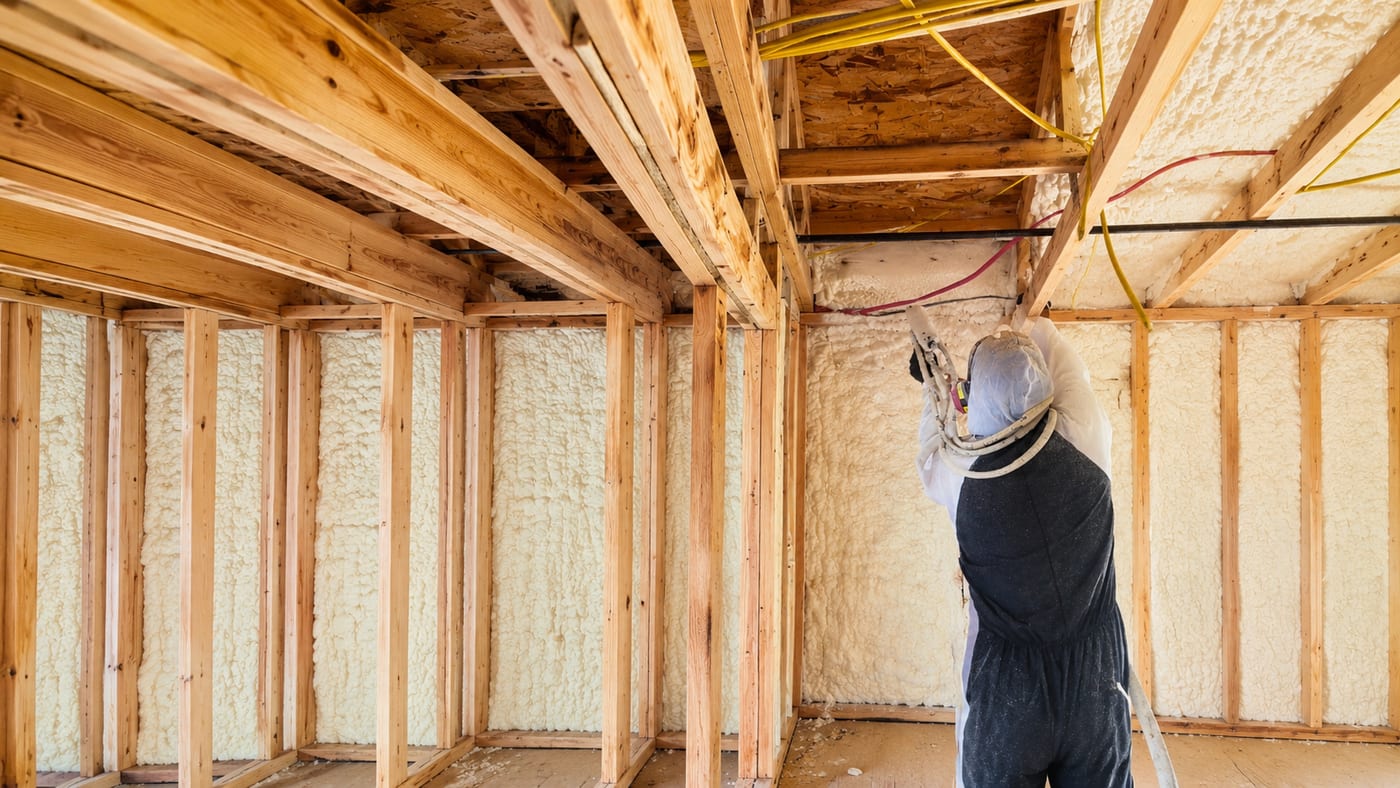
The application is straightforward. A spray foam installer applies the foam directly to the rim joist surface and the surrounding framing, sealing every gap, penetration, and joint in a single pass. The foam expands to fill all irregularities around pipes, wires, and joist connections that would be impossible to seal perfectly with cut-and-fit rigid board or fiberglass.
Real Energy Impact of Sealing Rim Joists
The numbers behind rim joist air sealing are compelling, especially relative to the small area being treated.
A verified case study using blower door testing showed that sealing only the rim joist areas in a home reduced overall air infiltration by 11.4 percent and cut estimated annual heating and cooling costs by approximately 19.3 percent. That is from treating just the rim joist, not the attic, not the walls, not the crawl space. Just the perimeter band where the floor meets the foundation.
The Department of Energy estimates that up to 40 percent of a home's total energy loss can be attributed to air infiltration. Walls and rim joists together typically make up more than 40 percent of the total building envelope area. Addressing the rim joist seals one of the most concentrated leakage zones in that envelope.
For homeowners who have already insulated their attic and are looking for the next highest-impact upgrade, rim joist insulation is almost always the answer. It is also one of the least disruptive projects. In most homes, the rim joist is accessible from the basement or crawl space without opening any walls or ceilings.
How to Know If Your Rim Joists Need Attention
Most homeowners have never inspected their rim joists. If your home was built before 2010 and no one has specifically addressed this area, there is a high probability it is either uninsulated or insulated only with fiberglass batts.
What to Look For | Where to Check | What It Means |
|---|---|---|
Bare wood visible at the perimeter where the floor meets the foundation | Basement or crawl space, looking up at the outer edge | Rim joist is completely uninsulated and unsealed |
Fiberglass batts stuffed between floor joists at the perimeter | Same location, typically pink or yellow insulation visible | Insulation present but not air sealed, moisture damage likely behind the batts |
Dark staining, white powdery residue, or musty smell on the wood | Pull back any existing insulation and inspect the wood surface | Signs of moisture damage, mold, or early rot from condensation |
Cold floors in rooms above the basement or crawl space perimeter | First floor rooms, especially near exterior walls | Cold air radiating up through the uninsulated rim joist below |
Drafts felt near baseboards at the floor level on exterior walls | Walk the perimeter of first floor rooms on a windy or cold day | Air infiltrating through the rim joist area and traveling up the wall cavity |
Insects or evidence of rodent activity in the joist bays | Basement or crawl space perimeter | Pests entering through gaps at the rim joist and sill plate |
A professional blower door test will quantify exactly how much air your home is losing and identify whether the rim joist is a primary contributor. If it is, the fix is targeted and efficient.
Frequently Asked Questions
Q: What is a rim joist? The rim joist, also called a band joist or band board, is the vertical piece of framing lumber that sits on top of the foundation wall and caps the ends of the floor joists. It runs the entire perimeter of your home and forms the outer edge of the floor system. In most older homes, it is one of the largest sources of air leakage and energy loss.
Q: Can I insulate my rim joists myself with canned spray foam? Small-scale sealing with canned low-expansion foam can help address individual gaps and penetrations. However, achieving a complete air seal across the entire rim joist perimeter typically requires professional spray foam application. Canned foam works for cracks up to about 3 inches, but it cannot create the continuous, bonded insulation layer that professional spray equipment delivers.
Q: Is closed cell or open cell better for rim joists? Closed cell is the preferred choice for most rim joist applications. It delivers higher R-value per inch (R-6 to R-7 versus R-3.5 to R-3.8 for open cell), acts as a vapor retarder at 2 inches thickness, and provides moisture resistance in an area that is highly vulnerable to condensation. Building Science Corporation specifically recommends closed cell foam at rim joists for its ability to eliminate condensation potential.
Q: How much energy can I save by insulating my rim joists? Results vary by home, but verified blower door testing has shown that sealing rim joists alone can reduce overall air infiltration by over 11 percent and cut annual heating and cooling costs by approximately 19 percent. The DOE estimates that air leaks at the rim joist and sill plate can account for up to 25 percent of a home's total air infiltration, making it one of the highest-impact areas to address.
Q: Will insulating my rim joists help with cold floors? Yes. Cold floors above basements and crawl spaces are one of the most common symptoms of uninsulated rim joists. The cold air infiltrating through the rim joist radiates upward into the floor system above. Sealing and insulating the rim joist eliminates this infiltration and typically makes a noticeable difference in floor comfort, especially along exterior walls.
Q: Do I need to remove old fiberglass before installing spray foam? Yes. Old fiberglass batts should be removed before spray foam is applied to the rim joist. The wood behind the fiberglass should be inspected for moisture damage, mold, or rot before sealing. Spray foam needs to bond directly to the wood surface to create a proper air and vapor seal. Spraying over fiberglass traps moisture and defeats the purpose of the upgrade.
If your rim joists are uninsulated or stuffed with old fiberglass batts, this is one of the most effective upgrades you can make before Oklahoma's next heating or cooling season. Rocking Rad Spray Foam LLC offers free on-site estimates with blower door testing so you can see exactly where your home is leaking and how much a rim joist seal would improve it. We also offer 0% financing. Call us or fill out our online form to schedule your assessment.