Blower Door Testing and HERS Ratings in Oklahoma Explained
TL;DR
A blower door test measures how much air leaks through your building envelope by depressurizing the house with a calibrated fan and calculating air changes per hour at 50 pascals (ACH50). Oklahoma's adopted 2015 IECC energy code requires new residential construction to achieve 3 ACH50 or less in Climate Zones 3 and 4, which covers most of the state. A HERS rating uses blower door results alongside energy modeling to produce a single score that represents your home's overall energy performance. The HERS baseline of 100 represents a home built to 2006 code. Lower is better. The average newly rated home in 2023 scored around 57. If you are building new, renovating, or trying to understand why your energy bills are high, these two tests give you the data to make informed decisions.
What a Blower Door Test Actually Does
A blower door test is the only reliable way to quantify how leaky your building envelope is. It replaces guesswork with a measured number.
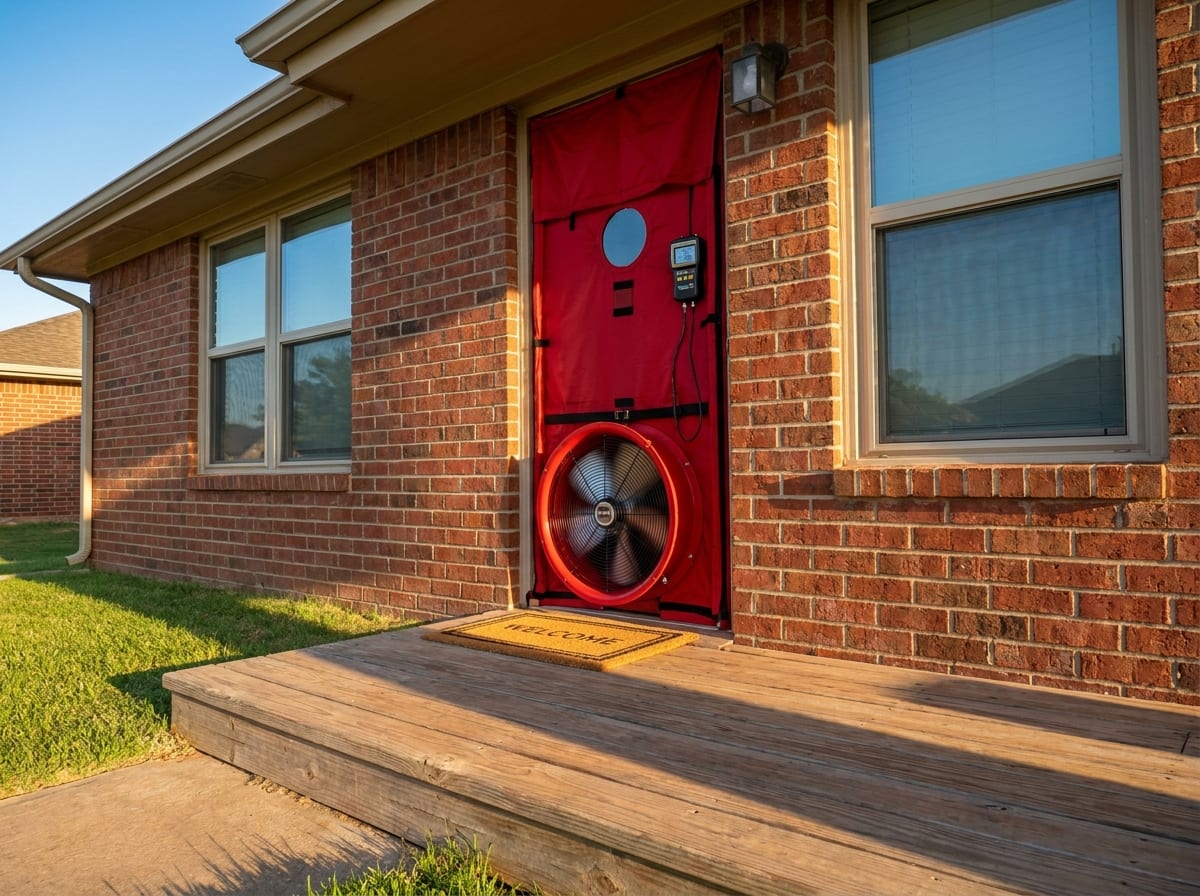
The equipment is straightforward. A calibrated fan is temporarily mounted in an exterior door frame using an adjustable panel. The fan pulls air out of the house, lowering the interior air pressure to a standardized 50 pascals below outdoor pressure. At that pressure difference, outside air rushes in through every crack, gap, and unsealed penetration in the building envelope. The fan measures how much air it takes to maintain that pressure difference, expressed in cubic feet per minute at 50 pascals (CFM50).
That CFM50 number is then converted to ACH50 (air changes per hour at 50 pascals) using the formula: ACH50 equals CFM50 multiplied by 60, divided by the volume of the house. ACH50 tells you how many times per hour the entire volume of air in your home would be replaced through leakage at test pressure. A lower number means a tighter house.
To put that in perspective, an Oak Ridge National Laboratory field study tested two comparable 1,200 square foot homes side by side. The home insulated with spray foam measured 0.08 ACH at 4 pascals. The home insulated with fiberglass batts measured 0.16 ACH, roughly double the air leakage. That difference translates directly into HVAC runtime, energy consumption, and monthly utility costs.
What the Numbers Mean: Reading Your Blower Door Results
The ACH50 number from your test is only useful if you know what to compare it against. Here is how the benchmarks break down.
The 2015 IECC, which Oklahoma has adopted, requires new residential construction to achieve 3 ACH50 or less in Climate Zones 3 through 8. Most of Oklahoma falls in Climate Zones 3A and 4A, so 3 ACH50 is the code target for new homes across the state. The code evolution tells the story of where the industry is headed: the 2009 IECC set the threshold at 7 ACH50, the 2012 and 2015 editions dropped it to 3 or 5 depending on climate zone, and the trend continues downward.
For existing homes, there is no code requirement to hit a specific ACH50 number. But the test still tells you how your home compares to modern standards. Most older Oklahoma homes test between 8 and 15 ACH50, meaning they leak two to five times as much air as a code-compliant new home. That leakage is where a significant portion of your heating and cooling energy goes.
The EPA estimates that homeowners save an average of 15% on heating and cooling costs by combining air sealing with insulation in attics, crawl spaces, and basements. A blower door test before and after the work gives you a measured result rather than an estimate.
For context on what different ACH50 values mean in practice: 10 or above is very leaky and common in pre-1980 Oklahoma homes with no air sealing. 7 to 10 is leaky and typical of homes built in the 1980s and 1990s with basic insulation but minimal air sealing. 5 to 7 is moderately tight and common in homes built to the 2009 IECC or with some retrofit air sealing. 3 to 5 is tight and meets or approaches current code for new construction. Below 3 is very tight and typically found in homes built with spray foam or advanced air sealing techniques. Below 1 is Passive House territory, requiring mechanical ventilation to maintain indoor air quality.
An important note: tighter is not always better without proper ventilation. Homes that achieve 3 ACH50 or below need mechanical ventilation (an HRV or ERV system) to bring in fresh air. Building codes require this, and your contractor and HERS rater should address it as part of any air-sealing project.
What a HERS Rating Is and How It Connects to Blower Door Testing
A HERS (Home Energy Rating System) rating is a comprehensive energy performance score developed by RESNET (Residential Energy Services Network). While a blower door test measures one thing (air leakage), a HERS rating evaluates the entire energy picture: insulation levels, window performance, HVAC efficiency, duct leakage, air leakage, and overall building design.
The process involves three stages. First, a certified HERS rater reviews the construction plans and uses accredited energy modeling software to generate a projected HERS score before construction begins. Second, the rater conducts mid-construction inspections to verify that insulation, air sealing, windows, and HVAC systems are installed as specified. Third, after construction is complete, the rater performs final testing (blower door test and duct leakage test) and generates the official HERS Index score.
The HERS Index uses a baseline of 100, which represents a home built to the 2006 IECC reference standard. A score of zero represents a net-zero energy home. Every point below 100 represents a 1% improvement in energy efficiency compared to the 2006 baseline. For context, the average HERS score for newly rated homes in 2023 was approximately 57, meaning the average new rated home is 43% more efficient than the 2006 baseline.
A HERS score of 100 does not mean your home is average by today's standards. It means your home performs like a home built to 2006 code, which is well below current requirements. If your existing home scores 120 or 130, there is substantial room for improvement.
When You Need a Blower Door Test in Oklahoma
Blower door testing is not always required, but it is always useful. Here is when it applies.
New residential construction requires a blower door test under Oklahoma's adopted 2015 IECC. The home must achieve 3 ACH50 or less, and a written test report signed by the party conducting the test must be provided to the building official. A final inspection cannot be passed without a test report demonstrating compliance.
HERS-rated homes require blower door testing as part of the HERS rating process. If your builder is pursuing an Energy Star certification, a HERS rating, or a specific energy performance target, the blower door test is built into the process.
Before and after insulation retrofits is where blower door testing provides the most value for existing homeowners. A pre-installation test establishes your baseline. A post-installation test proves the work made a measurable difference. Without both numbers, you are relying on how the house "feels" rather than documented performance data.
Energy audits typically include blower door testing as the primary diagnostic tool. The test identifies how much total air leakage exists, and a walk-through with a thermal camera or smoke pencil while the house is depressurized reveals exactly where the leaks are.
Insurance or real estate transactions may benefit from a HERS rating or blower door test as documentation of the home's energy performance. Buyers increasingly ask about energy costs, and a HERS score provides a standardized, third-party verified answer.
What the Test Cannot Tell You
Blower door testing is powerful but has limits. It measures total air leakage, not where specifically each leak is. To find individual leak locations, the test is combined with a thermal imaging camera or smoke pencil during depressurization. It also does not measure insulation R-value, duct leakage (that requires a separate duct pressurization test), or HVAC equipment efficiency. A HERS rating covers all of those, which is why the two services complement each other.
The test also measures leakage at a standardized 50 pascals, which is higher than normal wind and stack-effect pressures in daily life. The ACH50 number is a diagnostic benchmark, not a real-time measure of how much air leaks during normal conditions. Actual infiltration rates under normal conditions are roughly 1/20th of the ACH50 value as a general rule of thumb.
How to Prepare for a Blower Door Test
If you have a blower door test scheduled, a few simple steps help ensure accurate results.
Close all exterior windows and doors. Open all interior doors so every room is connected. Close the fireplace damper if you have one. Shut off any exhaust fans, dryers, or combustion appliances. Turn off the HVAC system. Ensure the attic hatch or access panel is in its normal closed position.
For new construction tests, the home should be completely finished with windows locked, doors installed, and all penetrations in their final state. The test measures the home as it will be lived in, not as an open construction site.
The test itself typically takes one to two hours, including setup, multiple pressure readings, and a walkthrough to identify leak locations if requested.
Ready to Get Your Numbers?
At Rocking Rad Spray Foam LLC, we provide blower door testing and HERS ratings for homeowners, builders, and contractors across Oklahoma. Whether you need code compliance documentation for new construction, a baseline measurement before an insulation retrofit, or a HERS score for an Energy Star certification, we have the equipment and the certified team to get it done. We offer free on-site estimates and 0% financing on insulation projects. Contact us or fill out our online form to schedule your test.
Frequently Asked Questions
How much does a blower door test cost in Oklahoma?
Standalone blower door tests for existing homes typically range from $200 to $400 depending on home size and whether thermal imaging is included. For new construction projects that also require a HERS rating, the combined cost is typically $400 to $800. Some contractors include blower door testing as part of the insulation project scope at no additional charge.
Can I fail a blower door test on a new home?
Yes. If the home exceeds 3 ACH50 in Oklahoma's Climate Zones 3 and 4, it does not meet the 2015 IECC requirement and will not pass the code inspection. The builder then needs to identify and seal the leaks and retest. Common failure points include unsealed top plates, electrical and plumbing penetrations, recessed light cans, attic hatches, and gaps at window and door rough openings.
Do I need a blower door test on an existing home?
It is not required by code for existing homes, but it is the most valuable diagnostic tool available if you are trying to understand why your energy bills are high or which air-sealing improvements will deliver the best return. A pre-and-post test around an insulation project gives you documented proof that the work improved performance.
What is the difference between a blower door test and a HERS rating?
A blower door test measures one thing: air leakage through the building envelope. A HERS rating is a comprehensive energy assessment that includes the blower door test plus evaluation of insulation, windows, HVAC, duct leakage, and building design. The HERS rating produces a single index score that represents the home's overall energy performance. Blower door testing is one component of the HERS rating process.
Does a tight house cause indoor air quality problems?
A house that achieves 3 ACH50 or below is tight enough that it needs mechanical ventilation (typically an HRV or ERV system) to bring in fresh outdoor air and exhaust stale indoor air. Building codes require mechanical ventilation at these tightness levels. When properly designed, a tight, mechanically ventilated home has better indoor air quality than a leaky home because the ventilation is controlled and filtered rather than random and unfiltered.
Can blower door testing help with my allergies?
Indirectly, yes. A blower door test identifies where outdoor air (carrying pollen, dust, and humidity) enters your home uncontrolled. Sealing those leaks and adding mechanical ventilation with filtration gives you control over what air enters your home and how it is filtered. Many Oklahoma homeowners report improvements in indoor air quality and allergy symptoms after air-sealing work guided by blower door testing results.