Why Your Oklahoma Home Feels Humid Even with the AC Running
TL;DR
Your air conditioner is designed to both cool and dehumidify. When it fails to remove moisture, the problem is usually not the equipment itself. It is what is happening around the equipment: air leaks bringing in humid outdoor air faster than the AC can process it, an oversized system that short cycles before dehumidification occurs, or duct leaks pulling humid attic or crawl space air into the supply stream. Oklahoma's outdoor dew points regularly climb into the mid-60s from April through October, which means every unsealed gap in your building envelope is a direct pipeline for moisture. Air sealing with spray foam insulation addresses the root cause by stopping uncontrolled humid air from entering the home, giving your AC the runtime it needs to actually remove moisture from the air it conditions.
How Your Air Conditioner Removes Moisture (When It Works Correctly)
Your AC does not just cool air. It dehumidifies it as a natural byproduct of the cooling process. Warm, moist indoor air is drawn across a cold evaporator coil where the moisture in the air condenses on the coil surface, drips into a drain pan, and is carried outside through a condensate line. The cooled, drier air is then blown back into your rooms.
This process only works when the system runs long enough for the evaporator coil to get cold, for moisture to condense, and for that moisture to drain. A typical cooling cycle needs to run for at least 10 to 15 minutes continuously before meaningful dehumidification begins. The first few minutes of any cycle are mostly sensible cooling (lowering the air temperature). Latent cooling (removing moisture) ramps up as the coil temperature stabilizes and condensation builds.
When your home feels cool but clammy, with that sticky, damp feeling even though the thermostat reads 72°F, the AC is cooling the air temperature but not running long enough or processing enough air to remove the moisture. The result is cold, humid air, which actually feels worse than warm, dry air at the same temperature.
The Three Reasons Oklahoma Homes Stay Humid
1. Air Leaks Bring in More Moisture Than Your AC Can Handle
Every gap, crack, and unsealed penetration in your building envelope is a pathway for outdoor air to enter your home. In Oklahoma, outdoor dew points from April through October regularly sit in the low to mid-60s. That air carries significant moisture, and every cubic foot that leaks in must be dehumidified by your AC on top of the moisture already inside the home.
The EPA reports that 9 out of 10 U.S. homes are under-insulated, and that air sealing combined with insulation saves an average of 15% on heating and cooling costs. But the humidity impact is often more noticeable than the energy savings. When you stop uncontrolled outdoor air from entering, your AC is no longer fighting an endless supply of new moisture. It can actually catch up and bring indoor humidity down to a comfortable range.
Common air leak locations that contribute the most moisture infiltration include unsealed attic penetrations (recessed lights, plumbing chases, wiring holes), crawl space vents and rim joists that connect directly to humid outdoor air, duct leaks in unconditioned spaces that pull humid attic or crawl space air into the supply stream, and gaps around windows, doors, and electrical outlets on exterior walls.
A blower door test quantifies exactly how much outside air is infiltrating your home and identifies where the worst leaks are. Without that data, you are guessing.
2. Your AC Is Oversized and Short Cycling
An oversized air conditioner is one of the most common causes of high indoor humidity, and it is also one of the least understood. An AC that is too large cools the home too quickly and shuts off before it can dehumidify the air. This is called short cycling: the system runs for only a few minutes, satisfies the thermostat's temperature setting, and shuts off. Then it restarts a few minutes later when the temperature rises slightly.
During those short run cycles, the evaporator coil never reaches the sustained cold temperature needed for efficient condensation. The system cools the air but leaves most of the moisture behind. The result is a home that is 72°F and 65% relative humidity, which feels cold and clammy rather than comfortable.
The Oklahoma State University Extension Service notes that a 14 SEER system can perform at an effective 5 SEER when installation and envelope issues undermine its efficiency. An oversized system in a leaky home is one of the fastest paths to both high humidity and high energy bills.
The fix is two-part: seal the building envelope first (which reduces the cooling load), then right-size the HVAC equipment to match the improved load. A properly sized system runs longer, steadier cycles that give the evaporator coil time to do its dehumidification job.
3. Duct Leaks Are Pulling Humid Air Into Your System
Energy Star reports that in a typical home, about 20 to 30 percent of conditioned air is lost through duct leaks, holes, and poorly connected joints. When those ducts run through a humid attic or crawl space, the problem compounds. Return duct leaks in unconditioned spaces actively pull hot, humid attic or crawl space air into the system. That moisture-laden air mixes with your conditioned air and gets distributed throughout the house.
You can feel this when certain supply registers blow air that feels cooler but damper than expected, or when rooms closest to the air handler feel more humid than rooms farther away. Sealing duct connections with mastic and bringing ductwork inside the conditioned envelope (by insulating the attic roof deck rather than the attic floor) eliminates this moisture source.
What "Comfortable" Humidity Actually Looks Like
The ideal indoor relative humidity range is 30 to 50 percent. The EPA identifies 60% relative humidity as the threshold above which mold growth becomes likely on building materials. ASHRAE Standard 62.1 requires that mechanical systems with dehumidification capability limit indoor relative humidity to 65% or less.
In practical terms, most people feel comfortable between 40 and 50% relative humidity at 72 to 75°F. Above 55%, the air starts to feel sticky. Above 60%, you are in the zone where mold risk, dust mite activity, and general discomfort increase noticeably.
A simple hygrometer (available for under $15 at any hardware store) placed in your main living area tells you exactly where your home sits. If you are consistently above 55% during cooling season with the AC running, one or more of the three causes above is likely at work.
How Air Sealing Fixes the Root Cause
Running a dehumidifier treats the symptom. Cranking the thermostat down treats the symptom. Both cost money every month and neither addresses why the moisture is getting in.
Air sealing with spray foam insulation addresses the root cause by closing the pathways that allow humid outdoor air to enter the home in the first place. When your building envelope is tight, your AC only needs to dehumidify the air already inside the home plus the controlled fresh air coming through your ventilation system. It is no longer fighting an endless supply of new moisture leaking in through every gap in the framing.
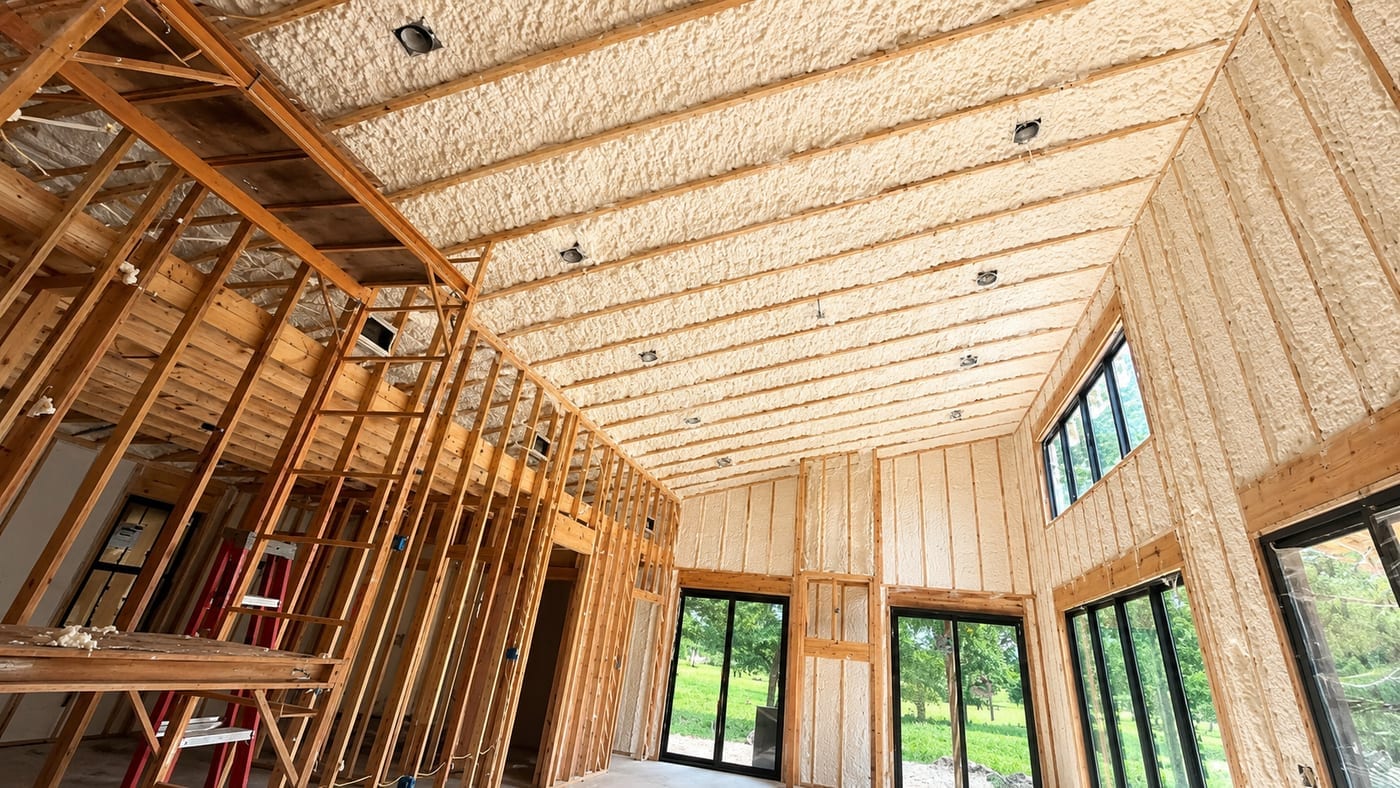
Open-cell spray foam in wall cavities and attic assemblies fills every void and seals around penetrations, eliminating the air paths that carry the most moisture. Closed-cell spray foam in crawl spaces and rim joists adds vapor retarder performance on top of air sealing, which is critical in below-grade and ground-contact locations where both air and vapor moisture are concerns.
The improvement is not subtle. Homeowners who complete air sealing projects consistently report that the clammy feeling disappears, the AC runs in longer, steadier cycles, and the home reaches and maintains comfortable humidity levels without supplemental dehumidification.
The Right Sequence: Seal First, Then Evaluate Equipment
If your home feels humid, the instinct is to call an HVAC technician or buy a dehumidifier. Before you do either, consider the sequence that actually solves the problem permanently:
Step 1: Get a blower door test to quantify how much outside air is infiltrating your home and identify where the worst leaks are.
Step 2: Seal the building envelope. Spray foam at attic penetrations, rim joists, crawl space walls, and any identified air leak pathways. Seal duct connections with mastic.
Step 3: After sealing, monitor indoor humidity for a few weeks. In many cases, the existing AC system can now dehumidify effectively because it is no longer overwhelmed by incoming moisture.
Step 4: If humidity remains high after sealing, evaluate the HVAC system. It may be oversized for the now-tighter envelope. A new Manual J load calculation based on the improved envelope determines the correct equipment size.
Step 5: If needed, add a whole-house dehumidifier integrated with your HVAC system. In Oklahoma's climate, some homes benefit from supplemental dehumidification even with a tight envelope, especially during the shoulder seasons (spring and fall) when the AC does not run enough to dehumidify but outdoor humidity is still high.
Ready to Find Out Why Your Home Feels Humid?
At Rocking Rad Spray Foam LLC, we help Oklahoma homeowners identify and fix the air leaks that cause indoor humidity problems. We offer blower door testing to quantify infiltration, spray foam insulation to seal the envelope, and the diagnostic experience to tell you whether your humidity problem is an envelope issue, an equipment issue, or both. Free on-site estimates and 0% financing available. Contact us or fill out our online form to schedule yours.
Frequently Asked Questions
Will a dehumidifier fix my humidity problem permanently?
A dehumidifier manages the symptom by removing moisture from the air, but it does not stop new moisture from entering. If air leaks are the root cause, the dehumidifier runs continuously, consuming electricity, while humid outdoor air keeps flowing in. Air sealing addresses the source. After sealing, a dehumidifier may still be helpful during shoulder seasons, but it will run far less often because the moisture load is dramatically reduced.
My AC is only a few years old. Can it still be the problem?
Yes. A newer system can still be oversized for your home. If it was sized using a square-footage rule of thumb rather than a proper Manual J load calculation, it may be too large for the actual cooling load. An oversized system short cycles regardless of its age or efficiency rating. After air sealing, the load drops further, which can make an already-oversized system even worse at dehumidification.
Should I set my fan to "On" or "Auto" for better humidity control?
Set it to "Auto." When the fan is set to "On," the blower runs continuously even between cooling cycles. During those off-cycles, the moisture that condensed on the evaporator coil during the last cooling cycle re-evaporates back into the air and gets blown through the house. Setting the fan to "Auto" ensures the blower only runs during active cooling cycles, allowing condensate to drain rather than re-evaporate.
How do I know if my ducts are leaking humid air into the system?
Signs include certain supply registers blowing air that feels damper than others, visible condensation on supply grilles, or rooms that feel more humid near the air handler. A duct pressurization test (often done alongside a blower door test) quantifies how much air your duct system is losing. Duct leaks in unconditioned attics and crawl spaces are the most problematic because those spaces carry the most moisture.
Can spray foam make my home too tight and cause other problems?
A home sealed to 3 ACH50 or below needs mechanical ventilation (an ERV or HRV system) to bring in controlled fresh air. Building codes require this, and it should be part of any air-sealing project. When properly ventilated, a tight home has better indoor air quality than a leaky one because the incoming air is filtered and controlled rather than random and unfiltered.
How quickly will I notice the difference after air sealing?
Most homeowners notice a difference within days. The clammy feeling diminishes, the AC runs in longer and more consistent cycles, and rooms that were chronically humid begin to feel comfortable. The improvement is especially noticeable during Oklahoma's spring and early summer when outdoor humidity is highest and the contrast between a sealed and unsealed home is most dramatic.