How Spray Foam Turns Your Attic Into Usable Space
TL;DR: Most Oklahoma attics are too hot in summer, too cold in winter, and too humid year-round to be good for anything. Moving the insulation from the attic floor to the roofline changes that. The attic becomes part of the conditioned space of your home, which opens the door to climate-controlled storage, a protected home for your HVAC equipment, and in some homes, a future bonus room. The insulation is the enabling step. What you can do with the space after that depends on your framing, your ceiling height, and building code, and this guide walks through all three.
Walk into a typical Oklahoma attic in July and you will not stay long. The air is stifling, the rafters radiate heat, and anything stored up there is slowly baking. That is by design. A vented attic is intentionally kept outside the thermal boundary of your home, with insulation on the attic floor and outside air flowing through soffit and ridge vents above it.
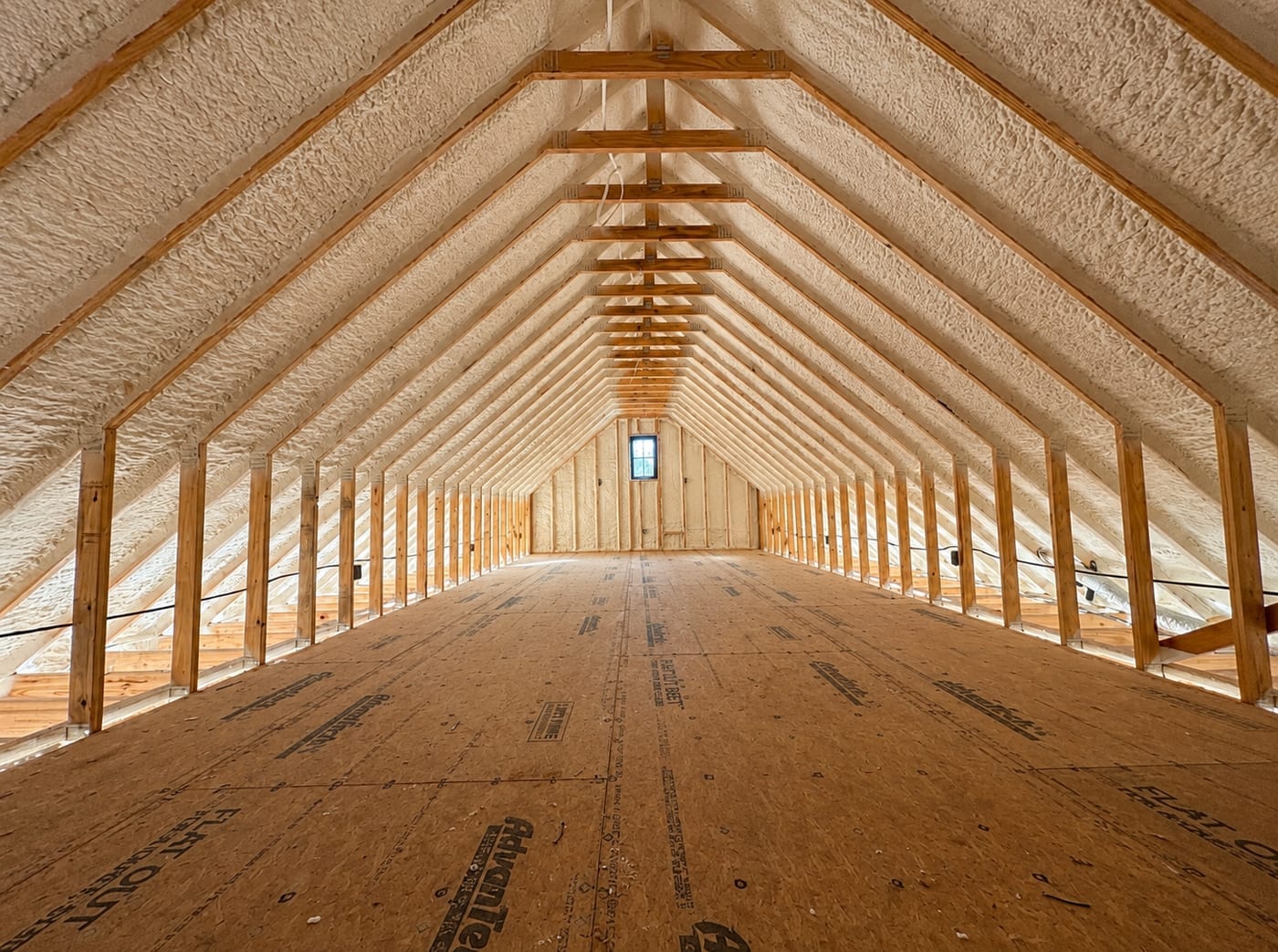
There is another way to build an attic, and it is the reason the photo above looks so different from the attic you might be picturing. When spray foam is applied to the underside of the roof deck and the gable walls instead of the attic floor, the attic moves inside the thermal boundary. The Department of Energy's Building America Solution Center describes how this unvented assembly creates an insulated, conditioned attic space that is resilient and durable in every climate zone, using an approach builders have relied on since the mid-1990s.
Once the attic is sealed and insulated at the roofline, the question changes from "how do I keep heat out of my house" to "what can I actually do with this space now?" That second question is the subject of this guide.
Why a Vented Attic Ruins Everything You Put in It
A vented attic tracks outdoor conditions, then amplifies them. In summer, solar heat loads the roof and the attic runs far hotter than the air outside, which is the same reason attic ductwork loses so much energy in Oklahoma homes. In winter, the attic drops toward freezing. And in every season, Oklahoma's humid air moves freely through the vents.
Those swings are hard on belongings. Photographs, electronics, candles, vinyl records, wood furniture, holiday decorations, important documents, fabric, and anything with adhesive or battery components all degrade faster in a space that cycles between temperature extremes while humidity comes and goes. The attic is often the largest unused area in a home, and the conditions inside it are the main reason it stays unused.
The same swings are hard on equipment. If your furnace, air handler, or ductwork lives in the attic, it spends every summer working inside the hottest space in the house and every winter in the coldest.
What Changes When the Insulation Moves to the Roofline
An unvented attic flips the arrangement. The Building America program explains that these assemblies work by eliminating ventilation openings and moving the thermal, moisture, and air control boundaries up to the plane of the roof deck. Spray foam is the most common way to do it, because the code path for unvented attics requires air-impermeable insulation, and spray foam insulates and air seals in a single application.
The result is an attic that stays close to the temperature of the rest of the house without ever touching your thermostat settings. DOE's guidance on converting a vented attic to an unvented one lists the practical benefits: heating and cooling equipment is protected from temperature extremes so it lasts longer and runs more efficiently, humid outside air and wind-driven rain stay out, and the conditioned attic can provide climate-controlled storage or potentially be converted to bonus living space if the structural support is in place.
That last sentence deserves attention, because it contains both the promise and the fine print. The research behind this assembly was strong enough that DOE named unvented conditioned attics a Top Innovation of its Building America program. But the phrase "if the structural support is in place" is doing real work, and an honest guide has to unpack it.
The Three Tiers of Usable Attic Space
Not every sealed attic can become a bedroom, and not every homeowner wants one. It helps to think of usable attic space in three tiers, each with its own requirements.
Tier | What it requires | What you get |
|---|---|---|
Climate-controlled storage | Roofline insulation, framing rated for storage loads, safe access | Stable temperatures and humidity for stored belongings |
Protected mechanical space | Roofline insulation | HVAC equipment and ducts operating inside the thermal envelope |
Bonus living space | All of the above, plus adequate ceiling height, fixed stairs, egress, permits, and structural design | Finished, habitable square footage |
Tier 1: Climate-Controlled Storage
This is the most attainable upgrade and the one most homeowners actually use. Once the attic is inside the thermal envelope, the boxes you store there live in roughly the same conditions as the boxes in your hall closet.
There is one caveat, and it is structural rather than thermal. Attic framing is designed for specific loads. Under the International Residential Code's live load table, an uninhabitable attic without storage may be designed for as little as 10 pounds per square foot, an attic with limited storage for 20, and habitable space for 30 to 40. Spray foam changes the temperature of your attic, not the strength of your joists. If your attic floor was framed for minimal loads, decking it and filling it with heavy totes can overload the framing below. A builder or engineer can tell you what your framing was designed to carry, and in new construction, telling your builder you want storage-rated framing up front is inexpensive compared to reinforcing it later.
Tier 2: Protected Mechanical Space
If your HVAC system or ductwork is in the attic, this tier happens automatically the day the foam goes on. Equipment that used to fight the hottest and coldest space in the house now operates in a tempered environment, and duct losses to unconditioned space stop being losses at all, since the space around the ducts is now inside the envelope. For many Oklahoma homes with attic-mounted systems, this benefit alone justifies the roofline approach.
Tier 3: Bonus Living Space
This is the tier that gets the most attention and requires the most honesty. A sealed, decked attic with a window might look like a nearly finished bonus room, but habitable space has a legal definition, and the gap between "usable" and "habitable" is where projects go wrong.
Under the IRC, a habitable attic needs a ceiling height of at least 7 feet, and the sloped ceiling exception still requires half of the required floor area to hit that 7-foot mark, with nothing below 5 feet counting toward the minimum at all. Habitable attics also require an emergency escape and rescue opening plus fixed stairs, and a pull-down stair does not satisfy that requirement even if the space is labeled unfinished storage. Add structural design for habitable floor loads, permits, and inspections, and it becomes clear that a bonus room is a construction project, not an insulation project.
None of that is a reason to skip the idea. It is a reason to sequence it correctly. Roofline spray foam is the enabling step that makes the space worth finishing, and it is dramatically easier to install before a conversion than after walls and ceilings go in. If a bonus room is in your future plans, insulating the roof deck now and building later is a sensible path, the same logic that makes new construction the ideal time to install spray foam.
What the Code Requires From the Assembly Itself
Unvented attics are not a loophole. They are a recognized assembly with their own code section, and getting the details right is what makes them durable. The IRC's requirements for unvented attic assemblies center on keeping the roof deck warm enough that moisture from indoor air never condenses on it, which is exactly what air-impermeable spray foam against the sheathing accomplishes. The code also prohibits a vapor retarder on the attic floor of a conditioned attic, so any moisture in the attic can dry toward the living space below.
Two practical details matter for attics you plan to occupy or use for storage. First, building code requires an ignition barrier or thermal barrier over exposed foam in attics that are accessed or occupied, which is a straightforward addition handled with approved fire-retardant coatings. Second, a conditioned attic should be connected to the home's air, whether through supply air or transfer openings, so it stays coupled to indoor conditions. These are standard steps for an experienced installer, and they are the difference between an attic that performs for decades and one that develops problems.
Retrofit or New Construction: When to Make the Move
In new construction, the decision is easy. Every surface is accessible, the framing can be specified for the loads you want, and the attic in the photo above is what the result looks like: foam at the roofline, gable walls sealed, floor decked, and a space that is genuinely part of the house from day one.
In an existing home, the conversion is still very achievable. Existing insulation on the attic floor is typically removed or addressed, vents are sealed, and foam is applied to the underside of the roof deck and gable walls. Homes with attic HVAC systems, homes where the upstairs runs hot, and homes where the owners simply want their largest unused space back are the strongest candidates.
Get an Attic You Can Actually Use
Rocking Rad Spray Foam installs unvented attic assemblies across Oklahoma, from new builds to retrofits, and as licensed home builders we can speak to both the insulation and the structural side of making your attic usable. Free estimates, 0% financing options available, and honest answers about which tier your attic can realistically reach. Call (580) 320-5620 or request your free estimate online.
Frequently Asked Questions
Can I store anything I want in my attic once it is spray foamed?
Temperature and humidity will no longer be the problem, but weight still can be. Attic framing is designed for specific loads, and many attics were framed for little or no storage. Have a builder or engineer confirm what your framing can carry before loading up heavy items, especially in truss-framed attics.
Does a conditioned attic need its own air vents?
It should be connected to the home's air in some form, either through a small amount of supply air or transfer openings to the floor below. It does not need to be conditioned like a bedroom. The goal is to keep the attic coupled to indoor conditions so temperatures and moisture stay stable.
My attic is decked and has a window. Is it a bonus room?
Not yet. Habitable space must meet ceiling height requirements, and a habitable attic needs fixed stairs and a code-compliant emergency escape opening, along with framing designed for habitable floor loads. A decked attic with a window is excellent storage and a strong candidate for future finishing, but finishing it is a permitted construction project.
Will sealing my attic cause moisture problems on the roof deck?
A correctly built unvented assembly is designed specifically to prevent that. Air-impermeable insulation against the sheathing keeps indoor moisture from ever reaching a cold condensing surface, which is why the code requires it and why the assembly has been used successfully for decades. The risks come from incorrect installation, not from the assembly itself.
What does converting to a conditioned attic cost?
It depends on attic size, existing insulation, foam type, and access, so an on-site estimate is the only accurate answer. If cost is a barrier, income-qualified Oklahoma homeowners may also want to look into the Oklahoma Weatherization Assistance Program, which helps eligible households improve home insulation.