Why Is It So Hot Upstairs? The Attic Fix Oklahoma Homes Need
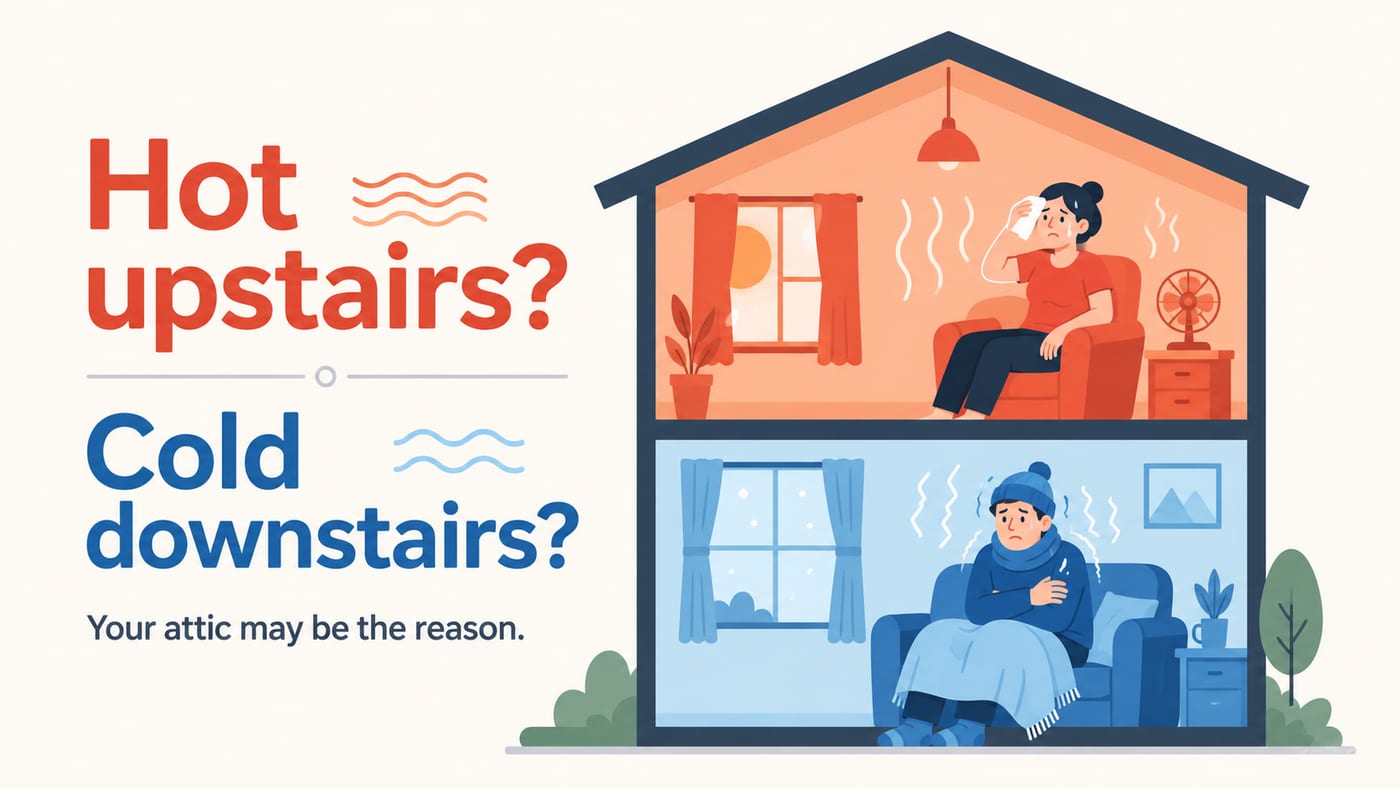
TL;DR: If your second floor feels like a different climate zone from your first floor, the problem usually is not your AC. It is your attic. Heat radiating down from an uninsulated or poorly sealed attic, combined with a physics principle called the stack effect, forces your HVAC system into overtime without ever solving the real issue. Air sealing and proper insulation at the attic level is the most effective way to even out temperatures between floors, lower your energy bills, and stop your system from burning out prematurely.
That Temperature Gap Between Floors Is Not Normal
Walk downstairs in July and your living room feels fine. Walk upstairs to your bedroom and it is ten degrees hotter. You have probably been told this is just how two-story homes work. It is not.
Yes, warm air rises. That is basic physics and it plays a role. But in a properly sealed and insulated home, your HVAC system should be able to overcome that natural tendency without breaking a sweat. When the temperature gap between your first and second floor is consistently five, ten, or even fifteen degrees, something else is going on.
In Oklahoma, that "something else" is almost always the attic.
Your Attic Is Cooking Your Second Floor
Here is what is actually happening above your ceiling. On a summer afternoon in Ada, Oklahoma, your attic temperature can easily exceed 150 degrees Fahrenheit. That kind of radiant heat load does not stay in the attic. It pushes straight down through the ceiling into your upstairs rooms.
Your second floor is not just fighting rising warm air from below. It is fighting a massive heat source pressing down from above. Your upstairs is getting squeezed from both directions, and your thermostat downstairs has no idea it is happening.
If your thermostat sits on the first floor (and in most Oklahoma homes it does), it reads a comfortable 72 degrees and tells the system to shut off. Meanwhile, your upstairs bedrooms are sitting at 80 or higher because the attic heat overhead never lets up.
The Stack Effect: Why Air Sealing Matters as Much as Insulation
There is a second force at work that most homeowners never hear about. It is called the stack effect, sometimes referred to as the chimney effect, and it makes the hot upstairs, cold downstairs problem significantly worse.
The stack effect works like this. Air enters your home at the lowest level through gaps in the foundation, crawl space vents, and cracks around basement windows. As that air warms inside your house, it rises. In a two-story home, it keeps rising through wall cavities, stairwells, and gaps around plumbing and electrical penetrations until it reaches the attic and escapes through unsealed openings in the ceiling plane.
As that warm air exits through the top of your home, it creates a pressure difference that pulls more outside air in from below to replace it. The cycle repeats continuously. Your HVAC system is conditioning air that is literally flowing out of the building.
According to ENERGY STAR, air leakage accounts for 25 to 40 percent of the energy used for heating and cooling in a typical home. That is not a small inefficiency. That is a quarter to nearly half of your energy budget being wasted on air you cannot keep inside your house.
The stack effect is strongest when the temperature difference between inside and outside is greatest. In an Oklahoma July with triple-digit outdoor temps, or during a January cold snap, the pressure driving air movement through your home is at its peak. Those are exactly the months your energy bills spike the hardest.
Why Duct Problems Make It Even Worse
If your HVAC ductwork runs through the attic (and in many Oklahoma homes it does), you have a compounding problem.
ENERGY STAR estimates that the average home loses 20 to 30 percent of the air moving through the duct system to leaks, holes, and poor connections. When those ducts are sitting in a 150-degree attic, two things happen at once. Cooled air leaks out of the supply ducts into the attic space where it does nothing useful. And the air that does stay in the ducts absorbs heat through the duct walls before it ever reaches your upstairs vents.
By the time that "conditioned" air exits the register in your second floor bedroom, it may have gained ten or fifteen degrees. Your AC produced cold air. Your ducts turned it warm before it arrived.
This is why so many Oklahoma homeowners crank their thermostat lower and lower in summer and never feel comfortable upstairs. The system is not undersized. The delivery path is the problem.
Solutions That Work (and Some That Don't)
When homeowners notice the temperature gap between floors, the first instinct is usually to call an HVAC technician. That is not always the wrong move, but it is often the wrong first move.
What usually does not fix it
Common "Fix" | Why It Does Not Work |
|---|---|
Closing vents downstairs | Increases duct pressure, causes more leaking, and strains your blower motor |
Lowering the thermostat | Runs the system longer without addressing the heat source above the ceiling |
Adding a portable AC upstairs | Treats the symptom, adds to your electric bill, and does nothing about the root cause |
Replacing the HVAC system | Expensive and will not help if the real problem is in the attic, not the equipment |
What actually addresses the root cause
The most effective approach targets the attic, because that is where the heat is entering and the conditioned air is escaping.
Solution | What It Does | Best For |
|---|---|---|
Air sealing the attic plane | Closes gaps around wiring, plumbing, recessed lights, attic hatches, and top plates to stop the stack effect | Every home with a temperature gap between floors |
Insulating the attic floor | Puts a thermal barrier between the hot attic and your living space | Homes without ductwork in the attic |
Insulating the roof deck (conditioned attic) | Applies insulation to the underside of the roof, bringing the entire attic inside the thermal envelope | Homes with ductwork in the attic (most effective approach) |
Duct sealing | Closes leaks in supply and return ducts using mastic or UL-181 rated tape | Any home with ducts running through unconditioned space |
A blower door test can quantify exactly how much air your home is losing and pinpoint where it is going, so you know which of these improvements will deliver the biggest return for your specific situation.
The EPA estimates that homeowners can save an average of 15 percent on heating and cooling costs by air sealing and adding insulation in attics, floors over crawl spaces, and basements.
Why This Matters More in Oklahoma Than Most States
Oklahoma's climate is uniquely punishing on two-story homes. You get extreme summer heat that turns attics into ovens, unpredictable spring temperature swings that cycle your HVAC system constantly, humid conditions that degrade traditional batt insulation over time, and winter cold snaps that reverse the stack effect and pull cold air in from below.
The U.S. Energy Information Administration reports that over 50 percent of household energy consumption goes toward space heating and air conditioning. In a state like Oklahoma, where both extremes hit hard, the building envelope is doing more work than in milder climates. A leaky, poorly insulated attic is not just an inconvenience here. It is a year-round drain on your budget and your comfort.
Energy Loss Factor | Impact | Source |
|---|---|---|
Air leakage through the building envelope | Accounts for 25% to 40% of heating and cooling energy use | ENERGY STAR |
Duct leaks in unconditioned spaces | 20% to 30% of conditioned air lost before reaching rooms | ENERGY STAR |
Heating and cooling share of total home energy | Over 50% of annual household energy consumption | U.S. Energy Information Administration |
Savings from air sealing and insulation | Average 15% reduction in heating and cooling costs | EPA |
How to Know If Your Attic Is the Problem
You do not necessarily need expensive diagnostic equipment to get a sense of whether your attic is contributing to the hot upstairs, cold downstairs pattern.
What You Notice | What It Likely Means |
|---|---|
Rooms directly below the attic are the hottest in the house | Radiant heat is transferring down through a poorly insulated ceiling |
AC runs constantly in summer but never catches up upstairs | The heat load from the attic is overwhelming your system's cooling capacity |
Visible gaps or daylight around attic hatches, recessed lights, or plumbing penetrations | Air is leaking between your living space and the attic, fueling the stack effect |
Old fiberglass insulation has settled below the top of the ceiling joists | Insulation has lost effective R-value and is no longer performing as designed |
Ductwork in the attic feels warm to the touch when the AC is running | Ducts are absorbing heat from the attic and warming your conditioned air before delivery |
Noticeably higher humidity upstairs compared to the first floor | Moisture-laden air is entering through attic leaks or being drawn upward by the stack effect |
A professional blower door test takes the guesswork out of it entirely. It depressurizes your home and measures exactly how much air is leaking and where. That data tells you precisely which improvements will make the biggest difference for your specific home.
Frequently Asked Questions
Q: Why is my upstairs so much hotter than downstairs even with the AC running? The most common cause is heat radiating down from a hot attic into the rooms directly below it. In Oklahoma, attic temperatures regularly exceed 150 degrees Fahrenheit in summer. When the attic is not properly air sealed and insulated, that heat pushes into your second floor continuously. Your AC may be producing cold air, but it cannot overcome the heat load coming from above.
Q: Will closing downstairs vents push more cool air upstairs? This is a common approach, but it usually backfires. Closing vents increases static pressure inside the duct system, which can cause more air to leak out of duct joints and connections. It also forces your blower motor to work harder, which can shorten equipment life. Balancing airflow is better handled by a technician adjusting dampers or by addressing the root cause of the temperature imbalance.
Q: Does the stack effect happen in summer too? Yes, although it behaves differently. In summer, the stack effect can still drive air movement through your home, particularly when the attic is significantly hotter than the outdoor ambient temperature. The greater the temperature difference between the bottom and top of your home, the stronger the pressure driving air upward. In Oklahoma summers, that difference is extreme.
Q: Is it better to insulate the attic floor or the roof deck? Both approaches can work, but they solve different problems. Insulating the attic floor keeps heat from entering your living space, but leaves your ductwork exposed to extreme attic temperatures. Insulating the roof deck brings the attic inside the conditioned envelope, protecting both the living space and the ductwork. For homes with ductwork in the attic, the roof deck approach typically delivers better results.
Q: How much can I actually save by fixing attic insulation and air sealing? According to ENERGY STAR, air leakage accounts for 25 to 40 percent of the energy used for heating and cooling. The EPA estimates that air sealing and adding insulation in attics, crawl spaces, and basements can save an average of 15 percent on heating and cooling costs. Actual savings depend on your home's current condition, but homes with significant air leakage and poor insulation tend to see the largest improvements.
Q: Do I need a new AC if my upstairs is always hot? Not necessarily. In many cases, the HVAC system itself is not the problem. If your attic is dumping heat into the second floor and your ductwork is leaking conditioned air into the attic space, even a brand new system will struggle. Addressing the attic insulation and air sealing first often reveals that the existing system was adequate all along. It is worth diagnosing the building envelope before investing in new equipment.
If uneven temperatures between your first and second floor have you frustrated heading into summer, start with what is above your ceiling. Rocking Rad Spray Foam LLC offers free on-site estimates with blower door testing so you know exactly where your home is losing the fight. We also offer 0% financing options to make the investment manageable. Call us or fill out our online form to schedule your assessment and get straight answers about what your home actually needs.