Can You Leave Spray Foam Exposed? What Oklahoma Code Says
TL;DR: Fresh spray foam looks finished, but whether it can stay exposed depends on the space it's in. Building code gives three paths. Living spaces need a thermal barrier, which is usually the drywall you were installing anyway. Attics and crawl spaces entered only to service utilities can use a lighter ignition barrier. And for shops, garages, and buildings where you don't want to cover the walls at all, approved intumescent coatings can satisfy the code while leaving the foam visible. The rules are simpler than they sound, and an experienced installer builds compliance into the job from the start.
The spraying is done, the foam has cured, and your shop or garage suddenly looks like the inside of a cooler. Then comes the question nearly every building owner asks next: do I have to cover this, or can I leave it just like it is?
It's a fair question, because the foam genuinely looks done. It's sealed, it's insulating, and covering it feels like extra work and extra money. The honest answer is that it depends on what the space is and how it's used, and building code has a specific section that sorts it out. This guide walks through what the code actually requires, which spaces qualify for lighter treatment, and the option that lets shop owners stay code-compliant without hanging a single sheet of drywall.
Why the Code Has Rules for Foam in the First Place
Spray polyurethane foam is a foam plastic, and the International Residential Code treats all foam plastics the same way, whether they're spray-applied, rigid boards, or anything else. Before any foam product reaches a job site, it has to pass surface burning tests, with a flame spread index of 75 or less and a smoke-developed index of 450 or less. Every legitimate spray foam product on the market meets those numbers.
The code then adds one more layer: in most interior applications, foam plastic needs to be separated from the occupied side of the building by a protective material. Think of it less as a judgment about spray foam and more as a standard rule the code applies to an entire category of building products. The good news is that complying is straightforward, and in many projects it happens automatically.
Path One: The Thermal Barrier
The baseline rule lives in Section R316 of the 2015 IRC, the code edition Oklahoma uses. Unless a specific exception applies, foam plastic must be separated from the interior of the building by an approved thermal barrier of at least 1/2 inch gypsum wallboard, or another material that passes the fire tests of NFPA 275.
Here's the practical translation: in any finished living space, the drywall you were already planning to install is the thermal barrier. Insulate the walls of a home, hang 1/2 inch drywall, and the requirement is satisfied without anyone thinking about it. The barrier's job is to hold back heat for a defined period, which is why the industry refers to it as a 15-minute barrier of protection between the foam and the occupied space.
For most homes, that's the whole story. The interesting questions start in the spaces that never get drywall.
Path Two: The Ignition Barrier Exception
The code recognizes that some spaces are different. An attic you crawl into twice a year to check the HVAC unit is not a bedroom, and the code doesn't treat it like one.
For attics and crawl spaces where entry is made only to service utilities, the full thermal barrier is not required. Instead, the foam can be protected by a lighter ignition barrier, and the code lists the acceptable materials: 1.5 inch mineral fiber insulation, 1/4 inch wood structural panel, 3/8 inch particleboard, 1/4 inch hardboard, 3/8 inch gypsum board, or corrosion-resistant steel of at least 0.016 inch thickness.
Two details matter here. First, the exception hinges on how the space is used. An attic that's only entered for service qualifies. Convert that attic into storage you visit regularly or a finished room, and it stops qualifying, which is one of the topics we covered in our guide to attic usable space. Second, certain foam products have been fire tested for specific assemblies, like crawl spaces and unvented attic roof decks, and can be approved without a separate prescriptive barrier. That's determined by the product's evaluation report, which is part of why product selection belongs to your installer rather than a guess.
Path Three: Intumescent Coatings, the Shop Owner's Answer
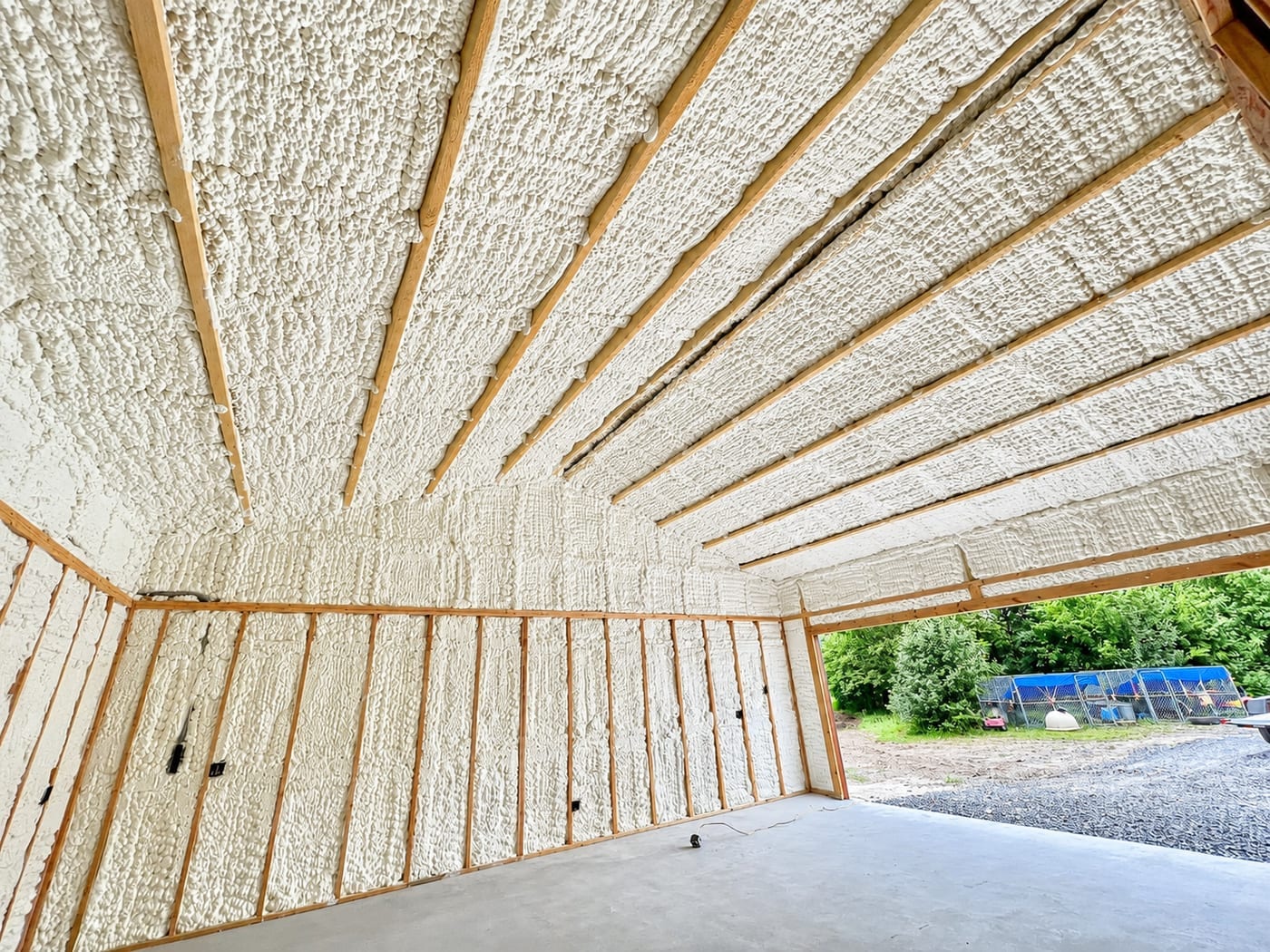
Now for the space in the photo above: a wood-framed shop or detached garage where the owner has no intention of hanging drywall. The walls are for tools, shelves, and pegboard, and covering every surface with gypsum board defeats the purpose of an open utility building.
This is where the code's third path comes in. Section R316.6 allows specific approval of alternative assemblies based on large-scale fire testing, and the most common alternative is a fire-protective intumescent coating sprayed directly over the cured foam. These coatings are tested with the specific foam products they cover, and when a tested coating and foam pairing is applied at the required thickness, the assembly complies without any board material at all.
Intumescent coatings work by reacting to high heat, swelling into a protective char layer that shields the foam underneath. Applied correctly, the coating adds a thin, paint-like finish over the foam, the texture of the installation stays visible, and the building keeps its open, functional character. For shops, barns, well houses, and metal buildings, this is usually the answer that fits how the building actually gets used, and it's the reason we offer fire-retardant coatings as a standard part of insulation projects rather than an afterthought.
One important caution: ordinary paint is not an intumescent coating, and a coating tested with one foam product doesn't automatically qualify over a different one. Compliance comes from the tested combination, applied at the tested thickness. This is exactly the kind of detail covered in our guide to spotting installation mistakes, because a missing or unqualified barrier is one of the most common shortcuts in low-bid work.
What This Means Space by Space
Space | Typical requirement | Common solution |
|---|---|---|
Finished living areas | Thermal barrier | 1/2 inch drywall, installed as part of finishing |
Attic, service access only | Ignition barrier or tested assembly | Prescriptive material or approved foam per its evaluation report |
Crawl space, service access only | Ignition barrier or tested assembly | Same as attic, per product approval |
Shop or garage being finished out | Thermal barrier | Drywall on the finished walls |
Shop, barn, or outbuilding left open | Alternative assembly | Approved intumescent coating over the foam |
Metal buildings | Similar framework under commercial code | Coating over foam is the standard approach |
Metal buildings deserve their own note. They typically fall under the International Building Code rather than the IRC, but the logic runs parallel: foam plastic needs a thermal barrier or an approved alternative, and coatings are the standard route since drywall rarely makes sense on a metal building interior.
Already Have Bare Foam? It Can Be Brought Up to Code
Plenty of Oklahoma shop and barn owners are reading this with foam already on the walls, installed years ago and never covered. The good news is that compliance doesn't require starting over. Intumescent coatings can be applied to existing, cured foam, and for most buildings that's a one-day project.
The process is simple. The foam surface is inspected and cleaned, any damaged sections are addressed, and the coating is spray-applied at the thickness its fire testing requires. Coverage matters more than anything else here, since the tested performance assumes the full surface is coated to spec, including the corners, framing transitions, and hard-to-reach areas above shelving and equipment. Once cured, the coating needs no ongoing maintenance beyond keeping it intact, and any future damage to a section can be spot-repaired.
If you're planning to eventually finish a shop with drywall anyway, it's worth deciding now rather than later. Drywall satisfies the requirement on the walls it covers, so a building that will be fully finished may not need coating at all, while a building staying open benefits from getting coated once and being done with it.
Who Actually Decides
Code sections set the framework, but the local code official interprets it for your building, and jurisdictions across Oklahoma vary in how they classify detached shops and accessory buildings. A detached building with no habitable space is sometimes viewed differently than an attached garage, and permit requirements differ from county to county.
The practical takeaway isn't to memorize code sections. It's to work with an installer who asks how each space will be used before the first pass of foam goes on, selects products whose evaluation reports match the application, and includes the right barrier or coating in the scope from day one. When compliance is planned into the job, it's a line item. When it's discovered after an inspection, it's a callback. Our overview of the Oklahoma code landscape covers the broader requirements that apply alongside R316.
Get the Foam and the Finish Right the First Time
Rocking Rad Spray Foam plans fire protection into every project, from drywall-ready residential work to intumescent coatings for shops, barns, and metal buildings across Oklahoma. Free estimates, 0% financing options available, and straight answers about what your specific building needs. Call (580) 320-5620 or request your free estimate online.
Frequently Asked Questions
Can I leave spray foam exposed in my detached shop?
Not bare, in most cases. If the shop won't be finished with drywall, the standard compliant route is an approved intumescent coating applied over the foam. Your local code official makes the final call for your building type, and your installer should confirm the requirement before the project starts.
Does regular paint count as a fire-protective coating?
No. Intumescent coatings are specialized products, fire tested in combination with specific foam products at specific thicknesses. Ordinary paint provides none of that protection and doesn't satisfy the code.
The foam in my attic has been exposed for years. Is that a problem?
It may be fully compliant. Attics entered only to service utilities qualify for the lighter ignition barrier rules, and some foam products are approved for that use based on their own fire testing, with no additional covering required. Whether your attic qualifies depends on the product installed and how the space is used, and an inspection can settle it quickly.
Do metal buildings need a thermal barrier too?
They follow a parallel set of rules under the commercial building code. Foam in a metal building needs a thermal barrier or an approved alternative, and since drywall is rarely practical against metal framing, a tested intumescent coating is the standard solution.
Does the coating change how the foam looks?
It adds a thin, uniform, paint-like layer over the foam surface, typically in white or light colors. The sprayed texture remains visible, and the building keeps its open utility feel. Most owners find the coated finish looks cleaner and brighter than bare foam.