Horse Barn Insulation Oklahoma: Temperature and Air Quality
TL;DR
Horse barns have fundamentally different insulation requirements than homes, shops, or cattle facilities. Horses are most comfortable between 45 and 65°F, a 1,000-pound horse produces roughly two gallons of moisture through respiration every day, and ammonia from urine in enclosed stalls creates respiratory risks that worsen in poorly ventilated, overly sealed environments. The goal of insulating a horse barn is not to make it airtight. It is to moderate temperature extremes, eliminate condensation dripping from the roof, and reduce radiant heat load in summer while maintaining the continuous airflow that keeps horses healthy. Closed-cell spray foam on the roof deck and walls provides the thermal break and condensation control that metal horse barns need, but it must be designed to work with ventilation, not replace it.
Why Horse Barns Are Not Like Other Metal Buildings
If you have read our guide to metal building and pole barn insulation, you know that uninsulated steel conducts heat aggressively, creates condensation on every cold surface, and makes climate control nearly impossible. All of that applies to horse barns.
But horse barns add a layer of complexity that shops, warehouses, and equipment storage buildings do not have: the animals inside them are sensitive to air quality, and the wrong insulation strategy can make respiratory problems worse rather than better.
Dave Freeman, Oklahoma State University Cooperative Extension equine specialist, puts it directly: closing up a barn to maintain heat may increase respiratory illnesses because of high ammonia content and bacterial growth in stalls. High humidity combined with warm temperature causes enough ammonia smell or bacteria growth to irritate the horse's respiratory system, frequently resulting in chronic, minor respiratory illnesses that interfere with performance.
This means the approach that works for a climate-controlled shop (seal everything, condition the air mechanically) is the wrong approach for most horse barns. Insulation and ventilation must be designed together from the start.
What Horses Actually Need from Their Environment
Horses are remarkably cold-tolerant when they have a full winter coat, adequate nutrition, and shelter from wind and rain. They are far less tolerant of heat, humidity, and poor air quality.
The ideal temperature range for stabled horses is approximately 45 to 65°F. A temperature of 50°F is comfortable for both horses and the people who work around them. Most healthy adult horses with a full coat do not need a heated barn in Oklahoma winters. What they need is protection from wind, rain, and condensation dripping on them from an uninsulated roof.
Humidity matters as much as temperature. According to Stable Management's guide to barn heating and ventilation, a good humidity level for horses is 50 to 75 percent, with 60 percent being optimal. Too dry is better than too humid. A single 1,000-pound horse puts approximately two gallons of moisture into the barn air every day through respiration alone. Four horses generate eight gallons daily before you count evaporation from urine, manure, and wet bedding.
That moisture has to go somewhere. In a sealed, unventilated barn, it condenses on cold surfaces, saturates bedding, and creates the warm, humid environment where ammonia concentrations rise, bacteria multiply, and respiratory problems develop. In a properly ventilated barn with insulated surfaces, the moisture exits through designed airflow paths while the insulation prevents it from condensing on the roof and walls.
What Insulation Does for a Horse Barn (and What It Should Not Do)
The purpose of insulating a horse barn is not to create an airtight, climate-controlled box. It is to accomplish three specific things:
Eliminate condensation drip. An uninsulated metal roof in Oklahoma will drip condensation on cool mornings from October through April. That water lands on horses, bedding, tack, and feed. Spray foam on the underside of the roof panels creates a thermal break that keeps the interior metal surface above the dew point, eliminating the drip. Even Penn State Extension's horse stable ventilation guide recommends a minimum of R-5 insulation on the roof of unheated barns specifically to prevent condensation, even under well-ventilated conditions.
Reduce summer heat load. Oklahoma horse barns with uninsulated metal roofs become dangerously hot in summer. The metal absorbs solar radiation and re-radiates it downward into the barn. Dr. Beau Whitaker of Brazos Valley Equine Hospital notes that spray foam insulation on the barn ceiling is helpful for cooling in hot weather and retaining warmth in cold months. The foam reflects and absorbs the radiant heat before it reaches the horses below, reducing interior temperatures significantly even without mechanical cooling.
Moderate temperature swings without sealing the barn. Oklahoma's 40-degree spring temperature swings (35°F at dawn, 75°F by afternoon) stress horses and create rapid condensation cycling. Insulation slows how quickly the barn interior responds to exterior temperature changes, giving the ventilation system time to manage moisture without the violent condensation events that occur on bare metal.
What insulation should not do in a horse barn is replace ventilation. A horse barn needs continuous air exchange to remove ammonia, dust, moisture, and pathogens. The University of Minnesota Extension guide to horse barn ventilation recommends at least one square foot of ridge opening and one square foot of eave opening per horse housed. Insulation moderates the thermal environment while ventilation manages air quality. Both are required. Neither works alone.
Where to Insulate in an Oklahoma Horse Barn
Not every surface in a horse barn needs the same treatment. Prioritizing the highest-impact locations keeps the project cost-effective.
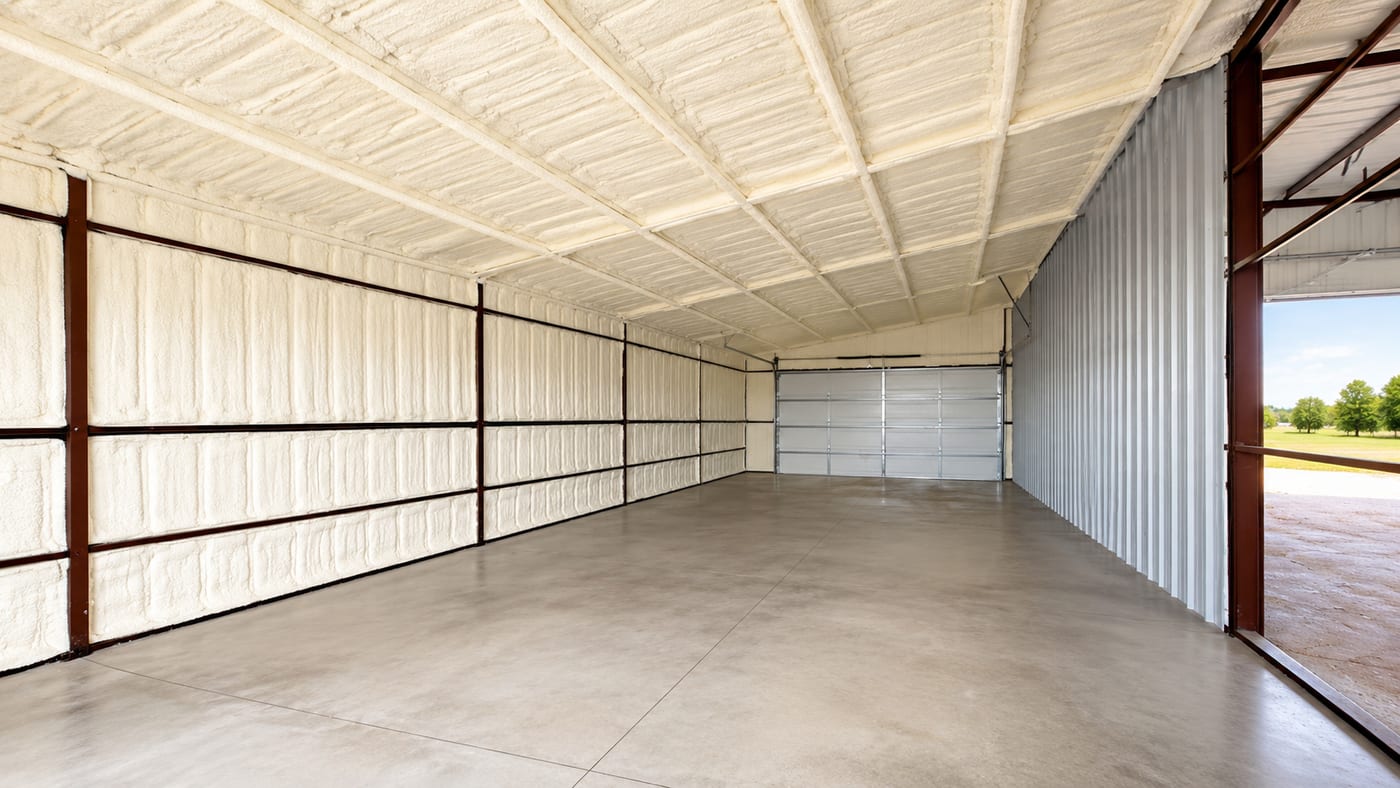
The roof deck is the highest priority. This is where condensation forms, where summer heat radiates down, and where the biggest thermal penalty exists. Two inches of closed-cell spray foam on the underside of the metal roof panels eliminates condensation drip, reduces radiant heat transfer, and provides approximately R-13 of thermal resistance. The foam conforms to the corrugated panel profile and seals around purlins and fasteners where condensation typically concentrates.
Exterior walls in stall areas come second. Horses standing in stalls are in direct proximity to the wall surface. An uninsulated metal wall radiates cold in winter and heat in summer directly onto the animal. Two inches of closed-cell foam on the stall-facing walls creates a thermal buffer and eliminates the cold surface that draws body heat away from the horse in winter.
End walls and gable areas benefit from insulation if the barn is partially enclosed. If the barn has open ends or large open bays for natural ventilation, insulating the end walls may not be necessary. Focus on the surfaces that are enclosed and face the horses.
Do not insulate areas designed for ventilation. Ridge vents, eave openings, cupola outlets, and intentional ventilation gaps must remain clear and functional. Spray foam should never cover or restrict these openings. The insulation goes on the solid surfaces between the ventilation pathways.
Why Closed-Cell Foam Is the Right Choice for Horse Barns
Open-cell spray foam is excellent for residential interior walls and attic assemblies, but it is not the right product for a horse barn's metal surfaces. Open-cell foam is vapor-permeable and absorbs moisture. In a horse barn where four horses can produce eight gallons of airborne moisture per day, open-cell foam on the metal walls or roof would absorb that moisture over time, lose R-value, and potentially support mold growth on the foam itself.
Closed-cell spray foam at R-6 to R-7 per inch achieves a vapor permeance below 1 perm at 2 inches, which prevents moisture from migrating through the foam to the cold metal surface behind it. It is rigid, does not absorb water, and bonds directly to the steel panels. It is also resistant to damage from horses rubbing against walls, kicking stall partitions, and the general physical demands of a working barn environment.
For horse barns where the foam will remain exposed (not covered with drywall or paneling), fire barrier requirements apply. An intumescent coating over the cured foam provides a code-compliant barrier in buildings where traditional wall coverings are impractical. Fire safety in horse barns is critical given the presence of hay, bedding, and animals that cannot self-evacuate.
The Ventilation Side of the Equation
Insulation without proper ventilation in a horse barn is worse than no insulation at all. A well-insulated but poorly ventilated barn traps moisture, ammonia, and heat, creating exactly the environment that causes respiratory illness.
The most effective ventilation approach for Oklahoma horse barns is natural ventilation using the stack effect: warm, moist air rises and exits through ridge vents or cupola openings at the peak of the roof, drawing cooler, drier air in through eave openings or sidewall inlets near ground level. This exchange happens continuously without fans or electricity.
Penn State Extension recommends at least one square foot of ridge opening and one square foot of eave opening per horse. For a 10-stall barn, that means 10 square feet of ridge opening and 10 square feet of eave opening at minimum. Cupola openings should be no smaller than 2 by 2 feet for single-story barns.
In Oklahoma's summer heat, supplemental fans may be needed to move air when the temperature difference between inside and outside is small (which reduces the stack effect's driving force). Fans designed for agricultural use with safety guards positioned out of horses' reach are the standard approach.
The key principle: insulate the solid surfaces to control temperature and condensation, then ventilate through designed openings to control air quality. The two systems complement each other.
Ready to Make Your Horse Barn More Comfortable and Safer?
At Rocking Rad Spray Foam LLC, we insulate horse barns, equine facilities, and livestock buildings across Oklahoma. We understand that horse barns require a balance between insulation and ventilation that is different from a shop or warehouse. We assess your barn's layout, stall configuration, and ventilation design before recommending foam type and thickness. We offer free on-site estimates and 0% financing. Contact us or fill out our online form to schedule yours.
Frequently Asked Questions
Will insulating my horse barn make it too warm in summer?
No. Insulation reduces radiant heat transfer from the metal roof, which actually makes the barn cooler in summer. The interior temperature will be lower than an uninsulated barn under the same conditions because the foam blocks the solar heat that the metal panels absorb and re-radiate downward. Ventilation still handles air exchange and removes the heat that does enter.
Should I heat my horse barn in Oklahoma winters?
For most healthy adult horses with a full coat, no. OSU Extension equine specialist Dave Freeman recommends maintaining temperatures around 45 to 55°F and using blankets for horses with short coats rather than heating the entire barn. Heated barns with poor ventilation increase respiratory illness risk. Insulation moderates temperature and prevents condensation without requiring supplemental heat in most Oklahoma winters.
How much moisture do horses actually produce?
A 1,000-pound horse produces approximately two gallons of moisture per day through respiration alone. Four horses generate eight gallons daily before counting evaporation from urine, manure, and wet bedding. This moisture must be managed through ventilation, not sealed inside the barn.
Can spray foam withstand horses kicking or rubbing against the walls?
Closed-cell spray foam is rigid and durable, but it can be damaged by direct impact from hooves. In stall areas where horses may kick, consider installing kick boards or protective paneling over the foam from ground level to approximately 4 feet. Above kick height, the foam can remain exposed (with appropriate fire barrier coating).
How much does horse barn insulation cost?
Cost depends on the barn's square footage of roof and wall area, foam thickness, and how many surfaces need coverage. A typical 6 to 10 stall horse barn with closed-cell foam on the roof and stall walls generally runs $8,000 to $20,000 depending on size and complexity. A free on-site estimate gives you exact numbers for your barn.
Are there financial assistance programs for horse barn insulation?
Agricultural building insulation may qualify for cost-share assistance through USDA programs such as EQIP (through NRCS). The Oklahoma Department of Commerce Weatherization Assistance Program serves qualifying households but does not cover agricultural buildings. Contact your local NRCS office for current program availability for equine facilities.