What Code Minimum Insulation Means in Oklahoma Homes
TL;DR
When a builder says "your home meets code," they mean it passes the minimum legal threshold for insulation. In Oklahoma, that is R-38 in the attic and R-13 in the walls for most of the state. What code does not guarantee is how well those numbers perform in the real world. RESNET studies show that the majority of fiberglass batt installations fall at Grade III quality, losing 30% or more of their rated performance due to gaps, compression, and voids around wiring and plumbing. The DOE confirmed in 2026 that homes with spray foam consume 22.4% less energy than homes with conventional fiberglass. That gap is the difference between what code requires on paper and what actually performs inside your walls. Understanding it helps you make a better decision whether you are building new, buying a recently built home, or trying to understand why your energy bills are higher than they should be.
What Oklahoma Code Actually Requires
Oklahoma's adopted energy code sets prescriptive minimums for insulation by climate zone. For Climate Zone 3A, which covers most of the state including Ada, Oklahoma City, Tulsa, Norman, and Lawton, the requirements are:
Attic or ceiling: R-38. Approximately 12 inches of blown-in fiberglass or 10 inches of cellulose.
Wood-frame walls: R-13 cavity insulation, or R-13 plus R-5 continuous exterior insulation, or R-20 cavity fill.
Floors over unconditioned space: R-19.
Crawl space walls: R-10 continuous or R-13 cavity.
Air leakage: 3 ACH50 or less on a blower door test for new construction.
For Climate Zone 4A (northern Oklahoma counties), requirements increase to R-49 attic and R-20 walls.
These numbers are reasonable engineering minimums. The code is not wrong. The problem is the gap between what these numbers mean in a laboratory test and what they deliver inside a real home built under real construction conditions.
The Gap Between Labeled R-Value and Installed Performance
This is the part that most homeowners never hear about, and it is where the real story of code minimum lives.
Fiberglass batts are tested and labeled under ideal laboratory conditions: no compression, no gaps, no voids, perfect contact with all six surfaces of the cavity. In a lab, R-13 fiberglass delivers R-13. In a real wall cavity with electrical wiring, plumbing, outlet boxes, and a framing crew working on a schedule, the installation rarely matches laboratory conditions.
RESNET grades insulation installation on three tiers. Grade I is perfect: complete cavity fill, uniform thickness, no gaps, no voids, no compression around obstructions. Grade II has minor imperfections. Grade III has visible gaps, compression, and missing coverage. The performance difference between Grade I and Grade III is 30% or more. An R-19 wall installed at Grade III performs like R-13 or worse.
The industry data is blunt: the majority of fiberglass batt installations in production homebuilding fall at Grade II or Grade III. Batts are stuffed behind wiring instead of being split around it. They are compressed around plumbing instead of being notched to fit. They are cut too short or too narrow, leaving gaps at the top, bottom, or edges of the cavity.
Oak Ridge National Laboratory research puts the impact in even starker terms: a 4% void in insulation coverage can reduce the effective R-value of the entire assembly by up to 50%. Four percent. That is one missed corner in a stud bay.
This is not about bad builders or lazy crews. It is about a product (fiberglass batts) whose performance is extremely sensitive to installation quality, installed under production conditions where speed and cost pressure work against perfection.
Why Builders Stop at Code Minimum
Builders are not doing something wrong by building to code. They are making a rational business decision driven by three forces:
Cost competition. In Oklahoma's competitive new construction market, every dollar added to the build cost makes the home harder to sell against comparable properties at a lower price. The cost premium for spray foam over fiberglass batts in a typical home is $3,000 to $10,000. If the buyer does not request or understand the difference, that premium comes directly out of the builder's margin or makes the home less competitive.
Invisible to buyers. A homebuyer walking through a finished home cannot see the insulation behind the drywall. R-13 fiberglass batts and 2-inch closed-cell spray foam both disappear behind the same sheet of drywall. Granite countertops are visible. Insulation is not. Builders invest where buyers can see the difference.
Code is the legal standard. Meeting code satisfies every inspection, qualifies for every mortgage, and fulfills every legal obligation. There is no penalty for building to code minimum and no regulatory incentive to exceed it in most Oklahoma jurisdictions. The decision to go above code is the buyer's responsibility, not the builder's obligation.
This is important framing: the issue is not that builders are cutting corners. The issue is that the market does not reward above-code insulation the way it rewards visible upgrades. The system works exactly as designed. It just does not optimize for energy performance.
What Code Minimum Actually Looks Like in Practice
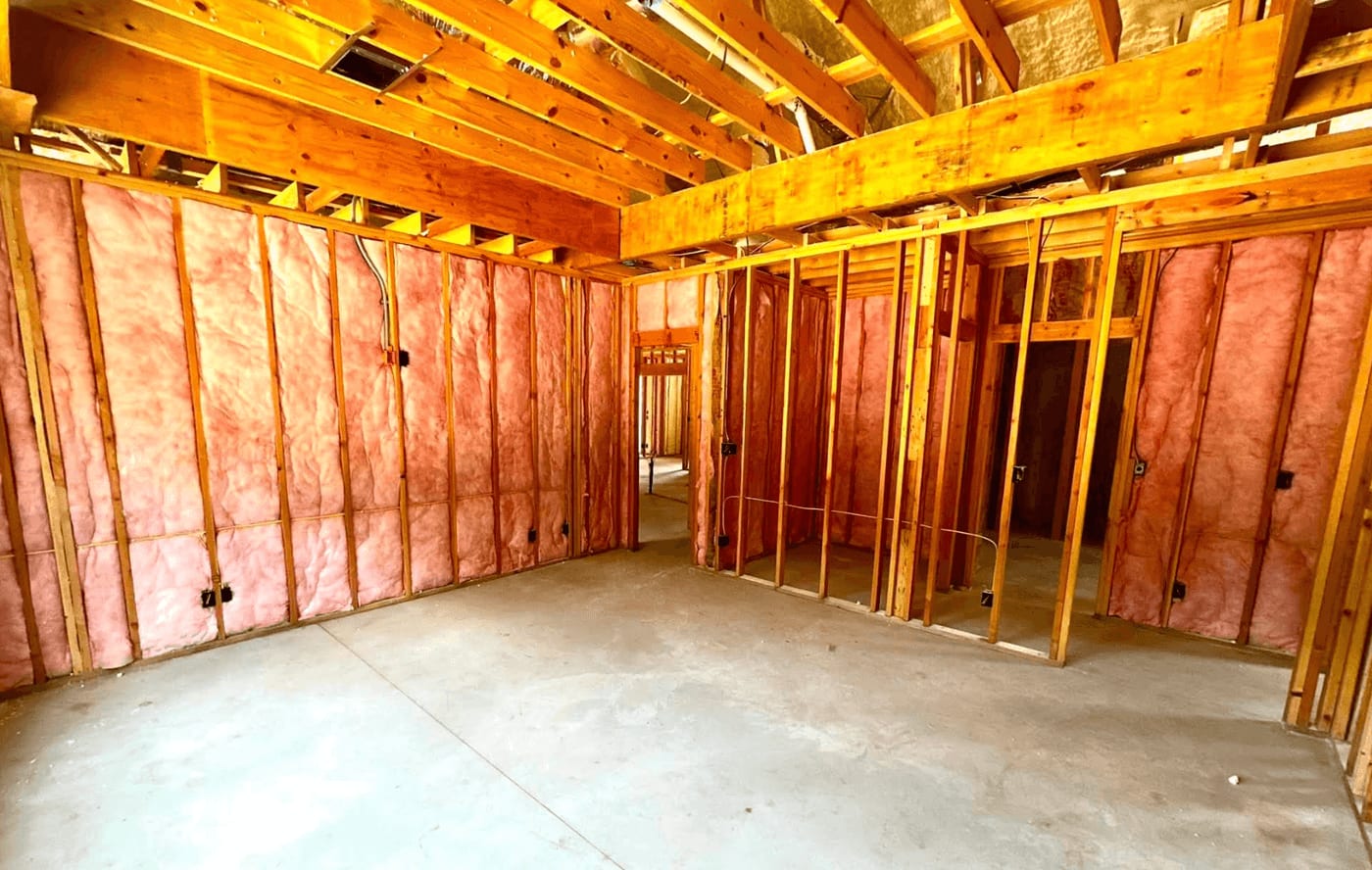
If you could see behind the drywall of a code-minimum Oklahoma home, here is what you would typically find:
R-13 fiberglass batts in 2x4 wall cavities. The batts are present and they are approximately the right size. Around electrical outlet boxes, the batt is compressed or pushed behind the box rather than being split and fitted around it. Around plumbing pipes, the batt is squeezed rather than notched. At the top of the cavity, there may be a gap between the top of the batt and the top plate. Each of these imperfections reduces the effective R-value at that specific point, and the cumulative effect across an entire house is significant.
R-38 blown-in fiberglass on the attic floor. The material is there. The depth markers confirm R-38. The code inspector checks the depth and passes the inspection. But underneath that insulation, the penetrations in the ceiling plane (recessed light cans, wiring holes, plumbing vents, HVAC boots, top plates where walls meet the ceiling) were not individually air sealed before the insulation was blown over them. The insulation covers the leaks but does not seal them. Air passes through the fiberglass as if it were not there.
Blower door test at or near 3 ACH50. The home passes the air leakage test, but the test measures the TOTAL leakage, not where each leak is. A home that squeaks past at 2.9 ACH50 with fiberglass and basic caulking has a fundamentally different air barrier than a home that tests at 1.5 ACH50 with spray foam. Both pass code. One leaks twice as much air.
The 22.4% Performance Gap
The DOE's 2026 Building Technology Office study measured what happens when you replace code-minimum fiberglass with spray foam in the same building assemblies. The result: homes with spray foam consume 22.4% less energy for heating and cooling compared to homes with conventional fiberglass.
That gap comes from three compounding factors:
Air sealing. The DOE identifies air leakage as responsible for 25 to 40% of heating and cooling energy use. Fiberglass does not stop air movement. Spray foam does. This single difference accounts for the largest portion of the performance gap.
Installation consistency. Spray foam expands to fill every void and conforms to every surface. There is no Grade III spray foam installation because the product does not rely on precise cutting and fitting. The foam itself guarantees full cavity coverage. The installation quality variable that plagues fiberglass is largely eliminated.
Thermal bridging reduction. In a standard wood-framed wall, 23 to 25% of the wall surface is framing, not insulation. Those wood members conduct heat 3 to 4 times faster than insulation. Spray foam applied continuously over or around framing reduces this thermal bridging effect. Fiberglass batts sitting between framing members leave the framing fully exposed as a heat highway.
What Above-Code Performance Looks Like
An above-code Oklahoma home does not look different from the outside. The difference is measurable and it shows up in every utility bill.
Walls. Instead of R-13 fiberglass batts with Grade II or III installation quality, closed-cell spray foam at 2 inches delivers R-13 plus air sealing plus vapor retarder plus structural reinforcement. Same labeled R-value. Dramatically different real-world performance because the air leakage and installation quality variables are eliminated.
Attic. Instead of R-38 blown-in fiberglass on the attic floor with no air sealing below, open-cell spray foam on the roof deck creates a conditioned attic, brings ductwork inside the envelope, and eliminates the 20 to 30% duct leakage penalty. Or spray foam air sealing at every attic floor penetration before blown-in fiberglass gives the fiberglass the air barrier it needs to perform at its rated value.
Blower door result. Code allows 3 ACH50. A spray-foamed home typically achieves 1.5 to 2.5 ACH50. Half the air leakage of a code-minimum home. Measurable with a blower door test. Visible on every energy bill.
HERS score. A code-minimum home scores approximately 80 to 100 on the HERS Index. A spray-foamed home with a tight envelope and right-sized HVAC can achieve scores in the 40s to 50s, meaning it uses 50 to 60% less energy than the 2006 baseline.
What This Means If You Are Building New
The window to upgrade from code minimum to above-code performance is open during construction and closes the day drywall goes up. Here is what to ask your builder:
What insulation product are you specifying? If the answer is R-13 fiberglass batts in the walls and R-38 blown-in in the attic, that is code minimum. Ask what it would cost to upgrade to spray foam.
What air sealing is included beyond the batts? Fiberglass does not air seal. If the only air sealing is caulk at the sill plate and foam at the window frames, the home will leak air at every unsealed ceiling penetration.
Will the HVAC be sized with a Manual J calculation based on the final insulation? If the HVAC is sized before the insulation type is confirmed, it may be oversized for the finished envelope.
Can I get a HERS rating to document performance? A HERS score gives you third-party verified proof of what you paid for.
What This Means If You Already Own a Code-Minimum Home
If your home was built to code minimum and you are experiencing high bills, uneven temperatures, or humidity problems, the insulation behind your walls is likely part of the cause.
You do not have to re-insulate the entire house at once. A blower door test identifies where the worst air leaks are. Starting with the attic (the single largest loss zone) delivers the most improvement per dollar. Adding crawl space encapsulation and rim joist sealing addresses the next largest leak sources. Each improvement brings your home closer to above-code performance one step at a time.
Ready to Find Out Where Your Home Stands?
At Rocking Rad Spray Foam LLC, we help Oklahoma homeowners understand the gap between code minimum and actual performance. We provide blower door testing, thermal imaging, and honest assessments that show you exactly where your home is losing energy and what it would take to fix it. Whether you are building new and want above-code insulation specified from the start, or you own an existing home that is not performing the way it should, we can help. Free on-site estimates and 0% financing available across Oklahoma. Contact us or fill out our online form to schedule yours.
Frequently Asked Questions
Is my builder doing something wrong by building to code minimum?
No. Code minimum is legal, standard, and what the market expects. Builders are required to meet code and are not penalized for not exceeding it. The decision to go above code is yours as the buyer. If you want spray foam or above-code performance, specify it in writing before construction begins and budget for the cost difference.
How much more does above-code insulation cost during new construction?
The cost premium for spray foam over fiberglass in a typical Oklahoma new build is $3,000 to $10,000 depending on home size and scope. This is the smallest it will ever be because the walls are open and there is no demolition or old insulation to remove. The same upgrade after the home is finished costs significantly more.
Can I tell if my existing home was built to code minimum?
Not from the finished interior. A blower door test measures air leakage. Thermal imaging reveals where heat is crossing the building envelope. Together, they show whether your insulation is performing at code minimum, below code, or above code. If your home was built before 2010 and has never been upgraded, it is very likely at or below current code minimums.
Does above-code insulation affect my home's resale value?
Standard appraisals do not have a line item for insulation quality. However, documented spray foam with a HERS score and low utility bills attracts more buyers, reduces days on market, and can generate stronger offers. The energy savings during ownership often recover the investment before the home goes on the market.
Why does spray foam perform so much better than fiberglass at the same R-value?
Because R-value only measures resistance to heat flow through the material. It does not measure air leakage, which is where 25 to 40% of heating and cooling energy is lost. Fiberglass delivers its rated R-value only under perfect installation conditions. Spray foam delivers its rated R-value plus a complete air seal in every installation. The 22.4% energy gap the DOE documented is almost entirely attributable to the air sealing difference.
Are there financial assistance programs for above-code insulation?
There is currently no federal tax credit for residential insulation. The Oklahoma Department of Commerce Weatherization Assistance Program provides no-cost energy efficiency improvements to qualifying households. Some Oklahoma utilities offer rebates. For a full breakdown, see: Oklahoma Spray Foam Rebates and Incentives.