Can Bad Spray Foam Be Fixed or Does It Need to Come Out?
TL;DR
It depends on what went wrong. Localized thin spots, small adhesion gaps, and missed areas can usually be repaired by cutting out the affected section and re-spraying. Widespread off-ratio foam, total adhesion failure like foam peeling off the substrate in sheets, and persistent chemical odors typically require full removal and reinstallation. Spray foam removal costs $3 to $12 per square foot depending on foam type and accessibility, which means a failed 1,000 square foot attic installation can cost $3,000 to $12,000 just to remove before any new insulation goes in. The EPA warns that removal of improperly applied spray foam may not always resolve the problem if chemical contaminants have migrated to other building surfaces. Getting it right the first time is always cheaper than fixing it the second time, but if you are already dealing with bad foam, this guide helps you understand your options.
Failures That Can Usually Be Repaired in Place
Not every spray foam problem requires tearing everything out. Some failures are localized and can be corrected without removing the entire installation.
Thin spots and insufficient thickness. If the foam is properly cured and adhered but was not applied thick enough in certain areas, the fix is straightforward. The thin area is identified (using a depth gauge or probe), and additional foam is sprayed over the existing cured foam to bring the thickness up to specification. New foam bonds well to properly cured existing foam, so this is a reliable repair. These thin spots are most common in corners, around penetrations, and at transitions between walls and ceilings where the gun could not reach easily.
Small adhesion gaps. If the foam has pulled away from the substrate in a limited area (a few square feet, not the entire surface), the delaminated section can be cut out, the substrate cleaned and prepared, and new foam applied to that specific spot. Building science guidance recommends verifying substrate moisture content and temperature before re-spraying to ensure the same adhesion failure does not recur.
Missed cavities or voids. If the installer missed a section entirely (a stud bay, a rim joist, an area behind a pipe), foam can be applied to the missed area without disturbing the rest of the installation. This is the simplest repair and only requires access to the unfoamed surface.
Minor shrinkage cracks. Some foam formulations can develop hairline cracks as they cure, especially if lifts were applied slightly too thick or ambient temperatures were at the edge of the acceptable range. If the cracks are shallow and the foam is otherwise well-adhered and properly cured, a fresh pass of foam over the cracked area seals the gaps. Deep cracks that extend through the full thickness of the foam indicate a more serious curing problem and need closer evaluation.
The key factor in all repairable failures: the foam that remains must be properly cured, correctly colored (cream or off-white, not discolored), and firmly bonded to the substrate. If the existing foam is the right product applied under acceptable conditions and the failure is limited in scope, repair is usually the most cost-effective path.
Failures That Require Full Removal
Some failures cannot be patched. When the underlying chemistry is wrong or the adhesion failure is systemic, the entire installation must come out.
Widespread off-ratio foam. When the A-side and B-side chemicals are mixed at the wrong ratio, the foam does not cure properly throughout the entire application, not just in one spot. Off-ratio foam may be discolored (dark amber or yellowish-brown instead of cream), excessively brittle (A-rich), or soft and gummy (B-rich). It may produce a persistent chemical odor from unreacted isocyanates. You cannot fix off-ratio foam by spraying new foam over it. The improperly cured material must be removed because it continues to off-gas, does not deliver its rated R-value, and does not function as an air barrier.
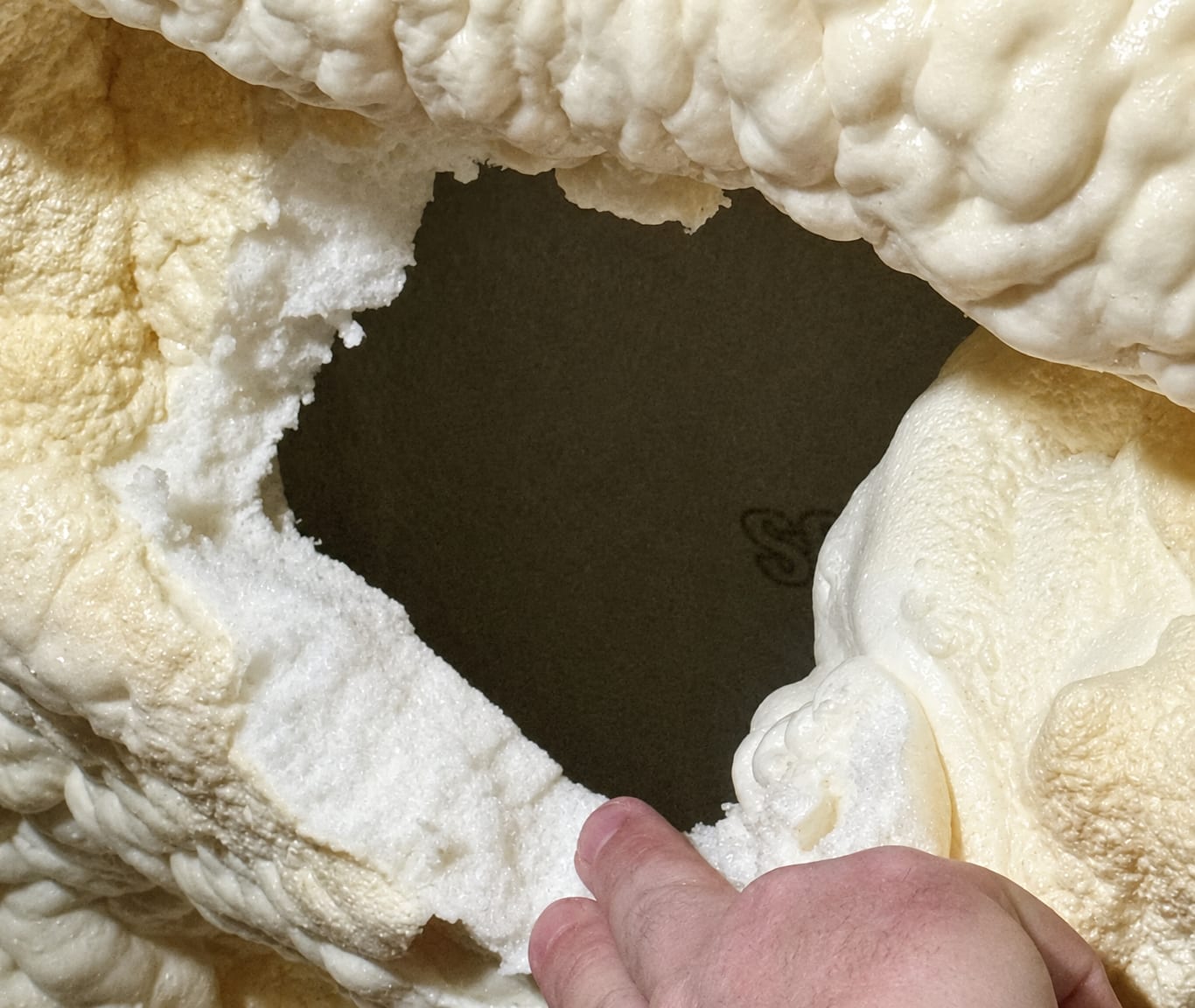
Total adhesion failure. The hero image on this blog shows what this looks like: foam peeling off the roof deck in sheets with zero bond to the substrate. When foam separates from the surface it was supposed to adhere to, it is not insulating, not air sealing, and not controlling moisture. The substrate was likely wet, dusty, below dew point temperature, or coated with a contaminant when the foam was applied. Removing the delaminated foam, preparing the substrate properly, and re-applying is the only fix. If the adhesion failure extends across most of the installation, full removal is faster and more reliable than trying to patch individual sections.
Persistent chemical odor. If you smell a strong, lingering chemical odor (fishy, sweet, or acrid) more than 48 hours after installation and ventilation does not resolve it, the foam is likely off-ratio and releasing unreacted isocyanates into the indoor air. The EPA states that the potential for off-gassing of volatile chemicals from spray polyurethane foam is not fully understood. In cases of widespread off-ratio installation, consultation with an indoor air quality professional is recommended before pursuing remediation. The foam must come out, and the building must be evaluated for chemical migration to other surfaces before new insulation is installed.
Foam that never fully cured. If the foam remains soft, tacky, or spongy days or weeks after application, it has not completed the chemical reaction. This foam will not achieve its rated R-value, will not function as an air or vapor barrier, and may continue to release chemicals indefinitely. Full removal is the only option.
What Spray Foam Removal Actually Involves
Removing spray foam is not like removing fiberglass batts. Spray foam bonds chemically and mechanically to the surfaces it touches. Getting it off requires labor-intensive mechanical methods.
The removal crew uses scrapers, grinders, and in some cases specialized milling tools to separate the foam from the substrate. Closed-cell foam is harder and more time-consuming to remove than open-cell because of its density and bond strength. The foam is removed in sections, bagged, and disposed of. The CPSC notes that disturbing cured spray foam can generate dust containing unreacted chemicals, so removal crews must wear appropriate respiratory protection and containment measures.
After removal, the substrate must be inspected. Roof sheathing, rafters, studs, and other framing members may have adhesive residue, surface damage from scraping, or moisture damage that was hidden behind the foam. Any structural damage must be repaired before new insulation is installed. If the original failure was caused by a wet substrate, the moisture source must be identified and corrected (roof leak, condensation, plumbing issue) before re-insulating.
What Removal and Reinstallation Costs
The financial reality of a failed spray foam installation is painful, and homeowners should understand the full scope before making decisions.
Removal costs for spray foam run $3 to $12 per square foot depending on foam type (closed-cell is more expensive to remove than open-cell), thickness, accessibility, and whether hazardous contamination is involved. For a typical 1,000 square foot attic, removal alone costs $3,000 to $12,000.
Substrate repair after removal adds cost if scraping damaged the sheathing or framing. Minor surface damage is common. Significant structural damage from aggressive removal or from moisture trapped behind failed foam can add $1,000 to $5,000 or more depending on scope.
Reinstallation with new spray foam adds the full cost of a new installation on top of the removal. For a 1,000 square foot attic, that is another $3,000 to $7,000 depending on foam type and thickness.
Total cost of a failed installation can easily reach $10,000 to $25,000 when you add removal, repair, and reinstallation. That is three to five times what a correct installation would have cost originally.
Who Pays for a Failed Installation?
This depends on the circumstances, the contractor's warranty, and whether the failure resulted from negligence.
If the original contractor is still in business and carries insurance, you should contact them first with documentation (photos, dates, description of the problem). A reputable contractor will inspect the work, acknowledge the failure if it is their fault, and either repair or remove and redo the job at their expense. Their liability insurance may cover the remediation costs.
If the contractor is unresponsive, out of business, or disputes responsibility, you may need an independent assessment from another qualified spray foam contractor or an indoor air quality professional. Their written report documenting the failure becomes your evidence for pursuing the claim through the contractor's insurance, your homeowner's insurance, or small claims court.
If the failure caused health effects (respiratory problems, persistent odors requiring temporary relocation), document medical visits and expenses. These may be recoverable through the contractor's liability insurance or through legal action.
Get a second opinion before authorizing removal. Not every complaint about spray foam warrants full removal. An independent SPFA-certified contractor can evaluate whether the problem is repairable, whether the foam is actually off-ratio or just cosmetically imperfect, and what the most cost-effective path forward is. For more on what to look for in a properly installed job, see our guide: Common Spray Foam Installation Mistakes and How to Spot Them.
How to Get It Right the Second Time
If you have been through a failed installation, the last thing you want is a repeat. Here is what to do differently when hiring the replacement contractor:
Verify SPFA certification for the individual who will be spraying, not just the company.
Ask for the specific foam product's technical data sheet and confirm that the substrate conditions (temperature, moisture content, cleanliness) will be verified before spraying begins.
Request a blower door test before and after installation to document the air sealing improvement in measured numbers. If the contractor will not test their own work, find one who will.
Get the re-entry time in writing based on the specific product being used, not a generic "24 hours."
Ask about their process for handling failures. A contractor who has a clear warranty policy and an honest answer about what they do when things go wrong is more trustworthy than one who claims nothing ever goes wrong.
For a full checklist of what professional installation looks like, see our guide: Why Spray Foam Is Not a DIY Project.
Ready for a Second Opinion on Your Spray Foam?
At Rocking Rad Spray Foam LLC, we evaluate failed spray foam installations for Oklahoma homeowners and property owners. We assess whether the foam can be repaired or needs to come out, identify the root cause of the failure, and provide a plan for getting it right. If you are dealing with foam that is peeling, crumbling, soft, discolored, or producing a persistent odor, we can help. Free on-site assessments and 0% financing on reinstallation projects. Contact us or fill out our online form to schedule yours.
Frequently Asked Questions
How do I know if my spray foam is off-ratio?
Off-ratio foam typically shows one or more of these signs: persistent chemical odor beyond 48 hours after installation, discoloration (dark amber, yellow-brown, or streaky rather than uniform cream), excessive brittleness (crumbles when pressed), or excessive softness (feels gummy or does not spring back). If you see or smell any of these, contact your contractor immediately and do not occupy the space until it is evaluated.
Can new spray foam be applied over old failed foam?
Only if the old foam is properly cured, well-adhered, and the failure is limited to insufficient thickness. New foam bonds well to properly cured existing foam. If the old foam is off-ratio, delaminated, or uncured, it must be removed first. Spraying over bad foam traps the problem and does not fix it.
How long does spray foam removal take?
A typical residential attic (1,000 to 1,500 square feet) takes two to four days for full removal depending on foam type, thickness, and accessibility. Closed-cell foam takes longer than open-cell due to its density and stronger bond. The removal crew works in shifts to manage fatigue and maintain safety in the confined space.
Will my homeowner's insurance cover a failed spray foam installation?
It depends on your policy and the nature of the damage. Some policies cover consequential damage (mold, water intrusion, structural damage caused by the failed insulation) but not the insulation itself. The original contractor's liability insurance is typically the first avenue for recovery. Consult your insurance agent with your documentation.
Should I get an independent air quality test before removal?
Yes, if you are experiencing persistent odors or health symptoms. An independent indoor air quality professional can test for isocyanate compounds, volatile organic compounds, and other indicators of off-ratio foam. Their report provides objective data for remediation planning and supports any insurance or legal claims.
Can Rocking Rad fix spray foam that another contractor installed?
Yes. We regularly assess and remediate failed installations from other contractors across Oklahoma. We evaluate the foam condition, identify the failure cause, recommend repair or removal, and handle the reinstallation with our own materials and crew. A free on-site assessment is the first step.