How Leaky Is Your Home? What a Blower Door Test Finds in OK
TL;DR: Air leakage accounts for 25 to 40 percent of the energy a typical home uses for heating and cooling, and most of it comes from places you can't see or feel. A blower door test measures exactly how leaky your home is in about an hour, shows where the air is actually getting in, and gives you a real number before you spend a dollar on improvements. It's the difference between guessing your house is drafty and knowing precisely how drafty, and it's the smartest first step for any Oklahoma homeowner considering insulation work.
You already know your house leaks. You feel it in the hallway that never warms up, the floors that stay cold through February, the way the AC runs all afternoon in July without ever quite catching up. What you don't know is how much it leaks, where the air is actually coming from, and whether fixing it is worth the money.
Most homeowners handle that uncertainty by guessing. They caulk a window, add a door sweep, maybe buy one of those draft stoppers shaped like a dog. Then the next utility bill arrives looking exactly like the last one, and the guessing starts over.
There's a test that ends the guessing. It takes about an hour, it doesn't damage anything, and it turns "my house feels drafty" into a precise measurement you can act on. Here's how a blower door test works, what it typically finds in Oklahoma homes, and why it's the right first step before any insulation decision.
The Hidden Scale of the Problem
Air leakage isn't a minor annoyance around a couple of windows. According to ENERGY STAR, air leakage accounts for between 25 and 40 percent of the energy used for heating and cooling in a typical residence. The Department of Energy estimates that of the roughly $2,000 the average American household spends on energy each year, $200 to $400 could be going to waste through drafts, air leaks, and outdated heating and cooling systems.
Here's the part that surprises people. When a Department of Energy scientist was asked about sealing homes, his answer was that while weatherstripping doors and windows might improve comfort, it makes a relatively small contribution to overall home leakage, because the biggest holes are in places like attics and crawl spaces.
In other words, the leaks you can feel are rarely the leaks that matter. The drafts at the window get your attention because they blow across your skin at standing height. The gaps that are actually costing you money sit above your ceiling and below your floor, where you never feel them at all. That's exactly why guessing doesn't work, and why measurement does.
What a Blower Door Test Actually Is
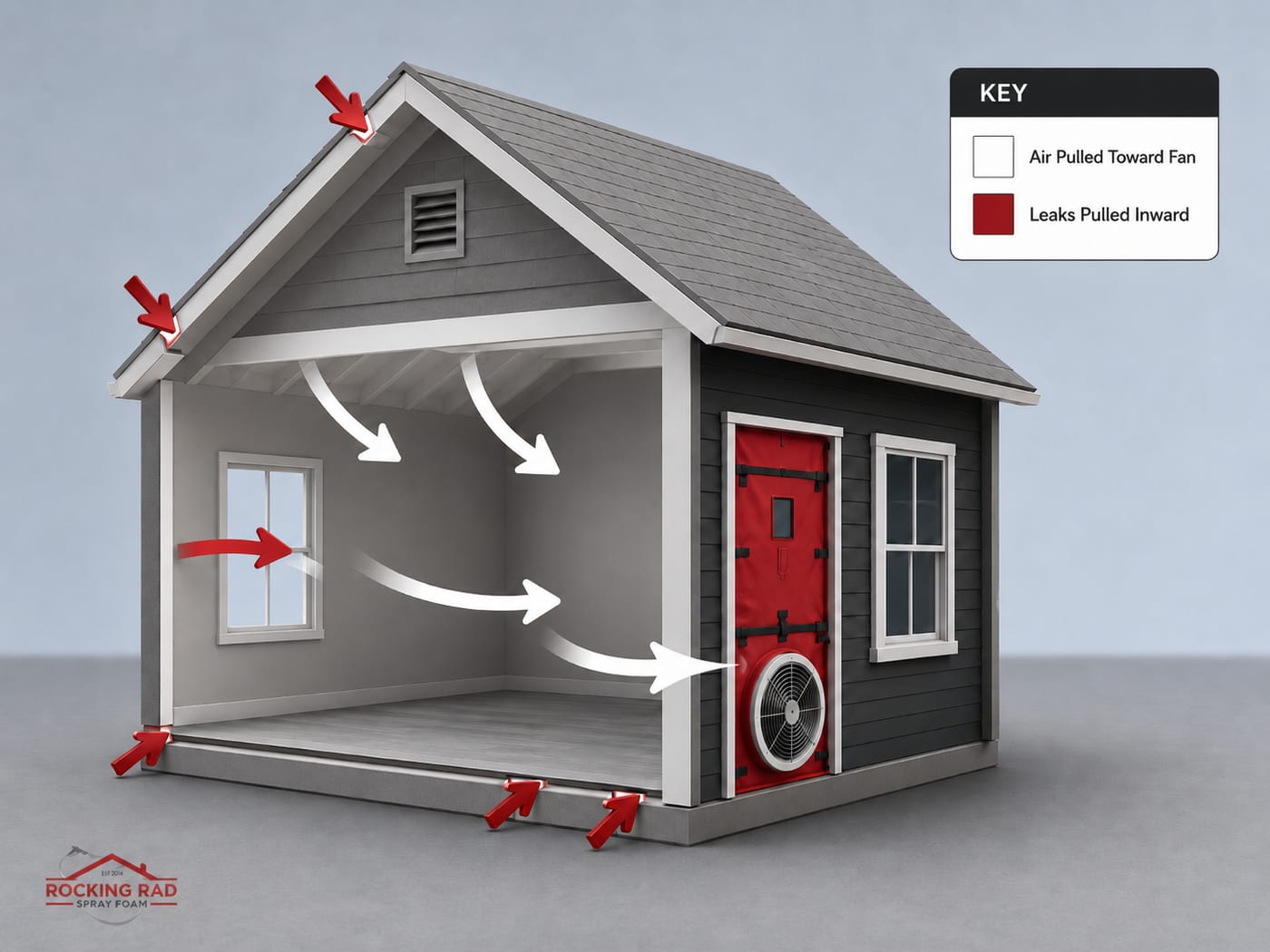
A blower door is a calibrated fan mounted in an adjustable frame that seals into one of your exterior doorways. Once it's sealed in place, the fan pulls air out of the house, lowering the pressure inside slightly below the pressure outside. Nothing dramatic happens. You can be home, walk around, and watch the whole thing.
With the house depressurized, physics does the honest work. Outside air pushes in through every gap, crack, and hole in the building envelope, all at once, all in the same direction. Leaks that are invisible during normal life suddenly become findable. The fan's instruments measure exactly how much air is moving through the house, which translates into a leakage number for your specific home.
Meanwhile the technician walks the house while the fan runs, feeling and tracing where the incoming air originates. A smoke pencil or an infrared camera makes the leak paths visible: air washing in around a ceiling light, pouring through a plumbing chase, streaming across the top of a wall. By the end of the hour, you have two things you didn't have before: a number that says how leaky the house is overall, and a map of where the leaks actually are.
If you want the deeper technical side, our guide to blower door testing and HERS ratings covers how the ACH50 measurement works and what Oklahoma's building code requires for new construction. For this article, the plain-language version is enough: lower numbers mean tighter homes, and older Oklahoma homes routinely test far leakier than anything code would allow today.
What the Test Typically Finds in Oklahoma Homes
Every house is different, but after enough tests, patterns emerge. These are the usual suspects in existing Oklahoma homes, and notice that none of them are windows.
Attic penetrations. Every wire, pipe, duct, and light fixture that passes through your ceiling is a hole in the envelope. Recessed can lights are among the biggest offenders, since older housings are essentially open chimneys into the attic. Individually each penetration looks trivial. Added together across a whole ceiling, they often behave like a small open window running around the clock.
The attic hatch. An uninsulated, unsealed pull-down stair or access panel is one of the largest single openings in most homes, and almost nobody thinks about it.
Rim joists. The band of framing where your floor system meets the foundation walls is one of the most overlooked leak sites in any home, which is why we wrote a full guide to rim joist sealing. In homes with crawl spaces, which covers a large share of Oklahoma housing, this band leaks air along the entire perimeter of the house.
Plumbing and chimney chases. The framed cavities that carry pipes and flues between floors act like interior highways for air, connecting the crawl space to the attic right through the middle of your house.
Ductwork in unconditioned space. While the blower door runs, leaky duct connections in the attic or crawl space often reveal themselves too, pulling air in through supply registers even with the system off. Duct leakage is technically its own problem with its own test, but a blower door appointment frequently catches the worst of it, and in Oklahoma homes with attic ducts it's a common finding.
Top plates and wall intersections. Where interior walls meet the ceiling, small construction gaps run the length of every wall. Invisible from below, and significant in total.
A blower door test doesn't just confirm these exist in your house. It ranks them, showing which ones are moving serious air and which are minor, so any money you spend afterward goes where it counts.
The Number Changes the Decision
Here's the practical value of testing before improving: the result tells you what kind of project your house actually needs, and sometimes it tells you what you don't need.
A house that tests moderately leaky with a few concentrated problem areas might be a targeted air sealing project. A house that tests very leaky, with air moving through the attic plane and crawl space along the whole footprint, is a strong candidate for spray foam, since foam insulates and air seals in one application, addressing both problems the test revealed. And a house that tests reasonably tight but still feels uncomfortable points the investigation somewhere else entirely, like duct leakage or an oversized AC that cools without dehumidifying.
That's the honest reason we lead with testing. It's the same logic behind our free energy audit: measure first, then recommend. When a contractor proposes insulation without measuring anything, the homeowner has no way to know whether the proposal fits the problem. When the recommendation follows a blower door number and a leak map, you can see the reasoning for yourself. If your insulation is aging on top of the leakage problem, the signs your insulation is failing usually show up during the same walkthrough.
There's a second benefit worth knowing about. If you do move forward with air sealing or spray foam, a follow-up test after the work measures exactly how much the house tightened. The improvement isn't a feeling or a promise. It's the difference between two numbers on the same instrument.
What to Expect at the Appointment
The whole visit typically runs about an hour for an average home. Before the technician arrives, there's almost nothing to do: the test works with the house as it normally operates. During setup, exterior doors and windows are closed, interior doors are opened, and fireplace dampers are shut. Then the fan runs for several minutes while measurements are taken, the technician walks the house tracing leaks, and afterward you review the findings together.
The test is non-destructive and safe for occupied homes. The pressure difference involved is small, roughly the equivalent of a 20 mph wind pushing on the house, something every Oklahoma home experiences regularly anyway. You'll feel air moving near the leaks, which is the point, and that's the extent of the drama.
Stop Guessing, Start Measuring
Rocking Rad Spray Foam performs blower door testing across Oklahoma, both as a standalone diagnostic and as the measurement step before and after insulation projects. Free estimates, 0% financing options available, and recommendations built on your home's actual numbers instead of assumptions. Call (580) 320-5620 or request your free estimate online.
Frequently Asked Questions
How long does a blower door test take?
About an hour for a typical home, including setup, the test itself, and walking through the findings. Larger homes take somewhat longer.
Do I need to prepare my house before the test?
Very little. The technician handles the setup, which involves closing exterior doors and windows, opening interior doors, and closing fireplace dampers. You can be home during the entire test, and nothing about it damages or alters the house.
Is a blower door test worth it for an older home?
Older homes benefit most. Homes built before modern energy codes were never air sealed in any deliberate way, and they routinely test far leakier than their owners expect. The test shows exactly where decades of accumulated gaps are costing you, and it ranks them so improvements start with the biggest offenders.
Can't I just find the leaks myself with a candle or incense?
You can find some of them, on a windy day, at the leaks you can reach. What you can't do is measure the total, find the hidden leaks in the attic plane and crawl space where most of the loss happens, or know when you've sealed enough. The blower door does all three, which is why it's the standard tool professionals use.
What happens after the test?
You get the leakage number for your home and a walkthrough of where the significant leaks are. If improvements make sense, the findings shape a specific recommendation, whether that's targeted air sealing, spray foam, or something else the test pointed to. If you proceed with work, a follow-up test can verify the improvement with a before-and-after comparison.