Spray Foam R-Value Explained for Oklahoma Homeowners
TL;DR: R-value measures how well insulation resists heat flow. Higher is better, but R-value per inch is only part of the picture. Closed cell spray foam delivers R-6 to R-7 per inch, open cell delivers R-3.5 to R-3.8, and fiberglass batts deliver R-2.9 to R-3.8. The number on the label matters less than what happens after installation. Fiberglass can lose 20 to 50 percent of its rated R-value due to air gaps, compression, and poor installation. Spray foam maintains its rating because it expands to fill every void and seals air movement at the same time.
What R-Value Actually Means
R-value measures thermal resistance. The higher the number, the harder it is for heat to pass through the material. That is all it measures. It does not measure air sealing, moisture resistance, durability, or how long the material performs at its rated level.
The U.S. Department of Energy defines R-value as the capacity of an insulating material to resist heat flow, noting that the higher the R-value, the greater the insulating power. It is calculated based on the material type, thickness, and density.
Most homeowners encounter R-value when they see it printed on insulation packaging or listed in a building code requirement. But understanding what those numbers mean in practice, especially across different insulation types, is where the real value lies.
R-Value Per Inch: How Spray Foam Compares
Not all insulation delivers the same thermal resistance per inch of thickness. This matters because it determines how much material you need to hit a specific R-value target, and how much space that material takes up inside your walls, attic, or crawl space.
Insulation Type | R-Value Per Inch | Inches Needed for R-20 | Acts as Air Barrier | Moisture Resistant |
|---|---|---|---|---|
Closed cell spray foam | R-6.0 to R-7.0 | About 3 inches | Yes (at 1 inch) | Yes (vapor retarder at 2 inches) |
Open cell spray foam | R-3.5 to R-3.8 | About 5.5 inches | Yes (at 3.5 inches) | No (vapor open) |
Fiberglass batts | R-2.9 to R-3.8 | About 6 inches | No | No |
Blown-in fiberglass | R-2.2 to R-2.7 | About 8 to 9 inches | No | No |
Blown-in cellulose | R-3.2 to R-3.7 | About 5.5 to 6 inches | No | No |
Rigid foam board (XPS) | R-5.0 | 4 inches | No (joints must be taped) | Yes |
Sources: U.S. Department of Energy, Johns Manville, University of Maryland Extension
Closed cell spray foam delivers roughly double the R-value per inch compared to fiberglass batts. That means you can achieve the same thermal resistance in about half the thickness. In a standard 2x4 wall cavity with only 3.5 inches of depth, that difference matters significantly. Closed cell foam can reach approximately R-21 to R-24.5 in that cavity. Fiberglass batts in the same space max out around R-13 to R-15.
Why R-Value on the Label Is Not the Whole Story
This is the part most insulation conversations skip, and it is arguably the most important part.
R-value is tested under controlled laboratory conditions. The material is placed flat, with no gaps, no compression, no air movement across its surface, and at a standardized temperature. In your home, none of those ideal conditions exist.
Fiberglass batts are particularly affected by real-world installation. According to research cited by ENERGY STAR and building science professionals, fiberglass can lose 20 to 50 percent of its effective R-value due to installation defects, compression around wiring and plumbing, gaps at framing members, and air movement through the material.
A fiberglass batt rated at R-19 that is compressed to fit around a pipe or electrical box might perform closer to R-11 or R-12 in that section. A batt that is cut slightly too narrow and leaves a half-inch gap at the stud bay performs as if the gap has almost no insulation at all, because air moves through the gap freely.
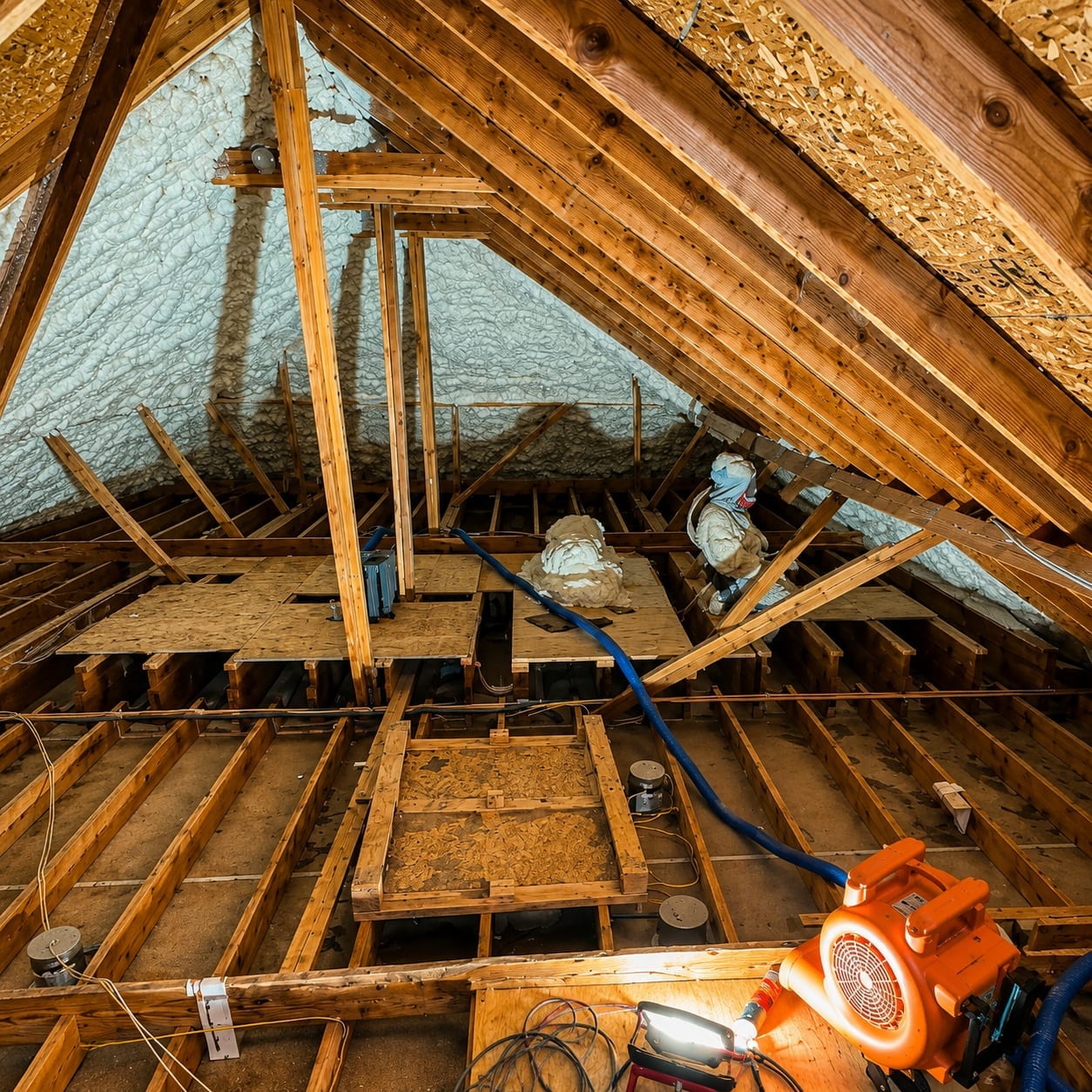
Spray foam does not have this problem. It is applied as a liquid, expands to fill the cavity, and adheres directly to every surface it contacts. There are no gaps, no compression, and no air channels for convective heat loss. The R-value it is rated at is very close to the R-value it delivers in service.
This is why building scientists and energy auditors frequently observe that a spray foam assembly rated at R-20 outperforms a fiberglass assembly rated at R-30 in actual energy use.
The Air Sealing Factor That R-Value Does Not Capture
R-value only measures resistance to conductive heat transfer, meaning heat moving through a solid material. It does not account for convective heat transfer, which is heat carried by moving air.
In a real home, air movement is responsible for a large share of energy loss. ENERGY STAR reports that air leakage accounts for 25 to 40 percent of the energy used for heating and cooling in a typical home. No amount of R-value can compensate for air that is freely flowing through or around your insulation.
This is where spray foam has a structural advantage that R-value alone does not reflect. Both open cell and closed cell spray foam function as air barriers when applied at sufficient thickness. Open cell becomes an air barrier at approximately 3.5 inches. Closed cell becomes an air barrier at just 1 inch. Fiberglass and cellulose, regardless of how thick they are applied, do not stop air movement.
When you combine R-value and air sealing into a single installed performance metric, spray foam consistently outperforms insulation types with similar or even higher nominal R-values.
What R-Value Does Oklahoma Code Require?
Oklahoma's energy code requirements vary depending on which climate zone your property sits in. Most of the state, including Ada, Oklahoma City, Tulsa, Norman, and Durant, falls within IECC Climate Zone 3. The northern panhandle region falls into Climate Zone 4.
Oklahoma has adopted a modified version of the 2021 IECC with state-specific amendments that reduced some requirements for Climate Zone 3.
Building Component | Oklahoma Climate Zone 3 | Climate Zone 4 (Northern OK) |
|---|---|---|
Ceiling / Attic | R-30 | R-38 |
Wood frame walls | R-13 | R-20 or R-13 + R-5 continuous |
Floor over crawl space | R-19 | R-30 |
Basement walls | R-5 continuous or R-13 cavity | R-10 continuous or R-13 cavity |
Crawl space walls | R-5 continuous or R-13 cavity | R-10 continuous or R-13 cavity |
Source: Oklahoma Administrative Code, modified 2021 IECC
These are minimums, not recommendations. Meeting code means your home passes inspection. It does not necessarily mean your home is comfortable or energy efficient in Oklahoma's extreme climate. Many building science professionals recommend exceeding code minimums, particularly for attics and exterior walls, where the temperature difference between inside and outside is greatest.
How Much Spray Foam Thickness Hits Code in Oklahoma
One of the most practical questions homeowners ask is how many inches of spray foam they actually need. The answer depends on the foam type, the building component, and which climate zone the property is in.
Target R-Value | Closed Cell (at R-6.5/inch) | Open Cell (at R-3.7/inch) |
|---|---|---|
R-13 (Zone 3 walls) | 2 inches | 3.5 inches |
R-20 (Zone 4 walls) | 3 inches | 5.5 inches |
R-30 (Zone 3 ceiling) | 4.6 inches | 8.1 inches |
R-38 (Zone 4 ceiling) | 5.8 inches | 10.3 inches |
For wall cavities, closed cell spray foam is often the practical choice because it achieves code R-value within the depth of a standard 2x4 or 2x6 stud bay. Open cell can work in deeper cavities, particularly in 2x6 framed walls or attic rafter bays where space is not a constraint.
For attic applications, open cell spray foam applied to the underside of the roof deck is common because the rafter depth provides enough room for the necessary thickness. Closed cell at the roof deck requires less thickness but is denser and heavier, which can be a consideration in some roof assemblies.
Common R-Value Misconceptions
"Higher R-value always means better insulation." Not necessarily. R-value measures one dimension of insulation performance. A product with R-30 that allows air to pass through it freely will underperform a product with R-20 that also seals air movement. Installed performance matters more than lab-tested R-value.
"All R-13 insulation performs the same." Two different materials can both be rated R-13 and perform very differently in the same wall. A fiberglass batt rated R-13 that is compressed, gapped, or poorly cut will deliver significantly less thermal resistance than spray foam rated R-13 that fills the entire cavity and seals air movement.
"You just need to add more insulation to fix energy problems." If your existing insulation is full of air leaks, adding more insulation on top of a leaky assembly does not solve the problem. The air movement underneath continues to carry heat past the insulation. Sealing the air leaks first, then insulating, is the correct order of operations.
"R-value stays the same forever." Some insulation types degrade over time. Fiberglass batts can sag and settle, losing effective R-value as they compress. Blown-in cellulose settles after installation, which is why installers typically blow it in at greater-than-rated depth to account for settling. Closed cell spray foam can experience a small amount of "thermal drift" as blowing agents slowly diffuse over the first five to ten years, typically settling from an initial R-7 per inch down to R-6 to R-6.5 per inch, where it stabilizes for the life of the product.
"R-value is the only thing building inspectors check." In Oklahoma, code compliance also includes air leakage testing. The 2021 IECC requires new homes to demonstrate no more than 5 ACH50 (air changes per hour at 50 Pascals of pressure) through a blower door test, though Oklahoma's adopted amendments may modify this threshold. Meeting R-value requirements alone does not guarantee passing a blower door test, which is another reason air-sealing insulation products have an advantage.
Frequently Asked Questions
Q: What R-value does spray foam insulation have? Closed cell spray foam delivers R-6.0 to R-7.0 per inch of thickness. Open cell spray foam delivers R-3.5 to R-3.8 per inch. The exact value depends on the specific product and manufacturer, but these ranges are consistent across the industry and confirmed by the U.S. Department of Energy.
Q: Is R-value the most important factor when choosing insulation? It is one important factor, but not the only one. Air sealing ability, moisture performance, durability, and installed quality all affect how well insulation actually performs in your home. A lower R-value product that also seals air leaks can outperform a higher R-value product that does not.
Q: How thick does spray foam need to be in Oklahoma? For most of Oklahoma (Climate Zone 3), walls require a minimum of R-13 and ceilings require R-30. Two inches of closed cell spray foam achieves R-13 for walls. For ceilings, approximately 4.6 inches of closed cell or 8.1 inches of open cell meets the R-30 minimum. These are code minimums, and exceeding them can improve comfort and energy savings.
Q: Does spray foam R-value decrease over time? Open cell spray foam maintains its R-value over time because it uses air as its insulating gas. Closed cell spray foam may experience a slight decrease as the blowing agent slowly diffuses over the first five to ten years, typically settling from R-7 to approximately R-6 to R-6.5 per inch, where it stabilizes permanently.
Q: Why does spray foam outperform fiberglass at the same R-value? Because R-value only measures resistance to conductive heat transfer. Fiberglass does not stop air movement, so convective heat loss passes through it freely. Spray foam blocks both conductive and convective heat transfer by insulating and air sealing in one application. In real-world conditions, this dual function makes spray foam significantly more effective than its R-value number alone would suggest.
Q: What R-value should I aim for in my Oklahoma attic? Oklahoma code requires R-30 for Climate Zone 3 ceilings. ENERGY STAR recommends R-38 to R-49 for attics depending on climate zone. Going beyond the code minimum in the attic typically delivers the highest return because attics see the largest temperature differentials and are responsible for the greatest share of heat gain and loss in most homes.
Understanding R-value is the first step, but knowing how it interacts with air sealing, moisture control, and real-world installation conditions is what leads to a smart insulation decision. If you want to know what R-value your home currently has and what it should have, Rocking Rad Spray Foam LLC offers free on-site estimates with blower door testing. We also offer 0% financing options. Call us or fill out our online form to get straight answers about your specific home.