Spray Foam for Oklahoma Workshops and Detached Buildings
TL;DR
An uninsulated detached garage, workshop, or outbuilding in Oklahoma is essentially an outdoor space with a roof. Summer interior temperatures exceed 130°F, winter temperatures match the outdoors, and any HVAC equipment you install fights a losing battle without an insulated envelope to hold the conditioned air. Pacific Northwest National Laboratory research found that insulating a garage can reduce heating and cooling energy consumption by up to 40% compared to an uninsulated space. Spray foam is the most effective single product for outbuildings because it insulates and air seals in one application, conforms to irregular framing, and does not require a separate vapor barrier. Insulate first, then size your HVAC. That sequence determines whether your workshop costs $30 a month to condition or $120.
The Difference Between "Storage" and "Work in It Every Day"
Most detached garages and outbuildings in Oklahoma were built to store vehicles, equipment, or materials. They were never designed for someone to spend hours inside them. The construction reflects that: single-layer walls with no insulation, no air barrier, no vapor control, and no mechanical ventilation. A metal or wood-framed shell that keeps rain out and nothing else.
That is fine for parking a truck. It is not fine for running a woodworking shop in July, working from a home office in January, training in a home gym in August, or spending an afternoon on a hobby when it is 100°F outside and 130°F inside.
Converting an outbuilding into a space you can comfortably occupy year-round requires two things in the correct order: first, an insulated and sealed building envelope that can hold conditioned air; second, a properly sized HVAC system matched to the insulated load. Skip the insulation and go straight to HVAC, and you are pumping conditioned air into a building that cannot hold it. Your equipment runs constantly, your energy bills spike, and the space still is not comfortable.
Why Insulation Must Come Before HVAC
This is the most expensive mistake outbuilding owners make, and it mirrors the same principle we cover for homes in our guide to HVAC sizing and equipment costs.
An uninsulated detached garage or workshop needs roughly 35 to 40 BTU per square foot of cooling capacity to maintain a comfortable temperature. The same space properly insulated with spray foam drops to approximately 25 to 30 BTU per square foot. For a 500 square foot workshop, that is the difference between needing an 18,000 BTU system and a 12,000 BTU system. The smaller unit costs less to buy, less to install, less to run every month, and lasts longer because it is not overworked.
Industry data consistently shows that insulating before installing HVAC can reduce the required equipment size by 30 to 40%. That is not a marginal improvement. It is the difference between a system that barely keeps up and one that maintains temperature effortlessly.
The EPA confirms that air sealing combined with insulation saves an average of 15% on heating and cooling costs. In an outbuilding starting from zero insulation, the savings percentage is typically much higher because the baseline is so poor.
Why Spray Foam Works Better Than Batts in Outbuildings
Detached workshops and garages present insulation challenges that fiberglass batts handle poorly.
Irregular framing. Many outbuildings, especially older ones and metal-framed structures, have non-standard stud spacing, mixed framing materials, and cavities that do not match standard batt widths. Spray foam expands to fill whatever cavity it encounters, regardless of dimensions.
No existing air barrier. Outbuildings typically have no housewrap, no air barrier membrane, and no taped sheathing. Every seam, every gap between framing members, and every penetration is a direct air path to the outside. Fiberglass batts do not stop air movement. Spray foam seals and insulates in one step.
Moisture exposure. Detached buildings in Oklahoma face humidity infiltration from every direction. An outbuilding with fiberglass batts and no vapor barrier absorbs moisture during humid spring months, loses R-value, and can support mold growth on the paper facing. Closed-cell spray foam at 2 inches functions as its own vapor retarder and does not absorb moisture.
Single-application simplicity. In an outbuilding where you want to insulate and get back to work, spray foam goes on in one day and cures within 24 hours. There is no separate air barrier to install, no vapor retarder to tape, and no batt fitting around pipes and wiring. The entire insulation, air sealing, and vapor control job happens in one visit.
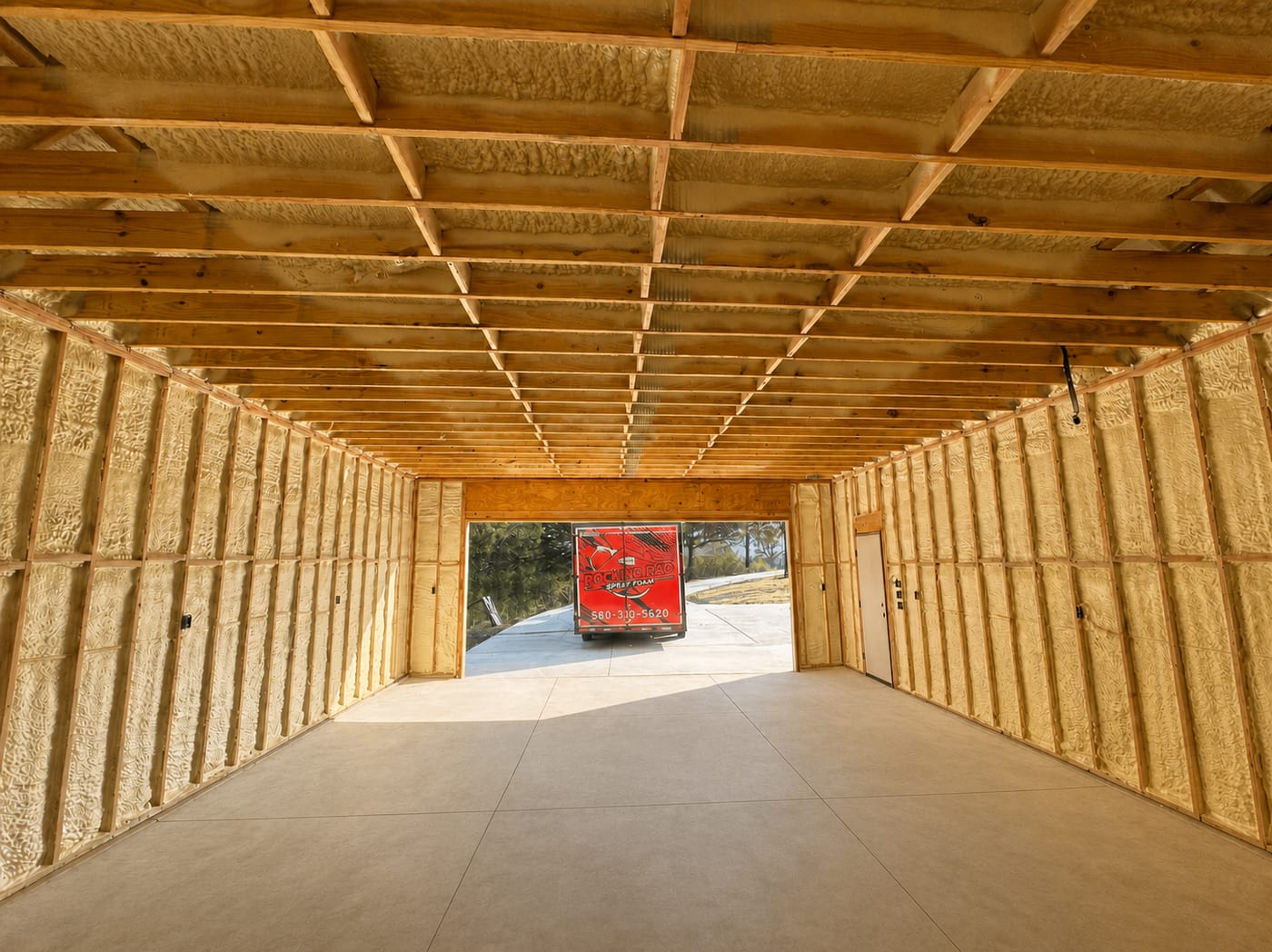
For most Oklahoma workshops, closed-cell spray foam at 2 inches on the walls delivers R-13 (meeting the Oklahoma 2015 IECC wall requirement) plus air sealing and vapor control. On the ceiling, 3 to 4 inches delivers R-20 to R-28 depending on the product. For deeper cavities or budget-conscious projects, a hybrid approach using closed-cell on the exterior walls and open-cell on the ceiling balances cost and performance. For more on how these two foam types differ, see our guide: What Is Spray Foam Insulation?
HVAC After Insulation: The Mini-Split Advantage
Once the envelope is sealed and insulated, the next step is climate control. For detached outbuildings, a ductless mini-split heat pump is the most practical option for several reasons.
No ductwork required. The indoor unit mounts on the wall and the outdoor unit sits outside. A single refrigerant line connects them through a small hole in the wall. There are no ducts to install, no trunk lines to route, and no duct leakage to worry about.
Independent from your house. A mini-split gives the outbuilding its own climate system that does not borrow capacity from your home's HVAC. Your house stays comfortable while the workshop runs independently.
Heating and cooling in one system. Mini-split heat pumps provide both cooling and heating. In Oklahoma, where you need AC from April through October and heat from November through March, a single unit handles both seasons.
Efficient operation. Modern mini-splits use inverter compressors that ramp up and down rather than cycling on and off. This produces more consistent temperatures, better dehumidification, and lower operating costs than window units or portable ACs.
Sizing guidance for insulated outbuildings: A properly insulated one-car garage or small workshop (200 to 300 square feet) typically needs a 9,000 to 12,000 BTU mini-split. A two-car garage or larger workshop (400 to 600 square feet) typically needs 12,000 to 18,000 BTU. A large shop (600 to 1,000 square feet) may need 18,000 to 24,000 BTU. These ranges assume the space is insulated with spray foam. Uninsulated spaces require 30 to 50% more capacity.
Workshop-Specific Considerations
If your outbuilding functions as a working shop rather than just a conditioned hangout space, a few additional factors matter.
Dust and air quality. Woodworking, metalworking, and automotive shops generate airborne particles that your mini-split's filter is not designed to handle long-term. A separate dust collection system and/or shop air filtration unit should supplement the HVAC system. Do not rely on the mini-split to clean shop air.
Ventilation for fumes. If you use paints, solvents, epoxies, or welding equipment, the space needs exhaust ventilation independent of the HVAC system. An exhaust fan rated for the space's volume, ducted to the exterior, removes fumes without relying on opening the garage door (which defeats the purpose of insulating).
The garage door problem. A large garage door is the weakest link in any outbuilding's thermal envelope. Even with insulated walls and ceiling, an uninsulated single-layer steel garage door loses heat and gains solar radiation aggressively. Upgrading to an insulated garage door (R-12 or higher) or adding an insulation kit to the existing door can reduce the building's heating and cooling load by another 20 to 30%. If budget is limited, insulate the walls and ceiling with spray foam first, and upgrade the door later.
Electrical capacity. A mini-split system requires a dedicated electrical circuit. Smaller units (9,000 to 12,000 BTU) typically run on a 115V/15-amp circuit. Larger units (18,000+ BTU) usually require a 208/230V circuit. If your outbuilding's electrical panel does not have capacity for a dedicated circuit, an electrician will need to add one before the HVAC install. Plan for this in your project budget.
What This Costs in Oklahoma
A typical workshop conversion project in Oklahoma involves two phases:
Insulation: Spray foam on walls and ceiling of a 500 to 600 square foot detached workshop typically runs $3,000 to $6,000 depending on foam type, thickness, and building construction. This is a one-time investment that does not need replacement.
HVAC: A ductless mini-split system (equipment plus professional installation) for an insulated outbuilding of this size runs $2,500 to $5,000 depending on capacity and brand.
Total project cost for a fully conditioned workshop: roughly $5,500 to $11,000. Monthly operating cost for a well-insulated outbuilding with a properly sized mini-split runs $30 to $60 per month during peak heating and cooling season in Oklahoma, compared to $100 to $150 or more for the same space uninsulated with an oversized unit running constantly.
Ready to Turn Your Outbuilding into a Space You Can Actually Use?
At Rocking Rad Spray Foam LLC, we insulate workshops, detached garages, hobby shops, and outbuildings across Oklahoma. We assess your building's construction, recommend the right foam type and thickness, and make sure the envelope is ready before you invest in HVAC equipment. Free on-site estimates and 0% financing available. Contact us or fill out our online form to schedule yours.
Frequently Asked Questions
Can I just insulate and skip the HVAC system?
In Oklahoma's climate, insulation alone will not keep a workshop comfortable in July or January. What insulation does is make the HVAC system effective and affordable to run. Without insulation, HVAC fights a losing battle. Without HVAC, insulation moderates temperatures but cannot maintain a comfortable working range during Oklahoma's extremes. You need both.
Should I insulate the garage door too?
Yes, if budget allows. An uninsulated garage door is the largest thermal weak point in most outbuildings. Insulated replacement doors (R-12 or higher) or retrofit insulation kits ($200 to $500) can reduce the building's heating and cooling load by 20 to 30%. However, if you must choose, insulate the walls and ceiling first. They represent more total surface area and are permanent improvements.
Is open-cell or closed-cell foam better for a workshop?
For exterior walls, closed-cell is the better choice because it provides moisture control and maximum R-value in typical stud depths. For ceilings with deeper rafters or trusses, open-cell can fill the cavity more cost-effectively. Many workshop projects use closed-cell on the walls and open-cell on the ceiling as a cost-performance hybrid.
Do I need a building permit to condition my outbuilding?
It depends on your jurisdiction. Adding electrical circuits, HVAC equipment, or changing the occupancy classification of an outbuilding may require a permit in some Oklahoma municipalities. Detached structures used as workshops or hobby spaces generally have less stringent requirements than those converted to living space or commercial use. Check with your local building department before starting.
Will spray foam help with noise in my workshop?
Yes. Open-cell spray foam in particular provides significant sound dampening that reduces noise transmission from power tools, compressors, and music both into and out of the building. If noise control matters for your neighbors or your own comfort, open-cell on the ceiling and interior walls is the better choice for acoustic performance.
Are there financial assistance programs for outbuilding insulation?
There is currently no federal tax credit for outbuilding or workshop insulation. The Oklahoma Department of Commerce Weatherization Assistance Program serves qualifying households but focuses on primary residences. Some utility rebate programs may apply to detached structures on your property. Check with your provider for current options.