Garage Insulation Oklahoma: The Shared Wall That Costs You
TL;DR
An attached garage in Oklahoma can reach 130°F in summer and drop below freezing in winter. Every wall, ceiling, and floor assembly shared between that garage and your living space transfers those temperatures directly into your home. The DOE's Building America Solution Center identifies air sealing and insulating garage walls shared with conditioned space as critical for both energy efficiency and indoor air quality, because an unsealed shared wall allows carbon monoxide and other garage contaminants to infiltrate your living space. Spray foam insulation on the shared wall and ceiling creates a continuous thermal and air barrier that fiberglass batts alone cannot achieve, and it is one of the most cost-effective single upgrades for homes with rooms that are always too hot or too cold next to the garage.
Your Garage Is Not a Neutral Space
Most homeowners think of their garage as separate from the house. Thermally, it is not. An attached garage shares structural surfaces with your living space: a common wall, and often a ceiling with a bedroom or bonus room above it. Those shared surfaces transfer heat and cold directly between the unconditioned garage and your conditioned home every hour of every day.
In Oklahoma, an uninsulated attached garage becomes a solar oven in summer. Afternoon sun on a west-facing garage door heats the interior air to 120 to 130°F. That heat radiates through the shared wall into your living room, hallway, or kitchen. Your air conditioner fights it all afternoon and into the evening.
In winter, the dynamic reverses. The garage drops to ambient outdoor temperature, and the shared wall becomes a cold surface that draws heat out of your living space. Rooms adjacent to the garage feel colder than the rest of the house no matter how high you set the thermostat.
If you have a bedroom or bonus room above the garage, the problem is even more direct. The garage ceiling is the floor of that room. Without insulation and air sealing in that assembly, you get cold floors in winter and a room that will not cool in summer, exactly the complaint we hear most often from Oklahoma homeowners with rooms over garages.
The Air Quality Problem Nobody Talks About
Temperature is not the only thing that moves through an unsealed garage wall. Air does too, and garage air is not something you want in your living space.
The DOE Building America Solution Center states that properly isolating and air sealing attached garages from the living space is critical for preventing the potential infiltration of carbon monoxide and other contaminants into the home. Cars idling in the garage, gasoline fumes, lawn equipment exhaust, paint and solvent vapors, and pesticide storage all produce airborne contaminants that can migrate through an unsealed shared wall and into the rooms where your family sleeps and eats.
Open joist bays above the garage that extend into living spaces need to be blocked and air sealed at the garage wall. Seams along the rim joist, top plate, sill plate, and foundation wall should be sealed. Any doors between the house and the garage should be weatherstripped with a tight-fitting threshold.
Fiberglass batts in the shared wall provide some thermal resistance, but they do not stop air movement. Warm air carrying garage fumes passes through fiberglass freely. Spray foam creates a continuous air barrier that blocks both thermal transfer and contaminant infiltration simultaneously.
Why the Shared Wall Needs to Be Treated Like an Exterior Wall
Building science professionals are clear on this point. Ecohome's guide to attached garage best practices states that the common wall between the garage and the house must be treated as an exterior wall and should be heavily insulated and air sealed to a high standard. The garage itself should be viewed as a buffer zone rather than an extension of the living space.
This means the shared wall needs the same level of insulation and air sealing that your home's exterior walls facing the outdoors receive. In many Oklahoma homes, the exterior walls have been upgraded or at least meet code, but the garage wall was treated as an interior partition during construction. It may have minimal insulation, no air barrier, and unsealed penetrations around electrical outlets, plumbing, and the door between the garage and the house.
The same applies to the garage ceiling if there is living space above. That ceiling assembly is a thermal boundary between conditioned space and an unconditioned environment that sees temperature extremes comparable to or worse than the outdoors.
Where Spray Foam Fits in Garage Insulation
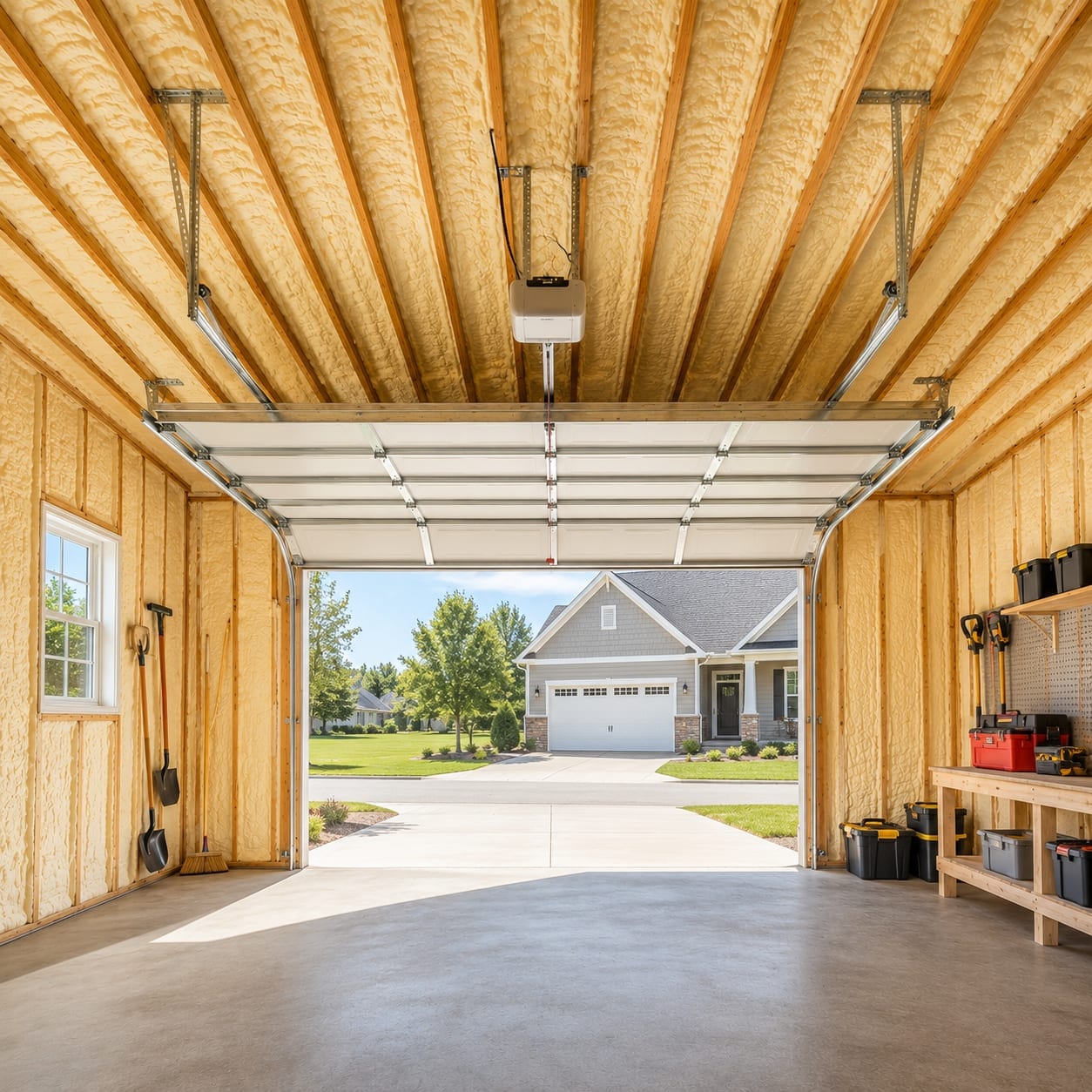
Spray foam is particularly effective for garage insulation because the shared wall and ceiling assemblies typically have the penetrations, irregular cavities, and air leakage pathways that spray foam is designed to solve.
The shared wall between the garage and living space is the highest priority. Open-cell spray foam fills every stud bay completely, seals around electrical boxes, plumbing penetrations, and wiring runs, and creates a continuous air and thermal barrier in a single application. For most Oklahoma garage walls, open-cell foam at 3.5 inches (filling a standard 2x4 cavity) delivers approximately R-13, which meets the Oklahoma 2015 IECC wall insulation requirement while providing the air seal that fiberglass cannot.
The garage ceiling (if a room is above) is equally critical. Open-cell foam between the ceiling joists seals the floor assembly and prevents heat transfer into the room above. This is also where air sealing matters most for indoor air quality, because stack effect naturally draws garage air upward through any gap in the ceiling assembly into the living space above.
Exterior garage walls (the walls facing outside, not shared with the house) are lower priority if you are not conditioning the garage. Insulating them makes sense if you plan to heat or cool the garage as a workshop or living space, but if the garage will remain unconditioned, focus your budget on the shared surfaces first.
The garage door itself is the largest uninsulated opening in the entire garage envelope. Even after insulating all walls and the ceiling, a single-layer steel garage door with no insulation will still allow significant heat gain and loss. Insulated garage doors with R-12 or higher are available and worth considering if you are investing in the rest of the garage envelope. However, the shared wall and ceiling should always come first because they directly affect your living space regardless of garage door quality.
What About Fire Separation Requirements?
Building codes require fire separation between an attached garage and the living space. The IRC requires at minimum 1/2-inch drywall on the garage side of the shared wall and 5/8-inch Type X drywall on the garage ceiling if there is living space above. These requirements exist to slow fire spread from the garage (where cars, fuel, and flammable materials are stored) into the occupied home.
Spray foam does not replace the fire-rated drywall requirement on shared garage surfaces. The drywall serves as both the fire separation and the thermal barrier over the spray foam. In a garage where spray foam is applied to the shared wall and ceiling, the drywall goes over the foam, fulfilling both code requirements simultaneously. This is one of the few applications where drywall is structurally required over the foam regardless of whether it is needed as a thermal barrier.
Signs Your Garage Wall Is Costing You Money
If any of these sound familiar, the shared wall between your garage and living space is likely under-insulated or unsealed:
Rooms next to the garage are always warmer in summer and cooler in winter than the rest of the house, even though the thermostat reads the same.
You can feel a temperature change when you walk from the center of the house toward a room adjacent to the garage.
The room above the garage is the least comfortable room in the house, with cold floors in winter and heat that will not dissipate in summer.
You smell garage odors (exhaust, gasoline, lawn chemicals) inside the house, especially when the garage door has been closed for a while.
Your HVAC system runs longer in the rooms adjacent to or above the garage than elsewhere in the house.
A blower door test confirms whether the garage wall is a significant source of air leakage. Combined with a thermal camera walkthrough, it reveals exactly where heat and air are crossing the boundary between the garage and your living space.
Ready to Fix the Weakest Wall in Your Home?
At Rocking Rad Spray Foam LLC, we insulate garage shared walls and ceilings for homeowners across Oklahoma. We identify the thermal boundary between your garage and living space, seal every penetration, and insulate the assembly so it performs like the exterior wall it should have been from the start. We offer free on-site estimates and 0% financing. Contact us or fill out our online form to schedule yours.
Frequently Asked Questions
Should I insulate all the garage walls or just the shared wall?
If you are not heating or cooling the garage, insulate only the shared wall and the ceiling (if there is living space above). These are the surfaces that directly affect your home's comfort and energy bills. Insulating the exterior garage walls makes sense only if you plan to condition the garage as a workshop, gym, or living space.
Is open-cell or closed-cell foam better for garage insulation?
For most shared garage wall and ceiling applications, open-cell is the more cost-effective choice. It fills the cavity completely, air seals, and provides good thermal resistance. Closed-cell is the better option if the garage has moisture issues (below-grade walls, frequent water intrusion) or if you need maximum R-value in a shallow cavity. In Oklahoma garages, open-cell handles the shared wall and ceiling well in most situations.
Will insulating the garage wall make my garage hotter in summer?
The shared wall insulation is designed to protect your living space, not to condition the garage. Your garage may remain hot in summer if the exterior walls and door are not insulated. But the heat will no longer transfer through the shared wall into your living room or the bedroom above. The rooms inside your home improve immediately even if the garage temperature stays the same.
Does the drywall on the garage side need to be fire-rated?
Yes. Building code requires at minimum 1/2-inch drywall on the garage side of shared walls, and 5/8-inch Type X drywall on the ceiling if there is living space above. This fire separation is required regardless of what insulation is used behind it. Spray foam goes in the cavity first, then the fire-rated drywall covers it.
How much does garage wall and ceiling insulation cost?
Cost depends on the square footage of shared surfaces, foam type, and access conditions. A typical attached garage with one shared wall and a ceiling over a bonus room might run $1,500 to $4,000 for open-cell spray foam on the shared surfaces. A free on-site estimate gives you exact numbers for your specific garage layout.
Are there financial assistance programs for garage insulation in Oklahoma?
There is currently no federal tax credit for residential insulation. However, the Oklahoma Department of Commerce Weatherization Assistance Program provides no-cost energy efficiency improvements to qualifying households at or below 200% of the federal poverty level. Some Oklahoma utilities also offer their own weatherization and rebate programs. Check with your provider for current options.